Loading...
Done
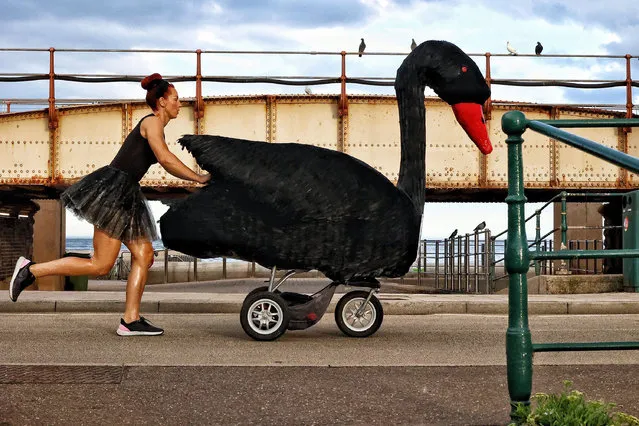
Dawlish Carnival 50th anniversary pram race featuring the famous Dawlish Black Swan in England on August 15, 2023. (Photo by nidpor/StockimoNews/Alamy Live News)

Dawlish Carnival 50th anniversary pram race featuring the famous Dawlish Black Swan in England on August 15, 2023. (Photo by nidpor/StockimoNews/Alamy Live News)
Details
08 Oct 2023 04:09:00
1944: Queen Elizabeth II (as Princess Elizabeth) writing at her desk in Windsor Castle, Berkshire

Queen Elizabeth II (as Princess Elizabeth) writing at her desk in Windsor Castle, Berkshire. (Photo by Lisa Sheridan/Studio Lisa/Getty Images). 30th May 1944
Details
24 Oct 2011 13:52:00
The shadow of a cross is pictured as Catholic faithful arrive to attend a reenactment of the “Via Crucis” (way of the Cross) during Holy Week in Abobote, an area of Abidjan, Ivory Coast, on April 18, 2025. (Photo by Luc Gnago/Reuters)

The shadow of a cross is pictured as Catholic faithful arrive to attend a reenactment of the “Via Crucis” (way of the Cross) during Holy Week in Abobote, an area of Abidjan, Ivory Coast, on April 18, 2025. (Photo by Luc Gnago/Reuters)
Details
07 Nov 2025 02:51:00


“Horst Ludwig Wessel (October 9, 1907 – February 23, 1930) was a German Nazi activist who was made a posthumous hero of the Nazi movement following his violent death in 1930. He was the author of the lyrics to the song “Die Fahne hoch” (“The Flag On High”), usually known as Horst-Wessel-Lied (“The Horst Wessel Song”), which became the Nazi Party anthem and, de facto, Germany's co-national anthem from 1933 to 1945”. – Wikipedia

Photo: German Nazi activist Horst Wessel (left) at the head of a parade of S.A. stormtroopers, or “brownshirts”, in Nuremberg, Germany, 1929. (Photo by Hulton Archive/Getty Images)
Details
08 Jul 2011 09:38:00
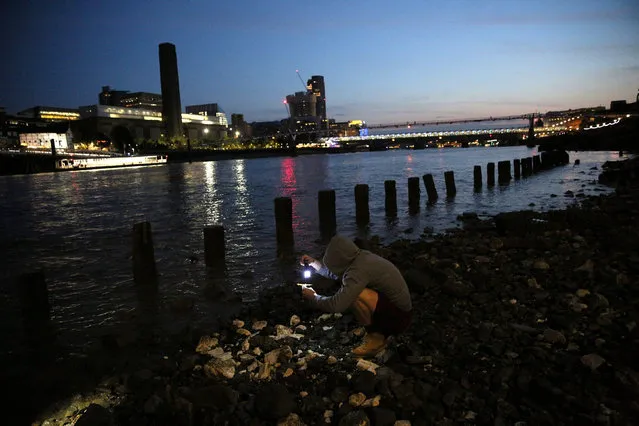
A mudlark uses a torch to look for items on the bank of the River Thames in London, Britain June 06, 2016. Mudlarking is believed to trace its origins to the 18th and 19th century, when scavengers searched the Thames' shores for items to sell. These days, history and archaeology fans are the ones hoping to find old relics such as coins, ceramics, artifacts or everyday items from across centuries. They wait for the low tide and then scour specific areas of exposed shores. "If you're in a field you could be out all day long, with the river you're restricted to about two or three hours," mudlark Nick Stevens said. While many just use the naked eye for their searches, others rely on metal detectors for which a permit from the Port of London Authority is needed. Digging also requires consent. (Photo by Neil Hall/Reuters)

A mudlark uses a torch to look for items on the bank of the River Thames in London, Britain June 06, 2016. Mudlarking is believed to trace its origins to the 18th and 19th century, when scavengers searched the Thames' shores for items to sell. These days, history and archaeology fans are the ones hoping to find old relics such as coins, ceramics, artifacts or everyday items from across centuries. their finds with the Portable Antiquities Scheme. Any item over 300 years old must be recorded. (Photo by Neil Hall/Reuters)
Details
27 Aug 2016 10:43:00
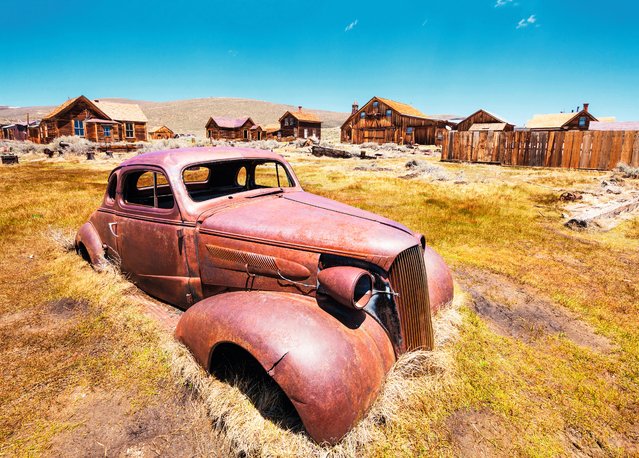
Bodie, Mono County, California. Gold was discovered at Bodie in 1859 (just after the initial California gold rush) and it went from mining camp to boomtown. Its decline began in 1880, when word spread of new boomtowns elsewhere. The Standard Consolidated Mine closed in 1913, and four years later the Bodie Railway was abandoned. By 1940 the population was down to 40. Today, Bodie is maintained in a state of arrested decay as a visitor attraction. (Photo by Alamy Stock Photo)

Kieron Connolly’s new book of photographs of more than 100 once-busy and often elegant buildings gives an idea of how the world might look if humankind disappeared. Here: Bodie, Mono County, California. Gold was discovered at Bodie in 1859 (just after the initial California gold rush) and it went from mining camp to boomtown. Its decline began in 1880, when word spread of new boomtowns elsewhere. The Standard Consolidated Mine closed in 1913, and four years later the Bodie Railway was abandoned. By 1940 the population was down to 40. Today, Bodie is maintained in a state of arrested decay as a visitor attraction. (Photo by Alamy Stock Photo)
Details
07 Sep 2016 09:50:00
A man runs on a small road in the outskirts of Frankfurt, Germany, before sunrise on Tuesday, September 1, 2020. (Photo by Michael Probst/AP Photo)

A man runs on a small road in the outskirts of Frankfurt, Germany, before sunrise on Tuesday, September 1, 2020. (Photo by Michael Probst/AP Photo)
Details
17 Oct 2020 00:03:00
A golden snub-nosed monkeys (Rhinopitheque de Roxelane) looks through its enclosure after quarantine during its presentation at the Beauval Zoopark in Saint-Aignan Central France, on May 7, 2025. ZooParc de Beauval (Loir-et-Cher) welcomed three golden snub-nosed monkeys on April 3, 2025, an endangered species from China, as part of a conservation program, becoming the first zoo outside Asia to house these long-haired, red-furred primates with bluish faces. (Photo by Guillaume Souvant/AFP Photo)

A golden snub-nosed monkeys (Rhinopitheque de Roxelane) looks through its enclosure after quarantine during its presentation at the Beauval Zoopark in Saint-Aignan Central France, on May 7, 2025. ZooParc de Beauval (Loir-et-Cher) welcomed three golden snub-nosed monkeys on April 3, 2025, an endangered species from China, as part of a conservation program, becoming the first zoo outside Asia to house these long-haired, red-furred primates with bluish faces. (Photo by Guillaume Souvant/AFP Photo)
Details
18 May 2025 02:44:00