Loading...
Done


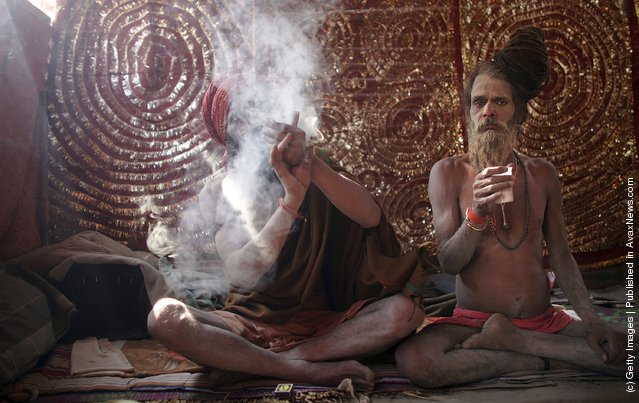
“Kumbh Mela is a mass Hindu pilgrimage in which Hindus gather at the Ganges river. The normal Kumbh Mela is celebrated every 3 years, the Ardh (half) Kumbh Mela is celebrated every six years at Haridwar and Prayag, the Purna (complete) Kumbh takes place every twelve years, at four places (Prayag (Allahabad), Haridwar, Ujjain, and Nashik). The Maha (great) Kumbh Mela which comes after 12 “Purna Kumbh Melas”, or 144 years, is held at Allahabad.

The last Ardh Kumbh Mela was held over a period of 45 days beginning in January 2007, more than 70 million Hindu pilgrims took part in the Ardh Kumbh Mela at Prayag, and on January 15, the most auspicious day of the festival of Makar Sankranti, more than 5 million participated. The previous Maha Kumbh Mela, held in 2001, was attended by around 60 million people, making it at the time the largest gathering anywhere in the world in recorded history”. – Wikipedia

Photo: Sadhus (holy men) smoke at their camp near the ritual site at Sangam, the confluence of the Ganges, Yamuna and mythical Saraswati rivers during the Ardh Kumbh Mela festival (Half Pitcher festival) January 18, 2007 in Allahabad, India. Millions of Hindu pilgrims have flocked to the largest religious gathering in the world which lasts for 45 days in northern India. The festival commemorates the mythical conflict between gods and demons over a pitcher filled with the “nectar of immortality”. Devotees believe that taking a holy dip in the Ganges at this time washes away their sins and paves the path to salvation. (Photo by Mario Tama/Getty Images)
Details
30 Jun 2011 10:27:00
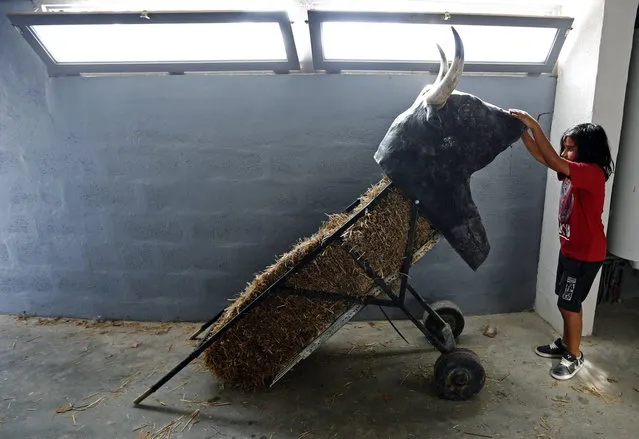
Nino, a ten-year-old toreador apprentice of the French Tauromachy Centre, nicknamed El Nino, touches a practice bull at the bullring of Garons, near Nimes, September 25, 2013. (Photo by Jean-Paul Pelissier/Reuters)

Nino, a ten-year-old toreador apprentice of the French Tauromachy Centre, nicknamed El Nino, touches a practice bull at the bullring of Garons, near Nimes, September 25, 2013. Since 1983, the French Tauromachy Centre in Nimes has trained some 1,000 youths in the art of bullfighting. Twenty of them have gone on to become professional matadors, facing fighting bulls in the arena. Twice a week, students take courses with a matador to learn the movements and gestures of the bullfighter in the ring, but without an animal present. Students train with calves in the surrounding fields during spring, and regularly participate in beginner's bullfights (becerradas) without killing calves. Solal has been taking courses for three years and Nino, for just a year now. Both are normally enrolled in French public schools, but have one thought in mind – bullfighting. They share a passion linked to the city of Nimes, famous for its ferias and bullring. (Photo by Jean-Paul Pelissier/Reuters)
Details
06 Nov 2013 10:12:00
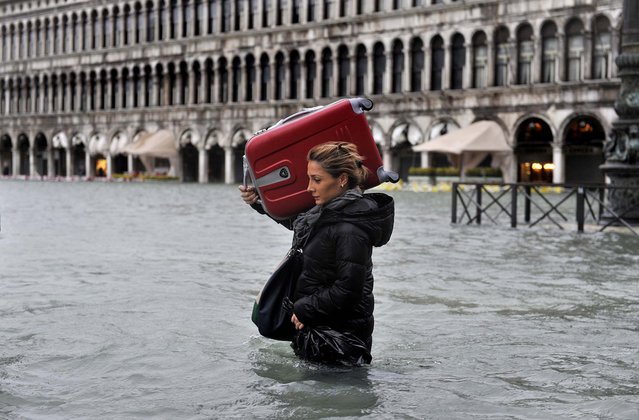
A tourist crosses flooded St. Mark's Square in Venice, Italy on November 11, 2012. Flooding is common this time of year and Sunday's level that reached a peak of 58.66 inches was below the 63 inches recorded four years ago in the worst flooding in decades. (Photo by Luigi Costantini/Associated Press)

A tourist crosses flooded St. Mark's Square in Venice, Italy on November 11, 2012. Flooding is common this time of year and Sunday's level that reached a peak of 58.66 inches was below the 63 inches recorded four years ago in the worst flooding in decades. (Photo by Luigi Costantini/Associated Press)
Details
14 Nov 2012 10:29:00
A submerged statue of the Hindu Lord Shiva stands amid the flooded waters of river Ganges at Rishikesh in the Himalayan state of Uttarakhand June 17, 2013. Early monsoon rains have swollen the Ganges, India's longest river, swept away houses, killed at least 60 people and left tens of thousands stranded, officials said on June 18, 2013. (Photo by Reuters/Stringer)

A submerged statue of the Hindu Lord Shiva stands amid the flooded waters of river Ganges at Rishikesh in the Himalayan state of Uttarakhand June 17, 2013. Early monsoon rains have swollen the Ganges, India's longest river, swept away houses, killed at least 60 people and left tens of thousands stranded, officials said on June 18, 2013. (Photo by Reuters/Stringer)
Details
21 Jun 2013 12:01:00
Russian Olympic Committee's goaltender Mariia Sorokina (foreground L) and teammate Veronika Korzhakova (foreground R) attempt to stop a shot by Switzerland's Phoebe Staenz (R) during the women's preliminary round group A match of the Beijing 2022 Winter Olympic Games ice hockey competition between players of Russia's Olympic Committee and Switzerland, at the National Indoor Stadium in Beijing on February 4, 2022. (Photo by Bruce Bennett/Reuters)

Russian Olympic Committee's goaltender Mariia Sorokina (foreground L) and teammate Veronika Korzhakova (foreground R) attempt to stop a shot by Switzerland's Phoebe Staenz (R) during the women's preliminary round group A match of the Beijing 2022 Winter Olympic Games ice hockey competition between players of Russia's Olympic Committee and Switzerland, at the National Indoor Stadium in Beijing on February 4, 2022. (Photo by Bruce Bennett/Reuters)
Details
07 Feb 2022 07:29:00


“Snowflake (c. 1964 – November 24, 2003) was an albino gorilla. He was the only known albino gorilla so far, and the most popular resident of the Barcelona Zoo in Catalonia, Spain. Originally named Nfumu Ngui in Fang language ("white gorilla") by his captor, he was then nicknamed Floquet de Neu (Catalan for little snowflake) by his keeper Jordi Sabater Pi. On his arrival to Barcelona where he was given an official reception by the then Mayor of Barcelona, Josep Maria de Porcioles, in November 1966, he was called Blancanieves (“Snow White”) in the newspaper Tele/Exprés. But he became famous with the name given to him by Sabater when National Geographic Magazine featured him on the main page in March 1967, with the English name Snowflake. This name spread among the press (Stern, Life, Paris-Match) and was later translated to Spanish as Copito de Nieve. Sabater himself called the gorilla Floquet or Copi, and in the later years Nfumu. The asteroid 95962 Copito, discovered by Catalan astronomer J. Manteca, is named in his honour”.
Details
07 Mar 2011 15:50:00
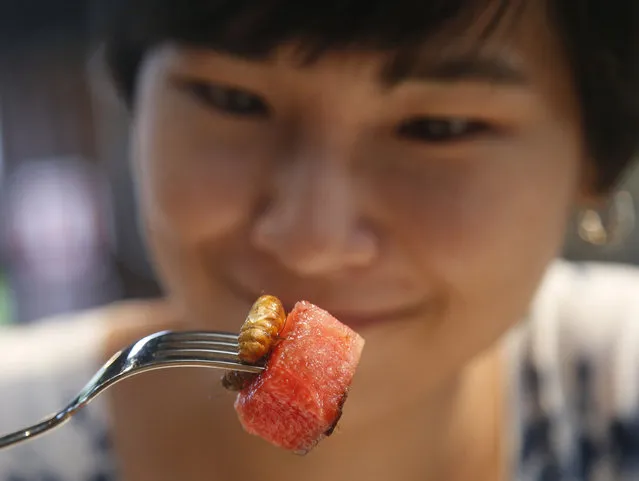
In this Tuesday, September 12, 2017 photo, Amornrat Simapsaisan, a local shop manager, watches before she ate watermelon salad with bamboo worms, at Inspects in the Backyard restaurant, Bangkok, Thailand. Tucking into insects is nothing new in Thailand, where street vendors pushing carts of fried crickets and buttery silkworms have long fed locals and adventurous tourists alike. But bugs are now fine-dining at the Bangkok bistro aiming to revolutionize views of nature’s least-loved creatures and what you can do with them. She tucked in quite happily to her watermelon and cricket salad on a recent evening.  “It’s tasty. It’s munchy”, she said. (Photo by Sakchai Lalit/AP Photo)

In this Tuesday, September 12, 2017 photo, Amornrat Simapsaisan, a local shop manager, watches before she ate watermelon salad with bamboo worms, at Inspects in the Backyard restaurant, Bangkok, Thailand. Tucking into insects is nothing new in Thailand, where street vendors pushing carts of fried crickets and buttery silkworms have long fed locals and adventurous tourists alike. But bugs are now fine-dining at the Bangkok bistro aiming to revolutionize views of nature’s least-loved creatures and what you can do with them. She tucked in quite happily to her watermelon and cricket salad on a recent evening. “It’s tasty. It’s munchy”, she said. (Photo by Sakchai Lalit/AP Photo)
Details
04 Oct 2017 06:54:00
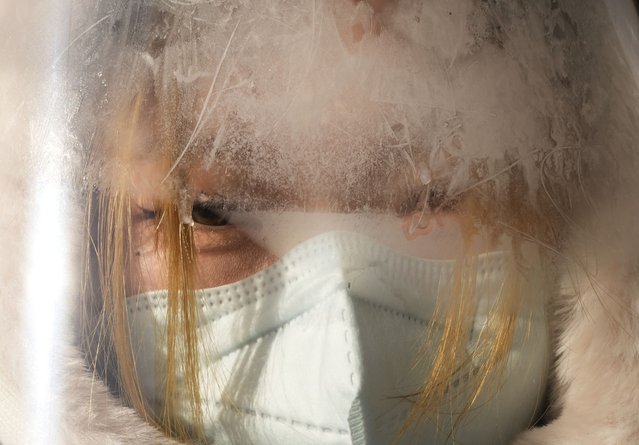
Frost covers a face shield of a volunteer before the start of the women's 7.5km + 7.5km skiathlon cross-country skiing competition at the 2022 Winter Olympics, Saturday, February 5, 2022, in Zhangjiakou, China. (Photo by Alessandra Tarantino/AP Photo)

Frost covers a face shield of a volunteer before the start of the women's 7.5km + 7.5km skiathlon cross-country skiing competition at the 2022 Winter Olympics, Saturday, February 5, 2022, in Zhangjiakou, China. (Photo by Alessandra Tarantino/AP Photo)
Details
08 Feb 2022 05:43:00