Loading...
Done
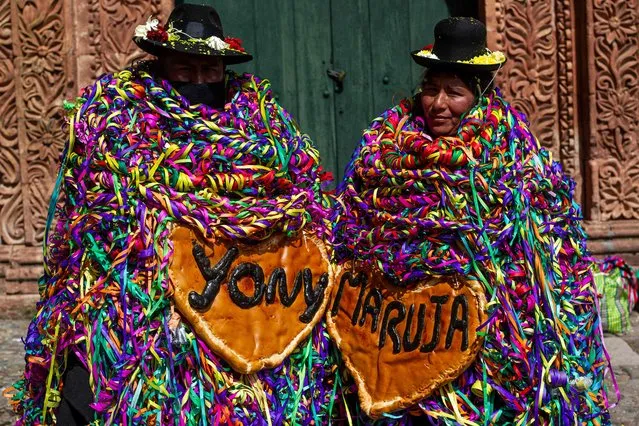
Aymara indigenous people celebrate the “Roscasiri”, the change of command of local authorities, in Pomata District, one of seven districts of the Chucuito Province in the Puno Region, southern Peru, on January 1, 2022. This ancient Aymara event, in which people adorn themselves with breads and fruits that represent abundance for the new year, celebrates the change of command of local authorities. (Photo by Carlos Mamani/AFP Photo)

Aymara indigenous people celebrate the “Roscasiri”, the change of command of local authorities, in Pomata District, one of seven districts of the Chucuito Province in the Puno Region, southern Peru, on January 1, 2022. This ancient Aymara event, in which people adorn themselves with breads and fruits that represent abundance for the new year, celebrates the change of command of local authorities. (Photo by Carlos Mamani/AFP Photo)
Details
03 Jan 2022 08:44:00
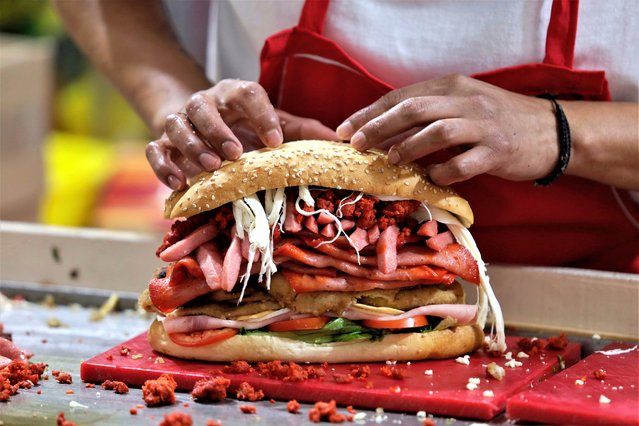
Preparation of a Cuban cake (a Mexican sandwich that is made with bread, generally a telera, bolillo or baguette, which is split in half and filled with different ingredients such as milanesa, sausages, cheese, avocado, onion, tomato, bacon, chili, chorizo, pineapple, among others), during the International Cake Fair on the esplanade of the Venustiano Carranza mayor's office in Mexico City on August 2, 2023. (Photo by Gerardo Vieyra/NurPhoto/Rex Features/Shutterstock)

Preparation of a Cuban cake (a Mexican sandwich that is made with bread, generally a telera, bolillo or baguette, which is split in half and filled with different ingredients such as milanesa, sausages, cheese, avocado, onion, tomato, bacon, chili, chorizo, pineapple, among others), during the International Cake Fair on the esplanade of the Venustiano Carranza mayor's office in Mexico City on August 2, 2023. (Photo by Gerardo Vieyra/NurPhoto/Rex Features/Shutterstock)
Details
15 Nov 2024 03:11:00
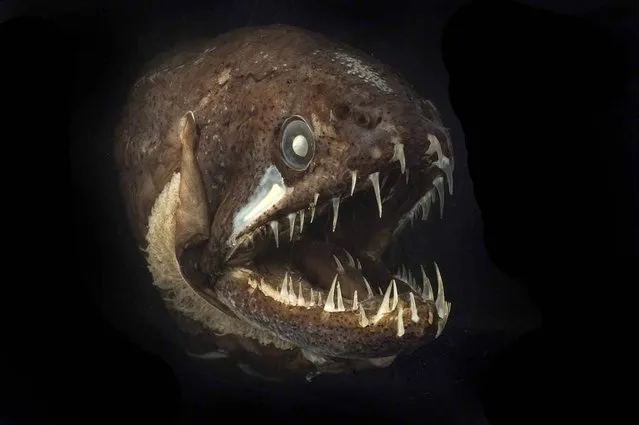
Imagine living in the sea where it is permanently dark, cold, and food is hard to find. For many animals at depth, it may be weeks to months between meals. If you find something to eat, you have to hang on to it

Imagine living in the sea where it is permanently dark, cold, and food is hard to find. For many animals at depth, it may be weeks to months between meals. If you find something to eat, you have to hang on to it. This is why so many deep-sea fishes have lots of big teeth. This dragonfish, spotted off the coast of Australia, even has teeth on its tongue. They would be terrifying animals ... if they weren’t the size of a banana. (Photo by Julian Finn/Museum Victoria)
Details
21 May 2012 12:14:00


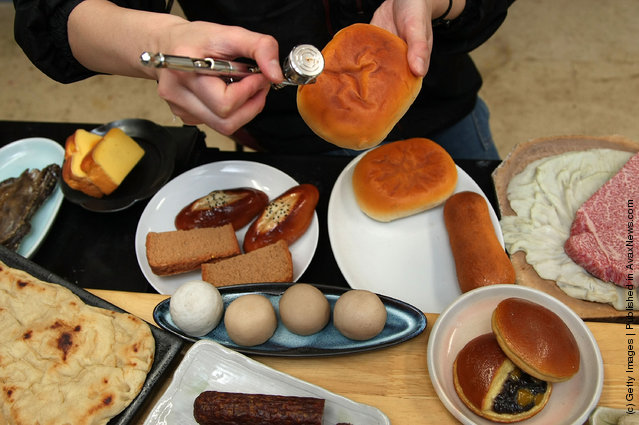
A craftsman makes imitation bread samples at The Sample Factory on February 25, 2008 in Gujo, Gifu, Japan. Gujo City has more than a 50 percent share of the imitation vinyl chloride samples industry. Replica foods are used in most restaurant window displays in Japan, and are popular as souvenirs for tourists. (Photo by Koichi Kamoshida/Getty Images)
Details
08 Apr 2011 09:07:00
Fake Food Hatanaka

Japanese manufacturer Fake Food Hatanaka had the idea to combine the two to create a line of fashion accessories, strange and twisted! From the Fries/Ketchup hairclip to the Pizza bread necklace through the Cheeseburger pendant, the bacon & eggs headbands or even spaghetti bolognaise earrings and necklace sausages, here is some ultra-realistic and WTF Japanese gadgets to turn Fake Food / Fast Food into fashion accessory!
Details
15 Aug 2013 11:01:00
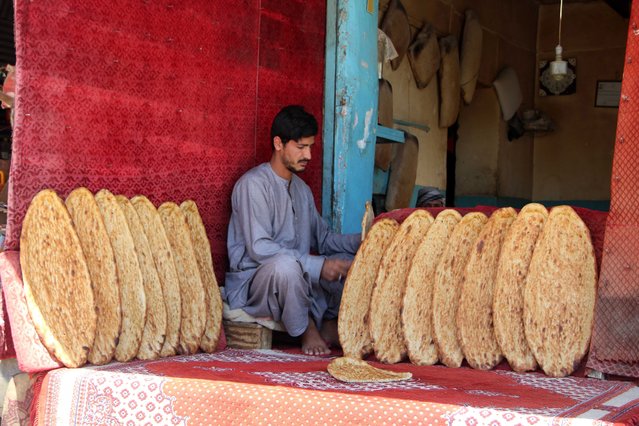
An Afghani man sells bread on a roadside in Kandahar, Afghanistan, 23 April 2024.  A recent World Bank report reveals a 26% decrease in Afghanistan's gross output over the past year, primarily attributed to a 1.3 billion USD income reduction for farmers due to the ban on drug cultivation. Although tax revenue saw a modest increase of 13% in 2023, exports experienced a 15% decline specifically to Pakistan. Afghan officials highlighted efforts to spur domestic production, improve trade, stabilize the national currency, and initiate key economic projects. (Photo by Qudratullah Razwan/EPA/EFE)

An Afghani man sells bread on a roadside in Kandahar, Afghanistan, 23 April 2024. A recent World Bank report reveals a 26% decrease in Afghanistan's gross output over the past year, primarily attributed to a 1.3 billion USD income reduction for farmers due to the ban on drug cultivation. Although tax revenue saw a modest increase of 13% in 2023, exports experienced a 15% decline specifically to Pakistan. Afghan officials highlighted efforts to spur domestic production, improve trade, stabilize the national currency, and initiate key economic projects. (Photo by Qudratullah Razwan/EPA/EFE)
Details
22 May 2024 03:16:00
Rangoli Folk Art From India

Rangoli, also known as kolam or Muggu, is a folk art from India in which patterns are created on the floor in living rooms or courtyards using materials such as colored rice, dry flour, colored sand or flower petals. It is usually made during Diwali, Onam, Pongal and other Indian festivals. They are meant to be sacred welcoming areas for the Hindu deities. The ancient symbols have been passed down through the ages, from each generation to the next, keeping both the art form and the tradition alive. Similar practices are followed in different Indian states: in Tamil Nadu, there is Kolam in Tamil Nadu; Mandana in Rajasthan; Chaookpurna in Chhattisgarh; Alpana in West Bengal; Aripana in Bihar; Chowk pujan in Uttar Pradesh; Muggu in Andhra Pradesh and others.
Details
16 Jun 2014 10:37:00
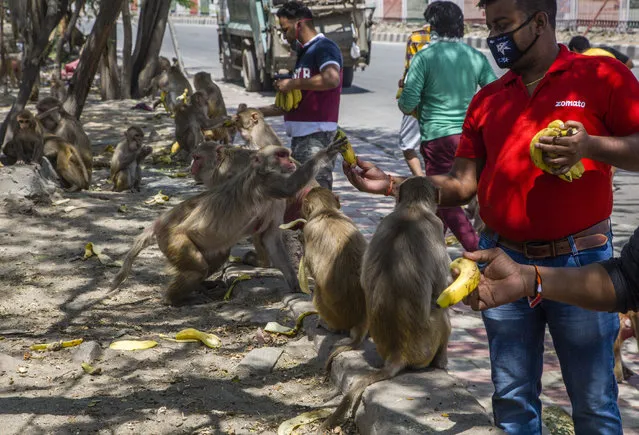
Men give bananas to monkeys gathered on the side of the road as India remains under an unprecedented lockdown over the highly contagious coronavirus (COVID-19) on April 08, 2020 in New Delhi, India. Wild animals, including monkeys, are roaming human settlements in India as people are staying indoors due to the 21-day lockdown. With India's 1.3 billion population and tens of millions of cars off the roads, wildlife is moving towards areas inhabited by humans. Wild animals in many countries have been seen roaming streets. A study says some 60 percent of the new diseases found around the globe every year are zoonotic, meaning they originate in animals and are passed on to humans. COVID-19 is a zoonotic disease that is suspected to have come from the wet markets of Wuhan, China. (Photo by Yawar Nazir/Getty Images)

Men give bananas to monkeys gathered on the side of the road as India remains under an unprecedented lockdown over the highly contagious coronavirus (COVID-19) on April 08, 2020 in New Delhi, India. Wild animals, including monkeys, are roaming human settlements in India as people are staying indoors due to the 21-day lockdown. (Photo by Yawar Nazir/Getty Images)
Details
12 Apr 2020 00:05:00