Loading...
Done
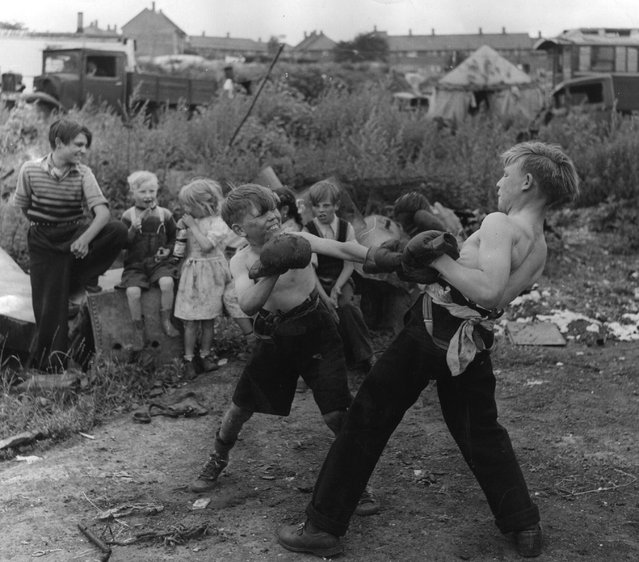
The unromantic gypsies. Children boxing in a gypsy camp in Kent, England on July 1, 1951. Like all boys these gypsy lads like to try their hand at boxing. Encouraged by their friends they fight it out on Corke's Meadow. Few Romanies now live a life of wandering romance. Most are like the three hundred squatters of Corke's Meadow, Kent, which is part of a “gypsy problem” that involves about 100,000 today. Of those about 25,000 can be rightly called gypsies, the rest are Mumpers and Posh-rats and Hobos. Corke's Meadow has both kinds. “Picture Post” cameraman Bert Hardy photographs the Corke's Meadow gypsies in their encampment. (Photo by Hulton-Deutsch Collection/Corbis via Getty Images)

The unromantic gypsies. Children boxing in a gypsy camp in Kent, England on July 1, 1951. Like all boys these gypsy lads like to try their hand at boxing. Encouraged by their friends they fight it out on Corke's Meadow. Few Romanies now live a life of wandering romance. Most are like the three hundred squatters of Corke's Meadow, Kent, which is part of a “gypsy problem” that involves about 100,000 today. Of those about 25,000 can be rightly called gypsies, the rest are Mumpers and Posh-rats and Hobos. Corke's Meadow has both kinds. “Picture Post” cameraman Bert Hardy photographs the Corke's Meadow gypsies in their encampment. (Photo by Hulton-Deutsch Collection/Corbis via Getty Images)
Details
12 Mar 2017 00:01:00
A pitch invader attempts to evade a security official during the 2019 Cricket World Cup group stage match between England and New Zealand at the Riverside Ground, in Chester-le-Street, northeast England, on July 3, 2019. (Photo by Lee Smith/Action Images via Reuters)

A pitch invader attempts to evade a security official during the 2019 Cricket World Cup group stage match between England and New Zealand at the Riverside Ground, in Chester-le-Street, northeast England, on July 3, 2019. (Photo by Lee Smith/Action Images via Reuters)
Details
08 Jul 2019 00:03:00
In this image provided by the Pairi Daiza park, giant panda Hao Hao holds her newborn baby in her mouth at the park in Brugelette, Belgium, on Thursday, June 2, 2016. With the help of the Chinese government Hao Hao and her mate Xing Hui arrived in Belgium two years ago and Pairi Daiza adapted its park to build a bamboo forest for them. (Photo by Benoit Bouchez/Pairi Daiza via AP Photo)

In this image provided by the Pairi Daiza park, giant panda Hao Hao holds her newborn baby in her mouth at the park in Brugelette, Belgium, on Thursday, June 2, 2016. With the help of the Chinese government Hao Hao and her mate Xing Hui arrived in Belgium two years ago and Pairi Daiza adapted its park to build a bamboo forest for them. (Photo by Benoit Bouchez/Pairi Daiza via AP Photo)
Details
03 Jun 2016 12:35:00
Brtukan. “Being a girl of colour in a society where the majority of the people are white, I have had to get used to all the different ways people approach me. From being asked what kind of rap music you listen to and how you wash your hair, to getting told, “you don’t sound black”, “you’re pretty for a black girl” or “you’re not that black so it’s OK”, as if being black is such a bad thing”. (Photo by Lisa Minogue/The Guardian)

As part of FLAIR Melbourne – a Flinders Lane art festival – Melbourne’s Lisa Minogue presents stylised photographic portraits of Australian women of colour, their faces painted vibrantly to accentuate their individuality and encourage the viewer to study each face more closely. Minogue asked each woman the same question: “What do the words “coloured girl” mean to you?”. (Photo by Lisa Minogue/The Guardian)
Details
17 Aug 2016 11:16:00
A woman walks past graffiti on a wall in the Williamsburg neighborhood of the borough of Brooklyn, in New York, September 16, 2014. The picture was taken through car window with raindrops. (Photo by Shannon Stapleton/Reuters)

A woman walks past graffiti on a wall in the Williamsburg neighborhood of the borough of Brooklyn, in New York, September 16, 2014. The picture was taken through car window with raindrops. (Photo by Shannon Stapleton/Reuters)
Details
20 Oct 2014 09:04:00
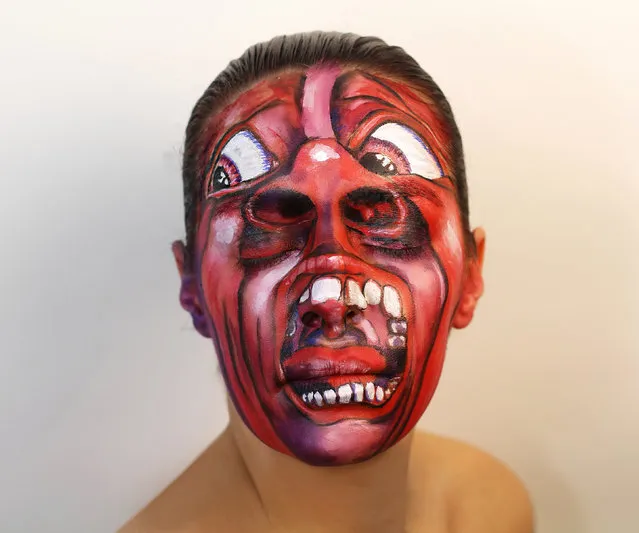
An artist has gone to incredible lengths to paint several iconic album covers on her own face. London-based artist Natalie Sharp wanted to celebrate Record Store Day in a unique way, and asked her Facebook friends for suggestions about which album covers to paint. She was overwhelmed with responses, and as a result painted 40 different album covers on her face, including Nirvana's “Nevermind”, King Crimson's “The Court of the Crimson King”, and “Melt” by Peter Gabriel. (Photo by Natalie Sharp/Caters News)

An artist has gone to incredible lengths to paint several iconic album covers on her own face. London-based artist Natalie Sharp wanted to celebrate Record Store Day in a unique way, and asked her Facebook friends for suggestions about which album covers to paint. She was overwhelmed with responses, and as a result painted 40 different album covers on her face, including Nirvana's “Nevermind”, King Crimson's “The Court of the Crimson King”, and “Melt” by Peter Gabriel. Here: King Crimson album. “In fact, I barely used by brushes for King Crimson; I would just keep smudging it with my fingers”. (Photo by Natalie Sharp/Caters News)
Details
29 Apr 2015 06:11:00
A man wearing an illuminated atmospheric diving suit as part of an installation titled “What Lies Beneath” looks at members of the public during the Vivid Sydney festival of light and sound in Sydney, Australia, May 26, 2017. (Photo by Steven Saphore/Reuters)

A man wearing an illuminated atmospheric diving suit as part of an installation titled “What Lies Beneath” looks at members of the public during the Vivid Sydney festival of light and sound in Sydney, Australia, May 26, 2017. (Photo by Steven Saphore/Reuters)
Details
28 May 2017 07:51:00


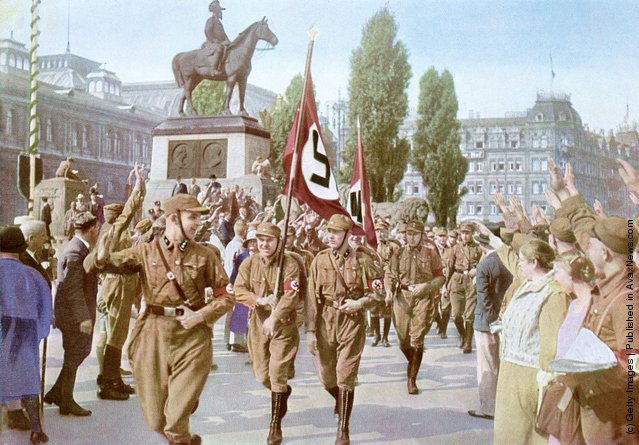
“Horst Ludwig Wessel (October 9, 1907 – February 23, 1930) was a German Nazi activist who was made a posthumous hero of the Nazi movement following his violent death in 1930. He was the author of the lyrics to the song “Die Fahne hoch” (“The Flag On High”), usually known as Horst-Wessel-Lied (“The Horst Wessel Song”), which became the Nazi Party anthem and, de facto, Germany's co-national anthem from 1933 to 1945”. – Wikipedia

Photo: German Nazi activist Horst Wessel (left) at the head of a parade of S.A. stormtroopers, or “brownshirts”, in Nuremberg, Germany, 1929. (Photo by Hulton Archive/Getty Images)
Details
08 Jul 2011 09:38:00