Loading...
Done
A mudlark uses a torch to look for items on the bank of the River Thames in London, Britain June 06, 2016. Mudlarking is believed to trace its origins to the 18th and 19th century, when scavengers searched the Thames' shores for items to sell. These days, history and archaeology fans are the ones hoping to find old relics such as coins, ceramics, artifacts or everyday items from across centuries. They wait for the low tide and then scour specific areas of exposed shores. "If you're in a field you could be out all day long, with the river you're restricted to about two or three hours," mudlark Nick Stevens said. While many just use the naked eye for their searches, others rely on metal detectors for which a permit from the Port of London Authority is needed. Digging also requires consent. (Photo by Neil Hall/Reuters)

A mudlark uses a torch to look for items on the bank of the River Thames in London, Britain June 06, 2016. Mudlarking is believed to trace its origins to the 18th and 19th century, when scavengers searched the Thames' shores for items to sell. These days, history and archaeology fans are the ones hoping to find old relics such as coins, ceramics, artifacts or everyday items from across centuries. their finds with the Portable Antiquities Scheme. Any item over 300 years old must be recorded. (Photo by Neil Hall/Reuters)
Details
27 Aug 2016 10:43:00
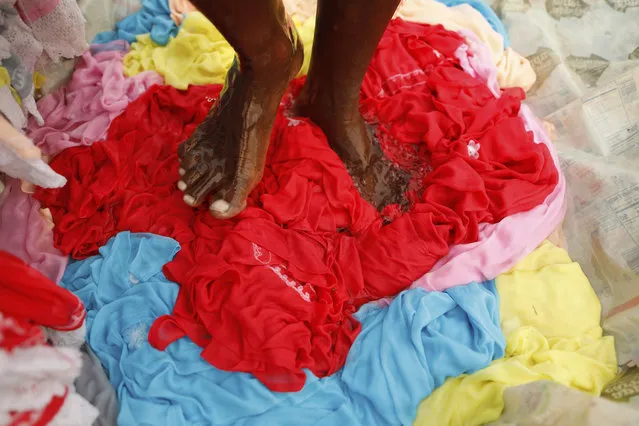
A dhobi, or a washerman washes cloths on the banks of the River Gomti in Lucknow, India, Saturday, September 12, 2020. Dhobis are traditional laundry workers who wash clothes by hand and dry them in the sun, an occupation which has been in existence for generations. Most cities in India have a Dhobi Ghat, or washermen's area, where the city's pile of clothes is laundered. This practice is still popular in India, despite of modern technology. Around 1,000 families work in Lucknow's Dhobi Ghat. However, in light of the novel coronavirus, their wages have decreased drastically. With each family earning around US$100-200 per month. (Photo by Rajesh Kumar Singh/AP Photo)

A dhobi, or a washerman washes cloths on the banks of the River Gomti in Lucknow, India, Saturday, September 12, 2020. Dhobis are traditional laundry workers who wash clothes by hand and dry them in the sun, an occupation which has been in existence for generations. Most cities in India have a Dhobi Ghat, or washermen's area, where the city's pile of clothes is laundered. This practice is still popular in India, despite of modern technology. Around 1,000 families work in Lucknow's Dhobi Ghat. However, in light of the novel coronavirus, their wages have decreased drastically. With each family earning around US$100-200 per month. (Photo by Rajesh Kumar Singh/AP Photo)
Details
25 Sep 2020 00:03:00
The expertly colourised shots were brought to life by French bank technician, Frédéric Duriez (51). The images were provided by the Valois collection which belongs to the BDIC. “By colourising these photos, I reduce the time that separates us today from this conflict”, said Frédéric. “A black and white photo does not attract the attention of young people, if you colour it, then people will look at it with curiosity. After this, we see the greater the misery and distress of these French fighters”. The total number of casualties in WW1 was more that 38 million. By the end of the war, over eight-million men had been called up to fight in the French army. France suffered 4.2 million casualties during the war with 1.3 million people dead. Here: Car cannon sections in firing position, Auxi-le-Château. (Photo by Frédéric Duriez/BDIC/Mediadrumworld.com)

The expertly colourised shots were brought to life by French bank technician, Frédéric Duriez (51). The images were provided by the Valois collection which belongs to the BDIC. “By colourising these photos, I reduce the time that separates us today from this conflict”, said Frédéric. Here: Car cannon sections in firing position, Auxi-le-Château. (Photo by Frédéric Duriez/BDIC/Mediadrumworld.com)
Details
03 May 2017 08:41:00
An Orchid Mantis (Hymenopus coronatus) is perched on the head of a frog hanging from a tree branch on March 15, 2017 in Padang, Indonesia. (Photo by Riau Images/Barcroft Images)

An Orchid Mantis (Hymenopus coronatus) is perched on the head of a frog hanging from a tree branch on March 15, 2017 in Padang, Indonesia. (Photo by Riau Images/Barcroft Images)
Details
19 Mar 2017 08:02:00
A bank employee exits the bank through a window broken by attackers, in Beirut, Lebanon, Wednesday, September 14, 2022. (Photo by Hussein Malla/AP Photo)

A bank employee exits the bank through a window broken by attackers, in Beirut, Lebanon, Wednesday, September 14, 2022. (Photo by Hussein Malla/AP Photo)
Details
27 Sep 2022 04:44:00
A Free Syrian Army fighter walks past a flag of al-Furqan brigade as a rifle hangs from a branch in the orchards of Kafar Zita in Hama countryside January 22, 2015. (Photo by Mohamad Bayoush/Reuters)

A Free Syrian Army fighter walks past a flag of al-Furqan brigade as a rifle hangs from a branch in the orchards of Kafar Zita in Hama countryside January 22, 2015. (Photo by Mohamad Bayoush/Reuters)
Details
07 Feb 2016 06:43:00
Belarusian ornithologist Vladimir Ivanovski, 72, stands on a tree as he builds an artificial nest for birds of prey from tree branches, in a marsh near the village of Kazyany, Belarus on October 20, 2019. (Photo by Vasily Fedosenko/Reuters)

Belarusian ornithologist Vladimir Ivanovski, 72, stands on a tree as he builds an artificial nest for birds of prey from tree branches, in a marsh near the village of Kazyany, Belarus on October 20, 2019. (Photo by Vasily Fedosenko/Reuters)
Details
10 Dec 2019 00:03:00
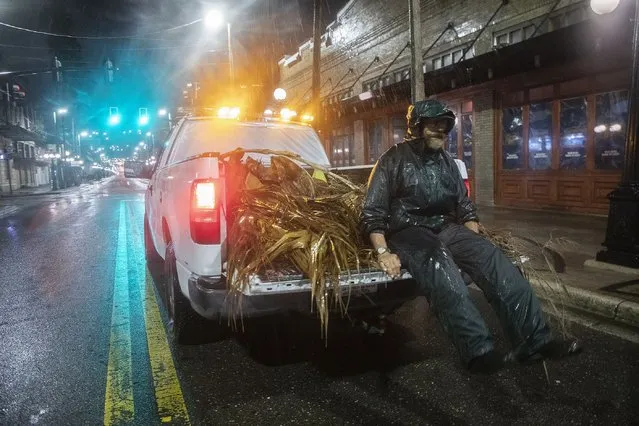
Lew Hendrix collects palm branches blown down by the outer bands of Hurricane Ian  in the Ybor City neighborhood of Tampa, FL, early Wednesday morning, September 28, 2022.  (Photo by Ted Richardson/The Washington Post)

Lew Hendrix collects palm branches blown down by the outer bands of Hurricane Ian in the Ybor City neighborhood of Tampa, FL, early Wednesday morning, September 28, 2022. (Photo by Ted Richardson/The Washington Post)
Details
04 Oct 2022 03:28:00