Loading...
Done
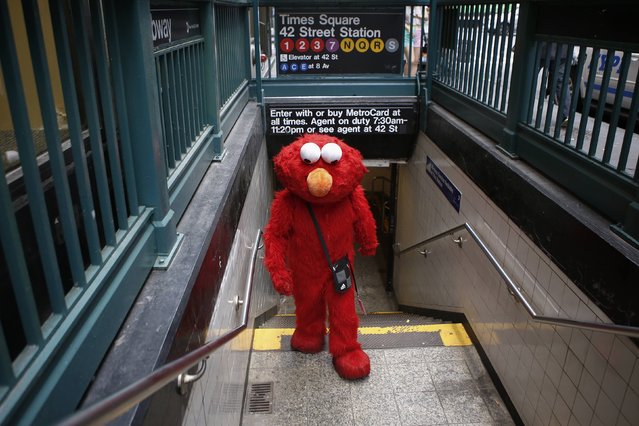
Jorge, an immigrant from Mexico, exits a subway station dressed as the Sesame Street character Elmo in Times Square, New York July 30, 2014. (Photo by Eduardo Munoz/Reuters)

Jorge, an immigrant from Mexico, exits a subway station dressed as the Sesame Street character Elmo in Times Square, New York July 30, 2014. Elmo and Cookie Monster have long delighted young viewers on TV's “Sesame Street”, but the recent antics of New York street performers dressed as the beloved characters have drawn the ire of city officials and now the show's producers. Sesame Workshop, which owns the rights to Big Bird, Ernie and the assorted puppet monsters on the 45-year-old program, said on July 29, 2014 it was drafting plans to stop performers who dress up as the characters from appearing in Times Square, where they pose for photos with tourists and then demand tips. (Photo by Eduardo Munoz/Reuters)
Details
05 Aug 2014 11:50:00


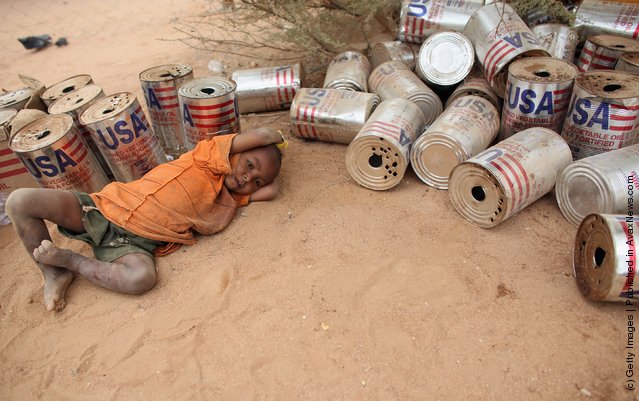
A young boy rests by empty USAID vegetable oil tins in the Dagahaley refugee camp which makes up part of the giant Dadaab refugee settlement on July 19, 2011 in Dadaab, Kenya. The refugee camp at Dadaab, located close to the Kenyan border with Somalia, was originally designed in the early 1990s to accommodate 90,000 people but the UN estimates over 4 times as many reside there. The ongoing civil war in Somalia and the worst drought to affect the Horn of Africa in six decades has resulted in an estimated 12 million people whose lives are threatened. (Photo by Oli Scarff/Getty Images)
Details
20 Jul 2011 12:08:00
Art by Christian Faur

Christian Faur is an artist based in Granville, Ohio. Looking for a new technique, he experimented with painting with wax, but he didn’t feel the results were satisfactory.Then, at Christmas in 2005, his young daughter opened a box of 120 Crayola crayons he’d bought her, and everything clicked into place. Faur decided he would create pictures out of the crayons themselves, packing thousands of them together so they become like the colored pixels on a TV screen. He starts each work by scanning a photo into a computer and breaking the image down into colored blocks He then draws a grid that shows him exactly where to place each crayon The finished artworks are packed tightly into wooden frames. He actually makes the crayons himself, hand-casting each one in a mould.
Details
28 Jul 2012 10:03:00
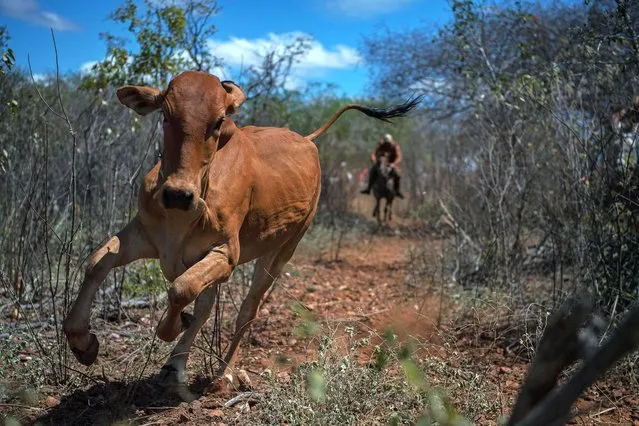
A young bull flees from a Brazilian vaqueiro, or cowboy, competing in the “Pega de Boi” (Ox Catch) tournament in Cabrobo, Pernambuco State, Brazil, on September 4, 2022. The riders compete in pairs to retrieve a cord from a bull which has been released and runs away from them and they are timed on how quickly they can return with the cord. The leather clothing provides them with protection from the dense savannah vegetation which contains a lot of large thorns. Riders have been known to die competing in the tournament (Photo by Carl de Souza/AFP Photo)

A young bull flees from a Brazilian vaqueiro, or cowboy, competing in the “Pega de Boi” (Ox Catch) tournament in Cabrobo, Pernambuco State, Brazil, on September 4, 2022. The riders compete in pairs to retrieve a cord from a bull which has been released and runs away from them and they are timed on how quickly they can return with the cord. The leather clothing provides them with protection from the dense savannah vegetation which contains a lot of large thorns. Riders have been known to die competing in the tournament (Photo by Carl de Souza/AFP Photo)
Details
25 Sep 2022 04:38:00
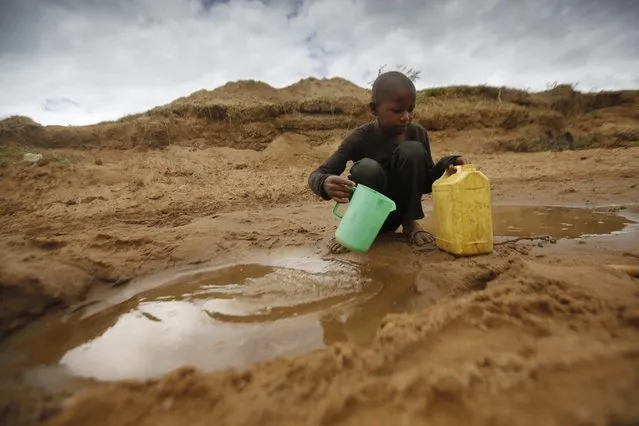
A young boy scoops water from a hand-dug well in the dry riverbed near Matinyani, in the semi-arid Kitui County in southeastern Kenya, 22 March 2015, the World Water Day. Residents of Kitui County and other arid and semi-arid areas of the country have been hard-hit by extremely poor rainfall this year while the government said in previous month that some 1.6 million people countrywide are facing acute starvation due to the drought and will need relief food over the next six months. (Photo by Dai Kurokawa/EPA)

A young boy scoops water from a hand-dug well in the dry riverbed near Matinyani, in the semi-arid Kitui County in southeastern Kenya, 22 March 2015, the World Water Day. Residents of Kitui County and other arid and semi-arid areas of the country have been hard-hit by extremely poor rainfall this year while the government said in previous month that some 1.6 million people countrywide are facing acute starvation due to the drought and will need relief food over the next six months. Residents of Matinyani say they haven't seen a drop of rain in nearly four months. Thousands of Kenyans in rural areas walk tens of kilometers just to fetch water to drink and to be used in their homes. According to an estimate by UNESCO (United Nations Educational, Scientific and Cultural Organization), 17 million people lack access to safe water in Kenya, where the drought is a perennial problem. (Photo by Dai Kurokawa/EPA)
Details
23 Mar 2015 11:01:00
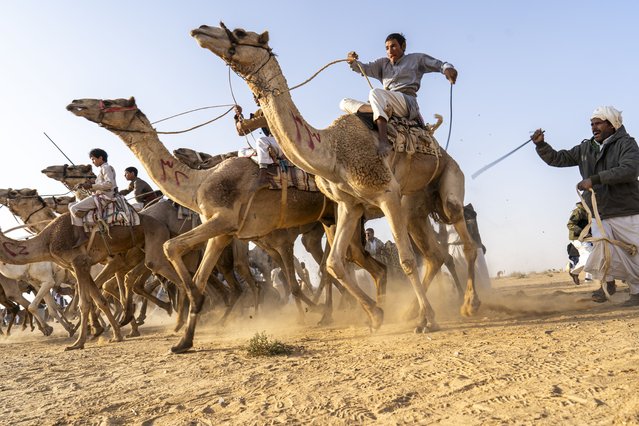
The start of the Al-Sirr camel race on November 19, 2025 in El Hassana, Egypt. The Al-Sirr camel race is one of the most culturally significant and widely celebrated sporting events among the Bedouin communities of Sinai. Every year, Bedouin tribes gather here to hold this traditional race, an event that preserves its authentic heritage. Unlike modern camel races elsewhere, the Bedouin here do not use robotic jockeys or advanced racing technologies. Instead, the camels are ridden by young boys aged approximately 5 to 16, maintaining a long-standing cultural practice. (Photo by Ali Moustafa/Getty Images)

The start of the Al-Sirr camel race on November 19, 2025 in El Hassana, Egypt. The Al-Sirr camel race is one of the most culturally significant and widely celebrated sporting events among the Bedouin communities of Sinai. Every year, Bedouin tribes gather here to hold this traditional race, an event that preserves its authentic heritage. Unlike modern camel races elsewhere, the Bedouin here do not use robotic jockeys or advanced racing technologies. Instead, the camels are ridden by young boys aged approximately 5 to 16, maintaining a long-standing cultural practice. (Photo by Ali Moustafa/Getty Images)
Details
03 Jan 2026 12:49:00
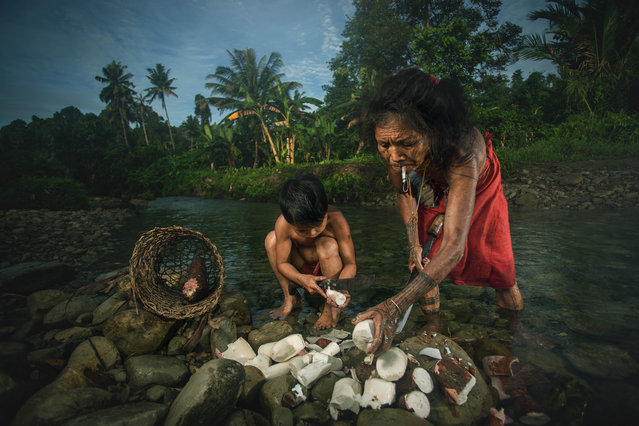
These stunning images document the everyday lives of the men, women and children of the Mentawai tribe. The Mentawai people, a native population in Indonesia, are famous for their decorative tattoos and for living a semi-nomadic life on the Mentawai Islands in West Sumatra. Shot by professional photographer Mohammed Saleh Bin Dollah, the series captures a glimpse of life on the island as the Mentawai men smoke and hunt for food and the children play in the river. (Photo by Muhamad Saleh Dollah/Barcroft Media)

These stunning images document the everyday lives of the men, women and children of the Mentawai tribe. The Mentawai people, a native population in Indonesia, are famous for their decorative tattoos and for living a semi-nomadic life on the Mentawai Islands in West Sumatra. Shot by professional photographer Mohammed Saleh Bin Dollah, the series captures a glimpse of life on the island as the Mentawai men smoke and hunt for food and the children play in the river. Here: A young boy helps a woman to prepare food taken on July 19, 2014 on the Mentawai Islands, Indonesia. (Photo by Muhamad Saleh Dollah/Barcroft Media)
Details
06 Feb 2016 13:09:00
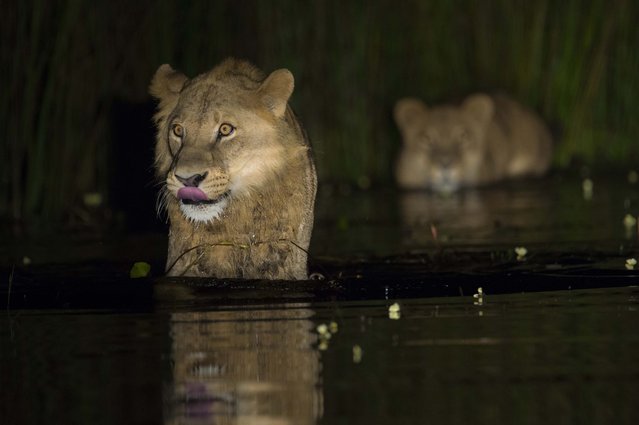
Lions submerged in water. (Photo by Wim van den Heever/Caters News)

These breath-taking photographs reveal the everyday lives of animals living in the wild. The incredible images were taken by wildlife photographer Wim van dan Heever, from Pretoria, South Africa, during trips to locations including Japan, Botswana and Svalbard. The 43-year-old has been photographing wildlife since he was a young boy and turned his passion for animals into a career and set up ODP Safaris. He has travelled across the globe to photograph wild animals – from lions and tigers, to elephants, dolphins and eagles – as they hunt, give birth and graze in their natural habitats. Here: Lions submerged in water. (Photo by Wim van den Heever/Caters News)
Details
07 Aug 2015 11:43:00