Loading...
Done
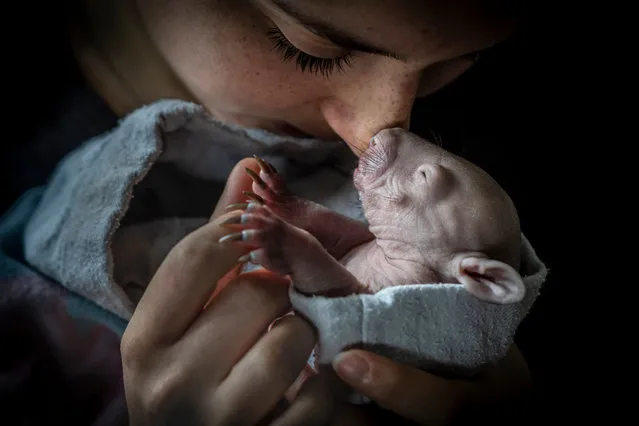
Nose to Nose; Human/Nature winner. “Doug Gimesy was documenting work at the Joey and Bat Sanctuary near Melbourne when he met a wombat (Vombatus ursinus) whose mother had been killed by a car. Gimesy watched as a young veterinary student bottle-fed the orphaned joey, then touched her nose to the joey’s in a tender moment of interspecies bonding”. (Photo by Doug Gimesy/BigPicture)

Nose to Nose; Human/Nature winner. “Doug Gimesy was documenting work at the Joey and Bat Sanctuary near Melbourne when he met a wombat (Vombatus ursinus) whose mother had been killed by a car. Gimesy watched as a young veterinary student bottle-fed the orphaned joey, then touched her nose to the joey’s in a tender moment of interspecies bonding”. (Photo by Doug Gimesy/BigPicture)
Details
25 Jun 2023 05:33:00
Protestors Stacie Ellen Murphy, Alanna Cassidy and Lena Seale walk in their Underwear on Grafton Street in Dublin, support of victims of sexual violence in Irerland. On Wednesday, November 16, 2018, in Dublin, Ireland. (Photo by PA Wire)

Protestors Stacie Ellen Murphy, Alanna Cassidy and Lena Seale walk in their Underwear on Grafton Street in Dublin, support of victims of sexual violence in Irerland on Wednesday, November 16, 2018. (Photo by PA Wire)
Details
25 Nov 2018 00:07:00
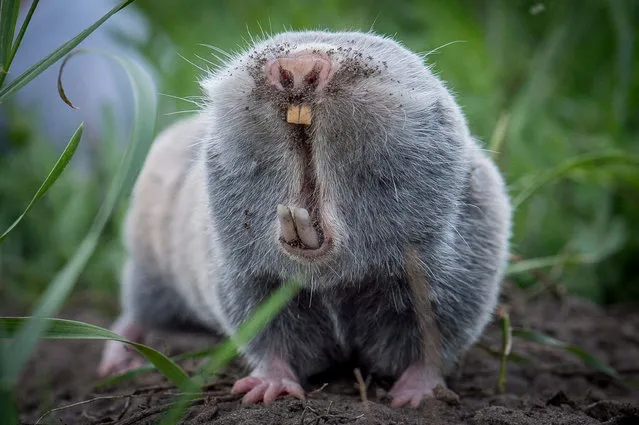
An adult specimen of Nannospalax (leucodon) montanosyrmiensis, a variant of the lesser mole-rat (Spalax leucodon) is pictured near Albertirsa, some 60 kilometers southeast of Budapest, Hungary, 12 May 2018. The critically endangered rodent lives in several isolated populations in the Carpathian Basin. (Photo by Sandor Ujvari/EPA/EFE)

An adult specimen of Nannospalax (leucodon) montanosyrmiensis, a variant of the lesser mole-rat (Spalax leucodon) is pictured near Albertirsa, some 60 kilometers southeast of Budapest, Hungary, 12 May 2018. The critically endangered rodent lives in several isolated populations in the Carpathian Basin. (Photo by Sandor Ujvari/EPA/EFE)
Details
20 May 2018 00:03:00
Centre of the Heart Nebula by Ivan Eder (Hungary). Situated 7500 light years away in the ‘W’-shaped constellation of Cassiopeia, the Heart Nebula is a vast region of glowing gas, energized by a cluster of young stars at its centre. The image depicts the central region, where dust clouds are being eroded and moulded into rugged shapes by the searing cosmic radiation. (Photo by Ivan Eder)

The competition, which is run by the Royal Observatory Greenwich in association with BBC Sky at Night Magazine, is now in its sixth year and has received over 2,500 entries. Photo: Centre of the Heart Nebula by Ivan Eder (Hungary). Situated 7500 light years away in the “W”-shaped constellation of Cassiopeia, the Heart Nebula is a vast region of glowing gas, energized by a cluster of young stars at its centre. The image depicts the central region, where dust clouds are being eroded and moulded into rugged shapes by the searing cosmic radiation. (Photo by Ivan Eder)
Details
03 Jul 2014 11:59:00
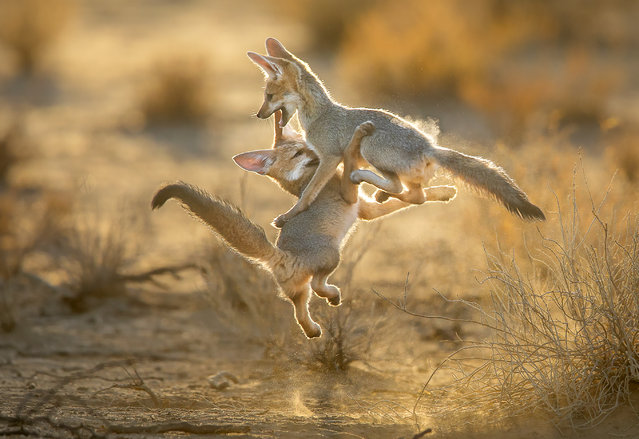
Cape fox cubs play fight in the last decade of May 2025 in the Kalahari Desert, South Africa, their silver and yellow fur camouflaging them in the desert. (Photo by John Mullineux/Solent News & Photo Agency)

Cape fox cubs play fight in the last decade of May 2025 in the Kalahari Desert, South Africa, their silver and yellow fur camouflaging them in the desert. (Photo by John Mullineux/Solent News & Photo Agency)
Details
08 Jun 2025 03:30:00
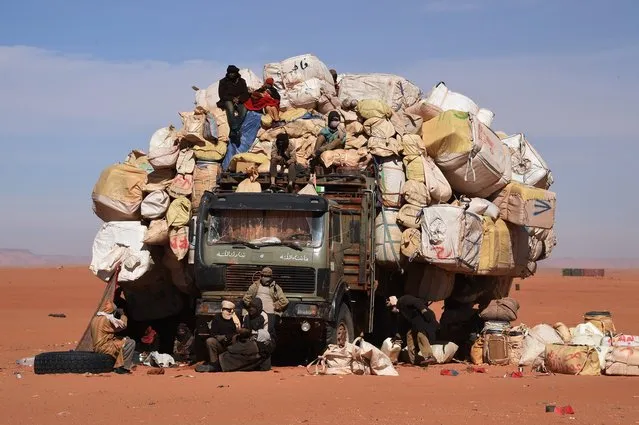
People sit near a fully loaded in Madama near the border with Lybia on January 1, 2015. French Defence Minister Jean-Yves Le Drian paid a surprise visit to northern Niger on January 1, to visit a base being built to combat the growing flow of weapons and jihadists from neighbouring Libya. Le Drian travelled from Chad to Madama, a desert outpost about 100 kilometres from Libya, where he saw in the New Year with troops at a French base. (Photo by Dominique Faget/AFP Photo)

People sit near a fully loaded in Madama near the border with Lybia on January 1, 2015. French Defence Minister Jean-Yves Le Drian paid a surprise visit to northern Niger on January 1, to visit a base being built to combat the growing flow of weapons and jihadists from neighbouring Libya. Le Drian travelled from Chad to Madama, a desert outpost about 100 kilometres from Libya, where he saw in the New Year with troops at a French base. Madama is situated on the route used by jihadists and arms smugglers in southern Libya to reach northern Mali and Niger. (Photo by Dominique Faget/AFP Photo)
Details
03 Jan 2015 13:27:00
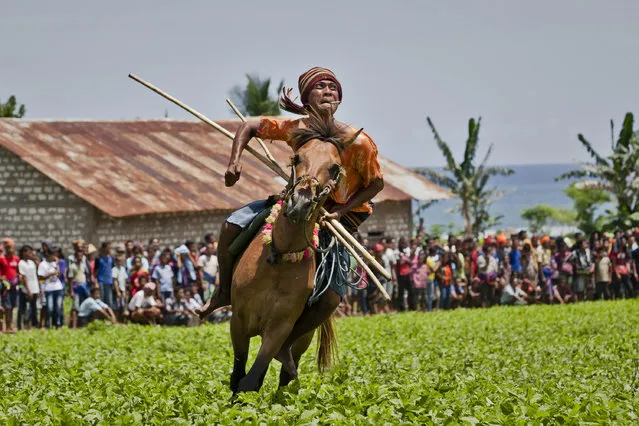
A Pasola rider reacts after throwing his spear during the Pasola war festival at Ratenggaro village on March 22, 2014 in Sumba Island, Indonesia. The Pasola Festival is an important annual event to welcome the new harvest season, which coincides with the arrival of  “Nyale” sea worms during February or March each year. Pasola, an ancient ritual fighting game, involves two teams of men on horseback charging towards each other while trying to hit their rivals with “pasol” javelins and avoid being hit themselves. (Photo by Ulet Ifansasti/Getty Images)

A Pasola rider reacts after throwing his spear during the Pasola war festival at Ratenggaro village on March 22, 2014 in Sumba Island, Indonesia. The Pasola Festival is an important annual event to welcome the new harvest season, which coincides with the arrival of “Nyale” sea worms during February or March each year. Pasola, an ancient ritual fighting game, involves two teams of men on horseback charging towards each other while trying to hit their rivals with “pasol” javelins and avoid being hit themselves. (Photo by Ulet Ifansasti/Getty Images)
Details
25 Mar 2014 07:54:00
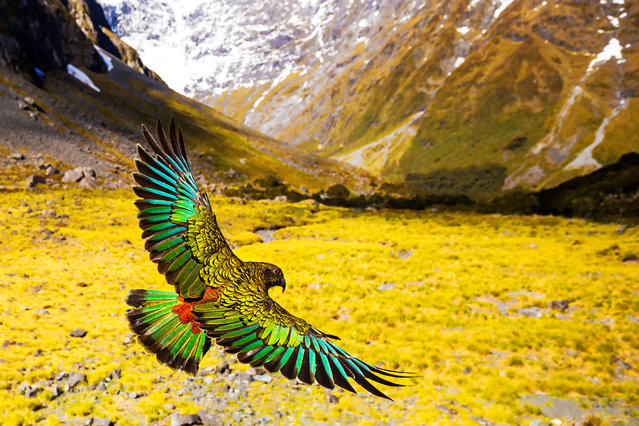
Kea are the only true alpine parrots in the world and thrive as cunning opportunists in the freezing conditions of the Southern Alps. Kea are thought to have developed their wide array of food-finding strategies during the last great ice age, where they learned to adapt using their unusual powers of curiosity. (Photo by Tom Walker/BBC Pictures/The Guardian)

Kea are the only true alpine parrots in the world and thrive as cunning opportunists in the freezing conditions of the Southern Alps. Kea are thought to have developed their wide array of food-finding strategies during the last great ice age, where they learned to adapt using their unusual powers of curiosity. (Photo by Tom Walker/BBC Pictures/The Guardian)
Details
19 Jul 2016 13:03:00