Loading...
Done
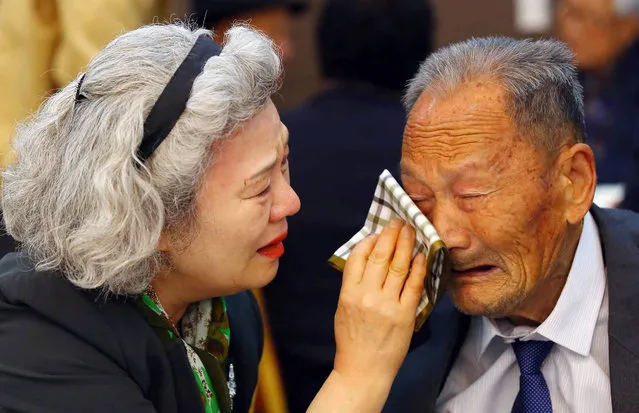
South Korean Lee Jung-sook (L), 68, wipes the tears from her North Korean father Lee Heung-jong, 88, as they bid each other a sad farewell at a resort on Mount Kumgang, North Korea, 22 October 2015. About 390 South Koreans arrived at the resort two days ago for the first face-to-face reunion of families separated by the 1950-53 Korean War in nearly 20 months. A second group of some 260 South Koreans will do the same for three days starting on 24 October. (Photo by Yonhap/EPA)

South Korean Lee Jung-sook (L), 68, wipes the tears from her North Korean father Lee Heung-jong, 88, as they bid each other a sad farewell at a resort on Mount Kumgang, North Korea, 22 October 2015. About 390 South Koreans arrived at the resort two days ago for the first face-to-face reunion of families separated by the 1950-53 Korean War in nearly 20 months. A second group of some 260 South Koreans will do the same for three days starting on 24 October. (Photo by Yonhap/EPA)
Details
24 Oct 2015 08:06:00
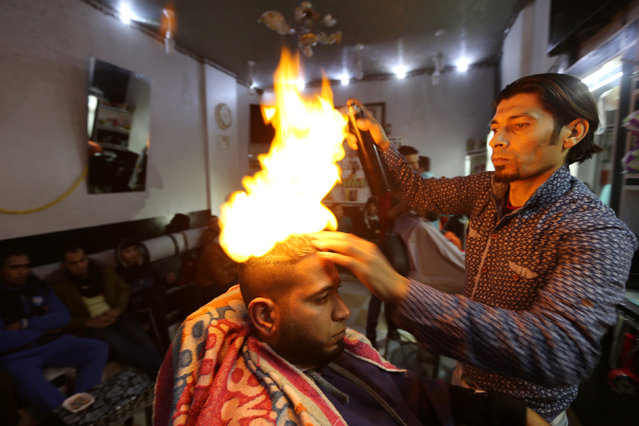
Palestinian barber Ramadan Odwan styles and straightens the hair of a customer with fire at his salon in Rafah, in the southern Gaza Strip February 2, 2017. In Ramadan Odwan's barbershop in Gaza, hair isn't just blow-dried, it's blowtorch-dried. “People have gone crazy about it, many people are curious to go through the experience and they are not afraid”, he told Reuters. “People here love adventures”. Odwan, 37, is not the first stylist in the world to use flame to straighten hair, but his craft is unique in the Gaza Strip. In his salon in the southern Gaza town of Rafah, Odwan applied what he described as a protective liquid coating to a customer's hair – he declined to disclose its contents – before aiming for the head and pressing the button on a small blowtorch. “I control how long I apply fire, I keep it on and off for 10 seconds or 15 seconds. It is completely safe and I have not encountered any accident since I started it two months ago”, Odwan added. Odwan charges 20 shekels ($5.20) for a haircut and fire-straightening. A barber for the past 18 years, he said part of the reason he uses the technique is to show that Palestinian barbers are as “professional as those out there around the world”. (Photo by Ibraheem Abu Mustafa/Reuters)

Palestinian barber Ramadan Odwan styles and straightens the hair of a customer with fire at his salon in Rafah, in the southern Gaza Strip February 2, 2017. In Ramadan Odwan's barbershop in Gaza, hair isn't just blow-dried, it's blowtorch-dried. “People have gone crazy about it, many people are curious to go through the experience and they are not afraid”, he told Reuters. “People here love adventures”. (Photo by Ibraheem Abu Mustafa/Reuters)
Details
11 Feb 2017 00:05:00
Topless protesters from the organization PETA (People for the Ethical Treatment of Animals) stand with “banderillas” filled with red powder as about 100 people rally in front of the town hall square in Pamplona, Navarra, northern Spain, demonstrating against the treatment of fighting bulls in the Fiesta de San Fermin, 05 July 2017. The renowned eight-day festival made famous by Ernest Hemingway's 1926 novel “The Sun Also Rises” has running-with-the-bulls and a bullfight each day for the fair, which begins at noon on 06 July 2017. (Photo by Jim Hollander/EPA)

Topless protesters from the organization PETA (People for the Ethical Treatment of Animals) stand with “banderillas” filled with red powder as about 100 people rally in front of the town hall square in Pamplona, Navarra, northern Spain, demonstrating against the treatment of fighting bulls in the Fiesta de San Fermin, 05 July 2017. The renowned eight-day festival made famous by Ernest Hemingway's 1926 novel “The Sun Also Rises” has running-with-the-bulls and a bullfight each day for the fair, which begins at noon on 06 July 2017. (Photo by Jim Hollander/EPA)
Details
06 Jul 2017 09:08:00
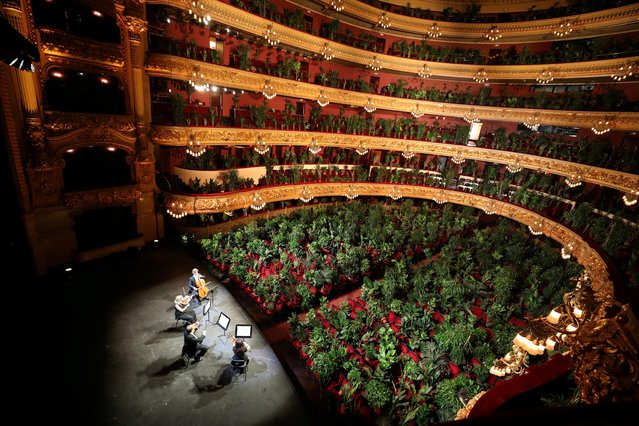
Nursery plants are seen placed in people's seats during a rehearsal as Barcelona's Gran Teatre del Liceu opera reopens its doors with a concert for plants, to raise awareness about the importance of an audience after the coronavirus lockdown, in Barcelona, Spain on June 22, 2020. The Gran Teatre del Liceu reopens its doors, in which the 2,292 seats of the auditorium will be occupied on this occasion by plants. It will be on 22 June, broadcast live online, when the UceLi Quartet string quartet performs Puccini's “Crisantemi” for this verdant public, brought in from local nurseries. (Photo by Nacho Doce/Reuters)

Nursery plants are seen placed in people's seats during a rehearsal as Barcelona's Gran Teatre del Liceu opera reopens its doors with a concert for plants, to raise awareness about the importance of an audience after the coronavirus lockdown, in Barcelona, Spain on June 22, 2020. The Gran Teatre del Liceu reopens its doors, in which the 2,292 seats of the auditorium will be occupied on this occasion by plants. It will be on 22 June, broadcast live online, when the UceLi Quartet string quartet performs Puccini's “Crisantemi” for this verdant public, brought in from local nurseries. (Photo by Nacho Doce/Reuters)
Details
24 Jun 2020 00:07:00
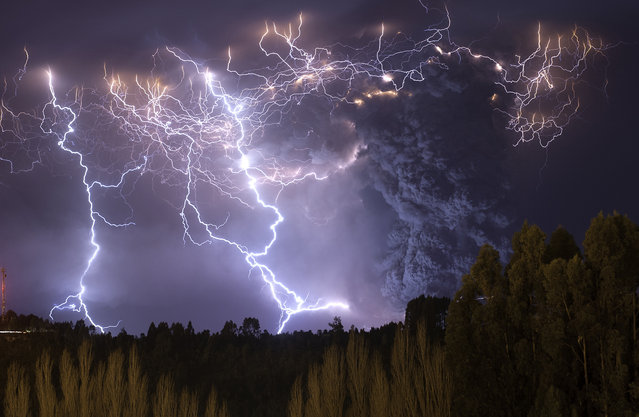
The eruption of Cordon Caulle began on June 4, 2011, located in the Region of Los Rios in Chile. For about 12 months, people and animals became accustomed to living with the daily fall of ash, which also caused problems in the air traffic in South America. The explosions and lightning during first days of the eruption could be seen from hundreds of miles around. This photograph was taken on the second night of eruption from the town of Lago Ranco. (Photo and caption by Francisco Negroni/National Geographic Traveler Photo Contest)

The eruption of Cordon Caulle began on June 4, 2011, located in the Region of Los Rios in Chile. For about 12 months, people and animals became accustomed to living with the daily fall of ash, which also caused problems in the air traffic in South America. The explosions and lightning during first days of the eruption could be seen from hundreds of miles around. This photograph was taken on the second night of eruption from the town of Lago Ranco. (Photo and caption by Francisco Negroni/National Geographic Traveler Photo Contest)

ATTENTION! All pictures are presented in high resolution. To see Hi-Res images – just TWICE click on any picture. In other words, click small picture – opens the BIG picture. Click BIG picture – opens VERY BIG picture.
Details
23 Jun 2013 11:24:00
A man crosses from a pirogue to another pirogue during the annual boat regatta in Yauri, Kebbi State, on February 15, 2025. The regatta festival started about 200 years ago as a display of naval strength of the Gungu people, where the Gungu warriors annually attacked dangerous hippopotamus that were destroying farmlands. Warriors would board various sizes of canoes with different types of weapons to attack the animal on the River Niger. This required expertise in canoe paddling and naval warfare. It also served as training exercise for upcoming Gungu warriors. (Photo by Toyin Adedokun/AFP Photo)

A man crosses from a pirogue to another pirogue during the annual boat regatta in Yauri, Kebbi State, on February 15, 2025. The regatta festival started about 200 years ago as a display of naval strength of the Gungu people, where the Gungu warriors annually attacked dangerous hippopotamus that were destroying farmlands. Warriors would board various sizes of canoes with different types of weapons to attack the animal on the River Niger. This required expertise in canoe paddling and naval warfare. It also served as training exercise for upcoming Gungu warriors. (Photo by Toyin Adedokun/AFP Photo)
Details
25 Feb 2025 01:59:00
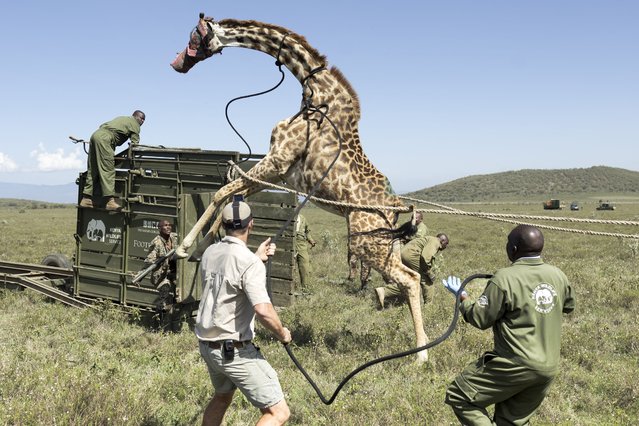
An adult female Masai giraffe rears on its hind legs as it resists efforts by Kenya Wildlife Services (KWS) rangers to guide it into a transportation crate using ropes during an exercise to translocate large herbivores from Kedong Ranch due to land subdivisions and corralling that have disrupted wildlife migratory routes in Naivasha, Nakuru County, on November 16, 2025. Driven by two long ropes held by about twenty rangers, the blindfolded giraffe enters a tall trailer that is to transport it out of its natural habitat in the Rift Valley, which is deteriorating after having been resold. This is the first step in a meticulous relocation operation in the vast Kedong ranch, part of an ancestral corridor between Mount Longonot and Hell's Gate Park, near the iconic Lake Naivasha. (Photo by Tony Karumba/AFP Photo)

An adult female Masai giraffe rears on its hind legs as it resists efforts by Kenya Wildlife Services (KWS) rangers to guide it into a transportation crate using ropes during an exercise to translocate large herbivores from Kedong Ranch due to land subdivisions and corralling that have disrupted wildlife migratory routes in Naivasha, Nakuru County, on November 16, 2025. Driven by two long ropes held by about twenty rangers, the blindfolded giraffe enters a tall trailer that is to transport it out of its natural habitat in the Rift Valley, which is deteriorating after having been resold. This is the first step in a meticulous relocation operation in the vast Kedong ranch, part of an ancestral corridor between Mount Longonot and Hell's Gate Park, near the iconic Lake Naivasha. (Photo by Tony Karumba/AFP Photo)
Details
23 Nov 2025 06:26:00
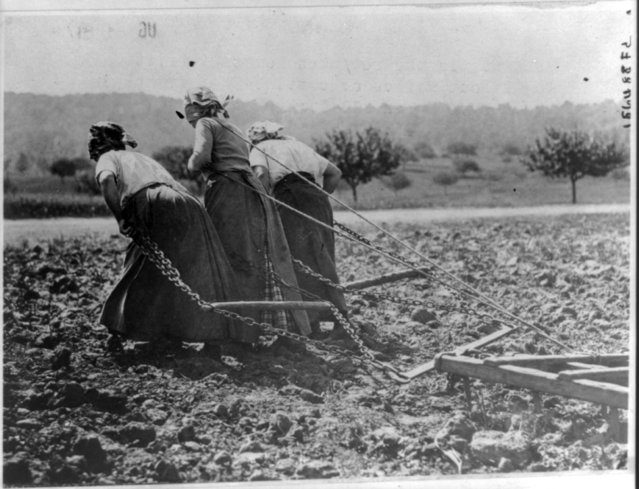
Peasants in the re-taken Somme District work in the fields, circa 1916- 1917, in this Library of Congress handout photo. (Photo by Reuters/Bain Collection/Library of Congress)

Peasants in the re-taken Somme District work in the fields, circa 1916- 1917, in this Library of Congress handout photo. For women 100 years ago, opportunities to work beyond the home and take part in political life were very limited. As the 20th century progressed, hard-won progress included gradually improved voting rights, while the upheaval of war pushed doors ajar as women worked as part of the war effort. U.S. Library of Congress archive photos show women's workplaces ranging from a flour mill in England to a coal mine in Belgium or Lincoln Motor Co.'s welding department in Detroit. International Women's Day is celebrated on March 8. (Photo by Reuters/Bain Collection/Library of Congress)
Details
03 Mar 2016 11:39:00