A girl lights a candle during an Easter service in the Volodymyrsky Cathedral, amid Russia's attack on Ukraine, in Kyiv, Ukraine, on May 4, 2024. (Photo by Alina Smutko/Reuters)
Swedish model Elsa Hosk stunned in the second decade of September 2024 as she posed on an office photocopier in stockings and suspenders. (Photo by Iamgia)
Quinn O'Hogan (L) and Kendall O'Hogan lean into the winds from Hurricane Helene as it passes offshore on September 26, 2024, in St. Petersburg, Florida. Helene is forecast to become a major hurricane, bringing the potential for deadly storm surges, flooding rain, and destructive hurricane-force winds along parts of the Florida West Coast. (Photo by Joe Raedle/Getty Images)
Argentine singer-songwriter Maria Becerra arrives for the Person of the Year Gala, as part of the events surrounding the 25th Annual Latin Grammy Awards, in Miami, Florida on November 13, 2024. (Photo by Marco Bello/Reuters)
A model presents a creation from The Blonds during New York Fashion Week Fall-Winter 2025 in New York City, U.S., February 8, 2025. (Photo by David Dee Delgado/Reuters)
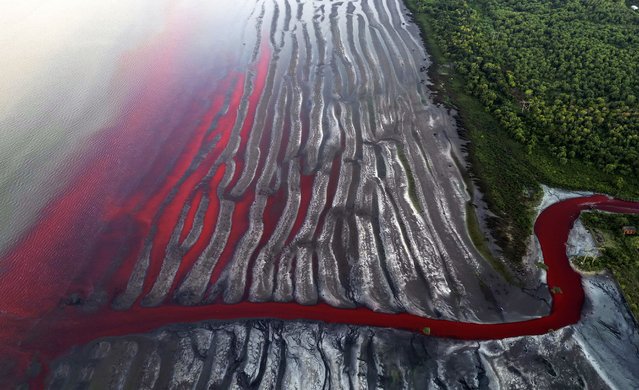
The “Sarandi” stream, dyed red due to unknown contaminants allege residents, flows into the Río de la Plata on the outskirts of Buenos Aires, Argentina, February 6, 2025. (Photo by Rodrigo Abd/AP Photo)
Lake Baikal is the world's oldest lake, at 25 million years (possibly older), and deepest, averaging 744.4 metres (2,442 ft).
Located in the south of the Russian region of Siberia, between Irkutsk Oblast to the northwest and the Buryat Republic to the southeast, it is the most voluminous freshwater lake in the world, containing roughly 20% of the world's unfrozen surface fresh water.
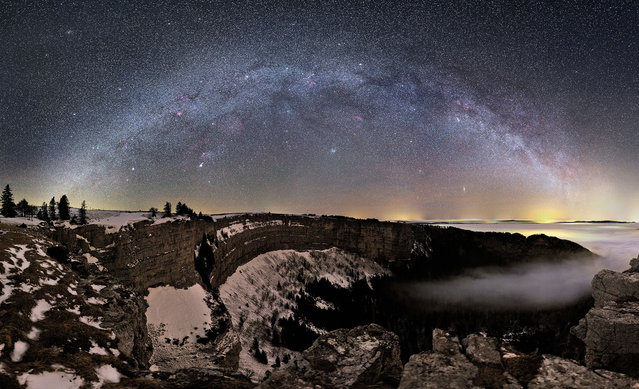
The Milky Way is the galaxy in which Earth is contained. This name derives from its appearance as a dim “milky” glowing band arching across the night sky, in which the naked eye cannot distinguish individual stars. The term “Milky Way” is a translation of the Classical Latin via lactea, from the Hellenistic Greek γαλαξίας κύκλος (pr. galaxías kýklos, “milky circle”). The Milky Way appears like a band because it is a disk-shaped structure being viewed from inside. The fact that this faint band of light is made up of stars was proven in 1610 when Galileo Galilei used his telescope to resolve it into individual stars. In the 1920s, observations by astronomer Edwin Hubble showed that the Milky Way is just one of many galaxies.