Loading...
Done
Demonstrators protest against bullfighting in front of the City Hall a day before of the famous San Fermin festival, in Pamplona, northern Spain, Friday, July 5, 2019. The festival will begin on July 6 with the “txupinazo” opening ceremony, with people participating in bull runs, music and dance, through the old city. (Photo by Alvaro Barrientos/AP Photo)

Demonstrators protest against bullfighting in front of the City Hall a day before of the famous San Fermin festival, in Pamplona, northern Spain, Friday, July 5, 2019. The festival will begin on July 6 with the “txupinazo” opening ceremony, with people participating in bull runs, music and dance, through the old city. (Photo by Alvaro Barrientos/AP Photo)
Details
07 Jul 2019 00:07:00
Circus performer from the Association of Circus Proprietors on Whitehall, London, Britain, 07 July 2020. The association handed a petition to Downing Street to ask British Prime Minister Boris Johnson to allow circuses to reopen. (Photo by Will Oliver/EPA/EFE)

Circus performer from the Association of Circus Proprietors on Whitehall, London, Britain, 07 July 2020. The association handed a petition to Downing Street to ask British Prime Minister Boris Johnson to allow circuses to reopen. (Photo by Will Oliver/EPA/EFE)
Details
09 Jul 2020 00:07:00
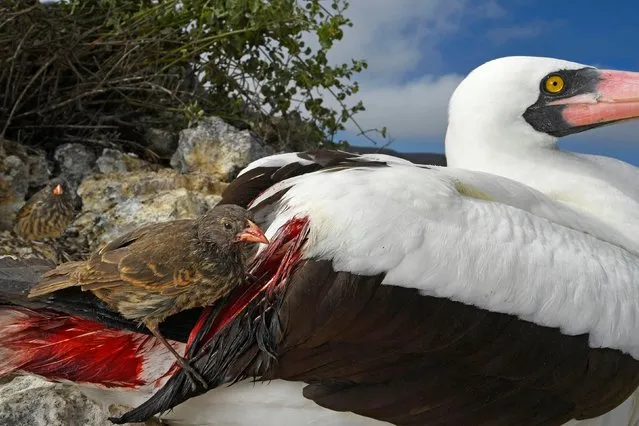
Bloodthirsty by Thomas P Peschak, Germany/South Africa — winner, Behaviour: birds. When rations run short on Wolf Island, in the remote northern Galápagos, the sharp-beaked ground finches become vampires. Their sitting targets are Nazca boobies and other large birds. The finches rely on a scant diet of seeds and insects, which regularly dries up, so they drink blood to survive. ‘I’ve seen more than half a dozen finches drinking from a single Nazca booby,’ says Tom. Rather than leave their nests the boobies tolerate the vampires, and the blood loss doesn’t seem to cause permanent harm. (Photo by Thomas P Peschak/2018 Wildlife Photographer of the Year)

Bloodthirsty by Thomas P. Peschak, Germany/South Africa — winner, Behaviour: birds. When rations run short on Wolf Island, in the remote northern Galápagos, the sharp-beaked ground finches become vampires. Their sitting targets are Nazca boobies and other large birds. The finches rely on a scant diet of seeds and insects, which regularly dries up, so they drink blood to survive. ‘I’ve seen more than half a dozen finches drinking from a single Nazca booby,’ says Tom. Rather than leave their nests the boobies tolerate the vampires, and the blood loss doesn’t seem to cause permanent harm. (Photo by Thomas P. Peschak/2018 Wildlife Photographer of the Year)
Details
19 Oct 2018 00:05:00
A government employee reacts as she is sprayed with disinfectant before entering a government office building to curb the spread of COVID-19 on March 19, 2020 in Pasig city, Metro Manila, Philippines. The Philippine government has sealed off Luzon, the country's largest and most populous island, to prevent the spread of COVID-19. Land, sea, and air travel has been suspended, while government work, schools, businesses, and public transportation have been ordered shut in a bid to keep some 55 million people at home. The Philippines' Department of Health has so far confirmed 217 cases of the new coronavirus in the country, with at least 17 recorded fatalities. (Photo by Ezra Acayan/Getty Images)

A government employee reacts as she is sprayed with disinfectant before entering a government office building to curb the spread of COVID-19 on March 19, 2020 in Pasig city, Metro Manila, Philippines. The Philippine government has sealed off Luzon, the country's largest and most populous island, to prevent the spread of COVID-19. Land, sea, and air travel has been suspended, while government work, schools, businesses, and public transportation have been ordered shut in a bid to keep some 55 million people at home. The Philippines' Department of Health has so far confirmed 217 cases of the new coronavirus in the country, with at least 17 recorded fatalities. (Photo by Ezra Acayan/Getty Images)
Details
07 Jan 2021 00:05:00
Members of the San Francisco Gay Freedom Day Marching Band and Twirling Corps do their thing down San Francisco's Market Street, June 27, 1982. Police estimate the crowd to be 300,000 for the Lesbian/Gay Freedom Day parade and rally. (Photo by Carl Viti/AP Photo)

Members of the San Francisco Gay Freedom Day Marching Band and Twirling Corps do their thing down San Francisco's Market Street, June 27, 1982. Police estimate the crowd to be 300,000 for the Lesbian/Gay Freedom Day parade and rally. (Photo by Carl Viti/AP Photo)
Details
11 Aug 2017 07:27:00
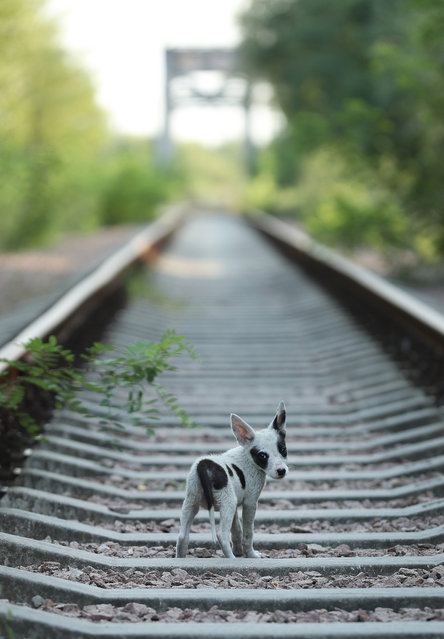
A stray puppy walks along abandoned train tracks near the Chernobyl nuclear power plant on August 19, 2017 near Chornobyl, Ukraine. (Photo by Sean Gallup/Getty Images)

A stray puppy walks along abandoned train tracks near the Chernobyl nuclear power plant on August 19, 2017 near Chornobyl, Ukraine. An estimated 900 stray dogs live in the exclusion zone, many of them likely the descendants of dogs left behind following the mass evacuation of residents in the aftermath of the 1986 nuclear disaster at Chernobyl. (Photo by Sean Gallup/Getty Images)
Details
24 Aug 2017 09:28:00
Members of the Women's Organization to War on Styles (WOW) picket a dress shop in Berkeley, Calif., August 23, 1947, in protest to longer skirts and padded hips. They are the wives of GI students at the University of California. Left to right: Jackie Houser; Wanda Ames; Dorothy Inman; Terry Ligon; Ruth Van Arkel; Carrol Reynolds, and Barbara Carmichael. (Photo by AP Photo)

Members of the Women's Organization to War on Styles (WOW) picket a dress shop in Berkeley, Calif., August 23, 1947, in protest to longer skirts and padded hips. They are the wives of GI students at the University of California. Left to right: Jackie Houser; Wanda Ames; Dorothy Inman; Terry Ligon; Ruth Van Arkel; Carrol Reynolds, and Barbara Carmichael. (Photo by AP Photo)
Details
18 Sep 2017 07:34:00
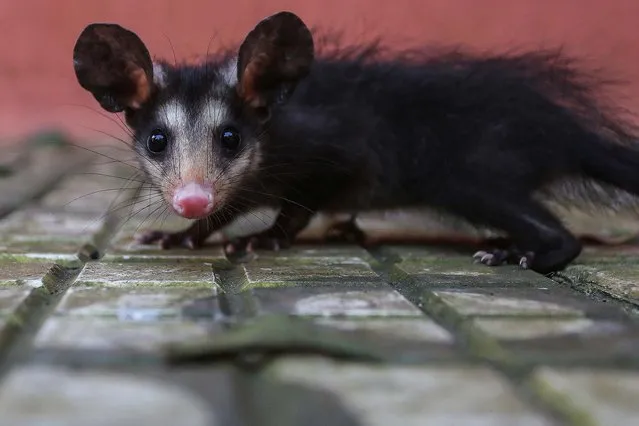
Photo taken on September 19, 2015 shows a baby Brazilian opossum at the “Parque Estoril” zoo in Sao Bernardo do Campo of Sao Paulo, Brazil. According to local press, the “Parque Estoril” zoo houses currently 23 orphan cubs of wild animals rescued in the south region of Sao Paulo, victims of illegal wildlife trade or problems caused by urban growth. (Photo by Rahel Patrasso/Xinhua via ZUMA Wire)

Photo taken on September 19, 2015 shows a baby Brazilian opossum at the “Parque Estoril” zoo in Sao Bernardo do Campo of Sao Paulo, Brazil. According to local press, the “Parque Estoril” zoo houses currently 23 orphan cubs of wild animals rescued in the south region of Sao Paulo, victims of illegal wildlife trade or problems caused by urban growth. According to the zoo, all the animals arrived in the last three months, and many of them, not being able to be reintroduced to their natural habitat, will be used as examples in environmental education classes. (Photo by Rahel Patrasso/Xinhua via ZUMA Wire)
Details
26 Sep 2015 08:00:00