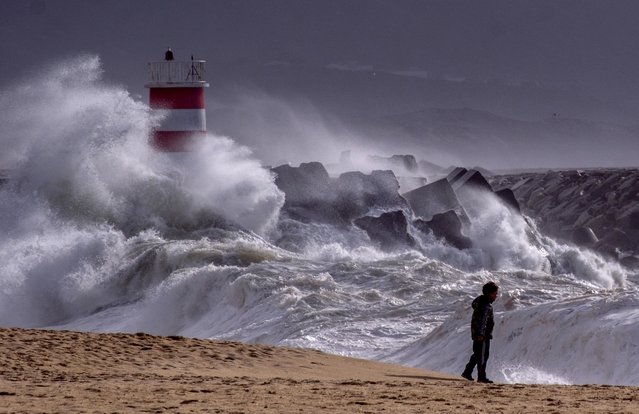
Big waves approach the beach of Nazare, Portugal, Tuesday, March 26, 2024. The high waves were caused by strong winds at one of the world's most popular surf spots. (Photo by Michael Probst/AP Photo)
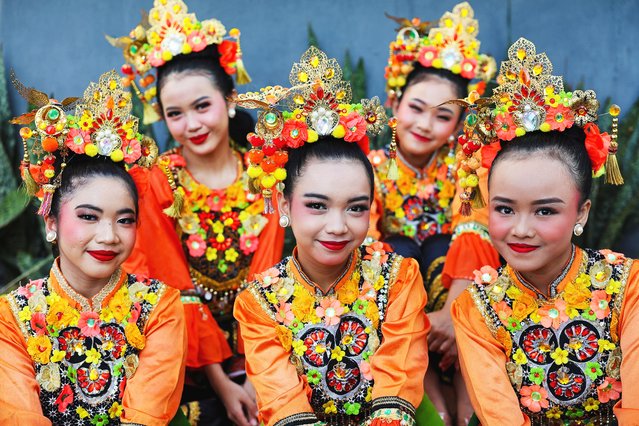
Dancers pose for a photo as they prepare during Festival Cilung or “Love the Environment” Festival, where boats made from recycled materials, mostly plastic bottles, sail on the Ciliwung River, one of the most polluted rivers in the world, to raise public awareness about river pollution, in Jakarta, Indonesia, on September 28, 2025. (Photo by Willy Kurniawan/Reuters)
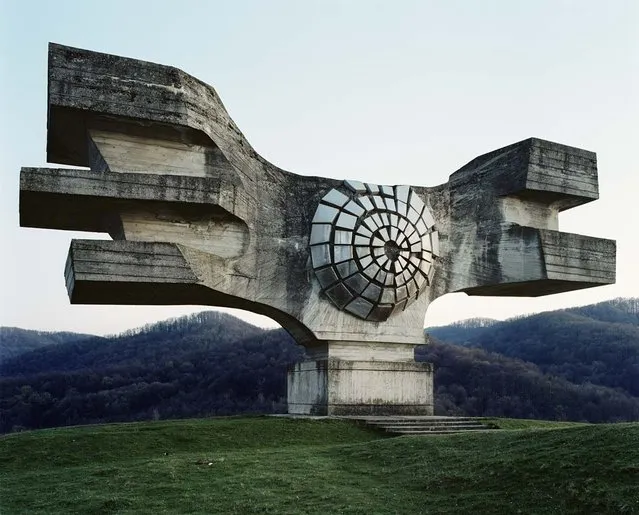
The brutalist war memorials found throughout the former Yugoslavia were weird enough when they were built in the 1960s and 70s. Today, separated by the end of an architectural movement and the disintegration of the country, they seem almost alien. Belgian photographer Jan Kempenaers treats them purely as artistic objects in his book, “Spomenik”, named for the Serb-Croat word for monument. Known for photographing geographical oddities, Kempenaers was captivated by the spomenik after seeing them in an art encyclopedia. After hearing that many had been destroyed or abandoned, he set out to record what was left. (Photo by Jan Kempenaers)
Syrian Tulin Hashemi waits for a job interview at a hotel in Vidigal slum in Rio de Janeiro, Brazil, September 22, 2015. Tulin, whose mother arrived two days ago, has been living in Brazil for two months. As she does not speak Portuguese, Tulin says it is difficult for her to find a job and therefore she is staying at the slum as it is one of the cheaper neighbourhoods to live in. According to the National Committee for Refugees (CONARE), 2,077 people fleeing the Syrian civil war have settled in Brazil, whilst a quarter of the 8,400 refugees in the Latin American country come from Syria. (Photo by Pilar Olivares/Reuters)
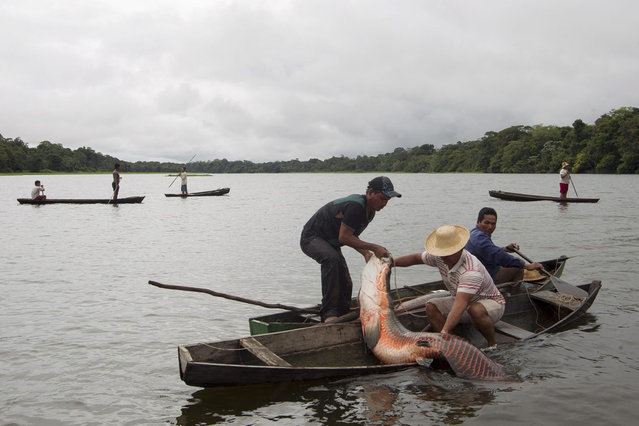
Villagers from the Porto Novo community load into their canoes arapaima or pirarucu, the largest freshwater fish species in South America and one of the largest in the world, while fishing in Poco Fundo lake along a branch of the Solimoes river, one of the main tributaries of the Amazon, in the Mamiraua nature reserve near Fonte Boa about 600 km (373 miles) west of Manaus, November 26, 2013. Catching the arapaima, a fish that is sought after for its meat and is considered by biologists to be a living fossil, is only allowed once a year by Brazil's environmental protection agency. The minimum size allowed for a fisherman to keep an arapaima is 1.5 meters (4.9 feet). (Photo by Bruno Kelly/Reuters)
France's paralympic triple jumper Arnaud Assoumani poses in front of The Louvre Pyramide, designed by Ieoh Ming Pei, in Paris on April 20, 2024, ahead of the Paris 2024 Olympic and Paralympic games. The Louvre was originally built as a fortress in the late 12th century, became one of the main residences of the kings of France later and actually is one of the largest museum in the world. (Photo by Franck Fife/AFP Photo)
Yan Zhengming (R), 94, and his wife Zhou Suqing (C), 90, attend their wedding ceremony at their home, on the 70th anniversary of their marriage, in Quxian county of Dazhou, Sichuan province, China, May 15, 2015. The wedding, organized by local charity groups, was a long-time wish of veteran of the World War Two Yan, who married Zhou 70 years ago, but could not afford to have a wedding ceremony, local media reported. (Photo by Reuters/Stringer)
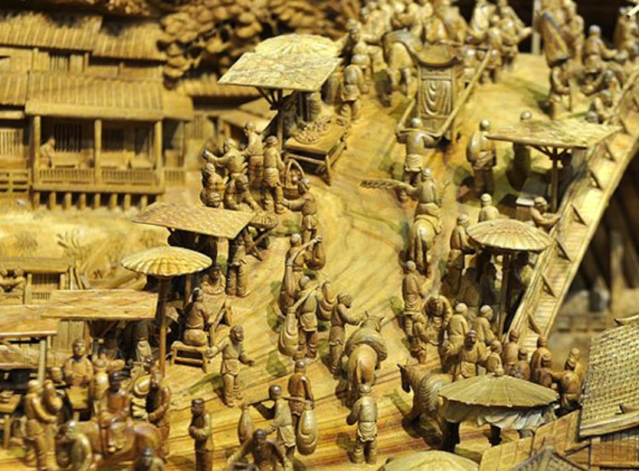
A famous Chinese wood carver, Zheng Chunhui has won a Guinness World Record after developing the longest wooden carving of the world. Zheng spent 4 years developing the artwork that is about forty feet long and made sculpture from a single tree trunk. The artwork is basically a copy of the popular Chinese painting named Along the River during the Qingming Festival that was made around one thousand years ago.