Loading...
Done
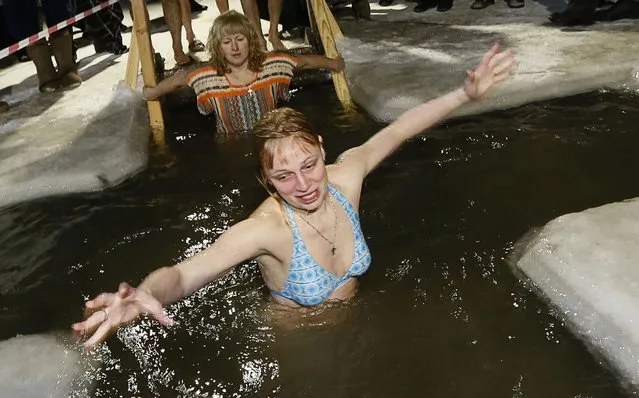
People immerse themselves in an ice hole in the Chulym river, with the air temperature at about minus 12 degrees Celsius (10.4 degrees Fahrenheit), during celebrations for the Russian Orthodox Epiphany outside of the town of Nazarovo, Krasnoyarsk region January 19, 2015. (Photo by Ilya Naymushin/Reuters)

People immerse themselves in an ice hole in the Chulym river, with the air temperature at about minus 12 degrees Celsius (10.4 degrees Fahrenheit), during celebrations for the Russian Orthodox Epiphany outside of the town of Nazarovo, Krasnoyarsk region January 19, 2015. (Photo by Ilya Naymushin/Reuters)
Details
19 Jan 2015 13:20:00
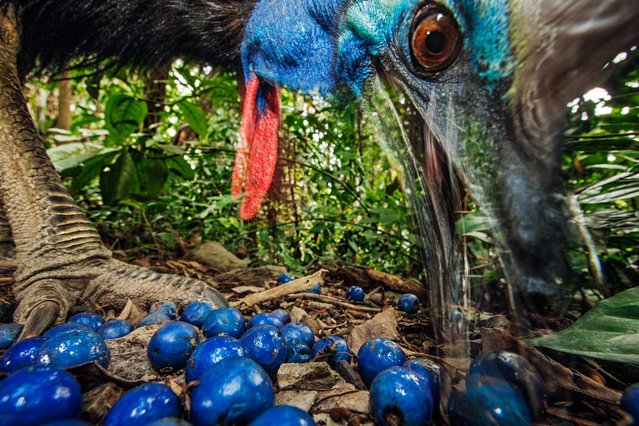
“Cassowaries are large, flightless birds related to emus and (more distantly) to ostriches, rheas, and kiwis”, writes Olivia Judson in the September issue of National Geographic magazine. (Photo by Christian Ziegler/National Geographic)

“Cassowaries are large, flightless birds related to emus and (more distantly) to ostriches, rheas, and kiwis”, writes Olivia Judson in the September issue of National Geographic magazine. How large? People-size: Adult males stand well over five foot five and top 110 pounds. Females are even taller, and can weigh more than 160 pounds. Dangerous when roused, they’re shy and peaceable when left alone. But even birds this big and tough are prey to habitat loss. The dense New Guinea and Australia rain forests where they live have dwindled. Today cassowaries might number 1,500 to 2,000. And because they help shape those same forests – by moving seeds from one place to another – “if they vanish”, Judson writes, “the structure of the forest would gradually change” too. (Photo by Christian Ziegler/National Geographic)

Details
06 Jan 2014 12:21:00
People make their way on an algae-covered beach in Qingdao, Shandong province, China, July 19, 2015. (Photo by Reuters/Stringer)

People make their way on an algae-covered beach in Qingdao, Shandong province, China, July 19, 2015. (Photo by Reuters/Stringer)
Details
20 Jul 2015 10:44:00
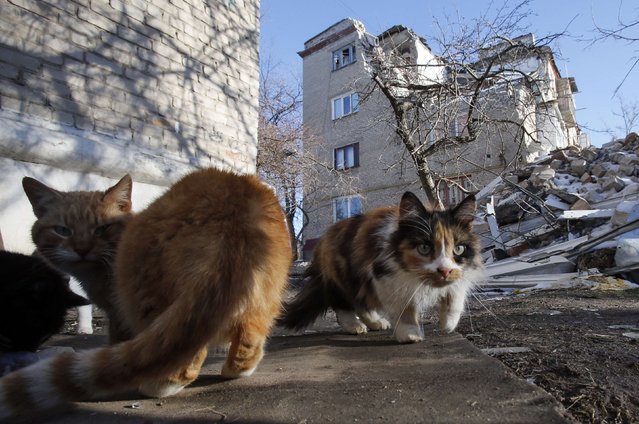
Cats gather in front of a house damaged by shelling in the town of Dokuchayevsk, south of Donetsk, February 12, 2015. (Photo by Maxim Shemetov/Reuters)

Cats gather in front of a house damaged by shelling in the town of Dokuchayevsk, south of Donetsk, February 12, 2015. (Photo by Maxim Shemetov/Reuters)
Details
19 Feb 2015 14:17:00
A man and a woman both wounded by what locals say was recent shelling by Ukrainian forces, react as they sit in an ambulance in Donetsk August 23, 2014. (Photo by Maxim Shemetov/Reuters)

A man and a woman both wounded by what locals say was recent shelling by Ukrainian forces, react as they sit in an ambulance in Donetsk August 23, 2014. (Photo by Maxim Shemetov/Reuters)
Details
26 Aug 2014 10:21:00
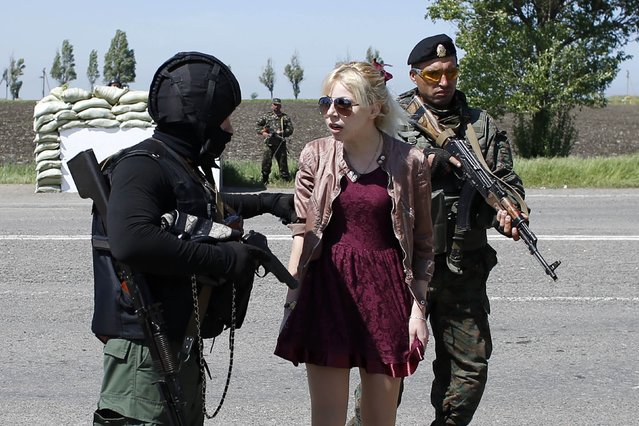
A woman is led aside as her partner is detained by Ukrainian security forces for being aggressive at an army checkpoint in the southeastern port city of Mariupol, on May 11, 2014. Residents’ attitudes appear to have hardened considerably with the deaths of dozens of pro-Russian activists in the city of Odessa this month and with reports that troops fired at a crowd in Mariupol last week. (Photo by Marko Djurica/Reuters)

A woman is led aside as her partner is detained by Ukrainian security forces for being aggressive at an army checkpoint in the southeastern port city of Mariupol, on May 11, 2014. Residents’ attitudes appear to have hardened considerably with the deaths of dozens of pro-Russian activists in the city of Odessa this month and with reports that troops fired at a crowd in Mariupol last week. (Photo by Marko Djurica/Reuters)
Details
12 May 2014 09:53:00
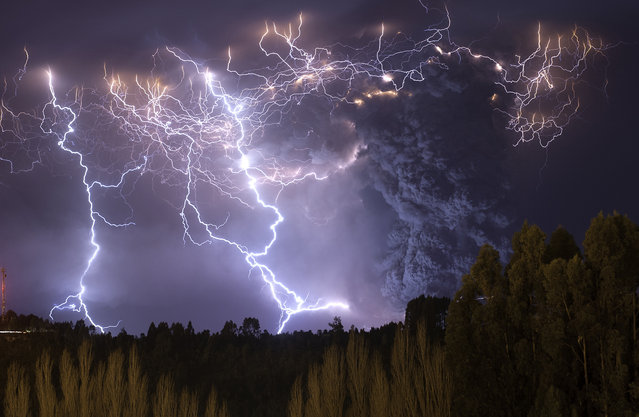
The eruption of Cordon Caulle began on June 4, 2011, located in the Region of Los Rios in Chile. For about 12 months, people and animals became accustomed to living with the daily fall of ash, which also caused problems in the air traffic in South America. The explosions and lightning during first days of the eruption could be seen from hundreds of miles around. This photograph was taken on the second night of eruption from the town of Lago Ranco. (Photo and caption by Francisco Negroni/National Geographic Traveler Photo Contest)

The eruption of Cordon Caulle began on June 4, 2011, located in the Region of Los Rios in Chile. For about 12 months, people and animals became accustomed to living with the daily fall of ash, which also caused problems in the air traffic in South America. The explosions and lightning during first days of the eruption could be seen from hundreds of miles around. This photograph was taken on the second night of eruption from the town of Lago Ranco. (Photo and caption by Francisco Negroni/National Geographic Traveler Photo Contest)

ATTENTION! All pictures are presented in high resolution. To see Hi-Res images – just TWICE click on any picture. In other words, click small picture – opens the BIG picture. Click BIG picture – opens VERY BIG picture.
Details
23 Jun 2013 11:24:00
Street vendors hold campaign posters for presidential candidate Patrice Talon ahead of the second round of Benin's presidential election on Sunday in Cotonou, Benin, March 18, 2016. (Photo by Charles Placide Tossou/Reuters)

Street vendors hold campaign posters for presidential candidate Patrice Talon ahead of the second round of Benin's presidential election on Sunday in Cotonou, Benin, March 18, 2016. (Photo by Charles Placide Tossou/Reuters)
Details
19 Mar 2016 12:55:00