Loading...
Done
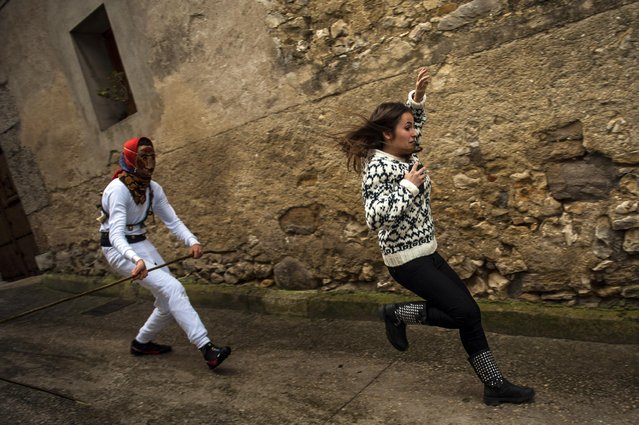
In this photo taken on Sunday, February 15, 2015 a girl runs away from a “Mamuxarro” during the carnival, in the small town of Unanu, northern Spain. While Rio de Janeiro may boast the world’s most famous carnival, the festive period of masquerades and wild and colorful costumes that precedes the Christian religious season of Lent is also a permanent and popular fixture for celebration in Spain and Portugal, with each country having its own strange and unique way of doing it. (Photo by Alvaro Barrientos/AP Photo)

In this photo taken on Sunday, February 15, 2015 a girl runs away from a “Mamuxarro” during the carnival, in the small town of Unanu, northern Spain. In the northern Spanish ancient village of Unamu, people dress up as “Mamuxarro”, folkloric figures in white with a red sash and a metal mask to cover their faces as they pursue townsfolk with sticks. According to custom, their “victims” (usually young women) must kneel and kiss the mamuxarro’s knee after he makes the sign of the cross on their forehead. (Photo by Alvaro Barrientos/AP Photo)
Details
22 Feb 2015 10:51:00
A child parades on a float during the Bun Festival on May 25, 2015 in Hong Kong, Hong Kong. One of Hong Kong's most colourful cultural celebration event, Cheung Chau Bun Festival, will be staged on 25 May 2015 (Monday) till 26 May 2015 midnight (Tuesday). This festival has over 100 years of history. (Photo by Lam Yik Fei/Getty Images)

A child parades on a float during the Bun Festival on May 25, 2015 in Hong Kong, Hong Kong. One of Hong Kong's most colourful cultural celebration event, Cheung Chau Bun Festival, will be staged on 25 May 2015 (Monday) till 26 May 2015 midnight (Tuesday). This festival has over 100 years of history. Every year, thousands of people descend upon the tiny island for The Piu Sik (Floating Colours) Parade, Lucky Bun (Ping On Bun) and The Bun Scrambling Competition, the ancient custom during the festival. (Photo by Lam Yik Fei/Getty Images)
Details
26 May 2015 10:54:00
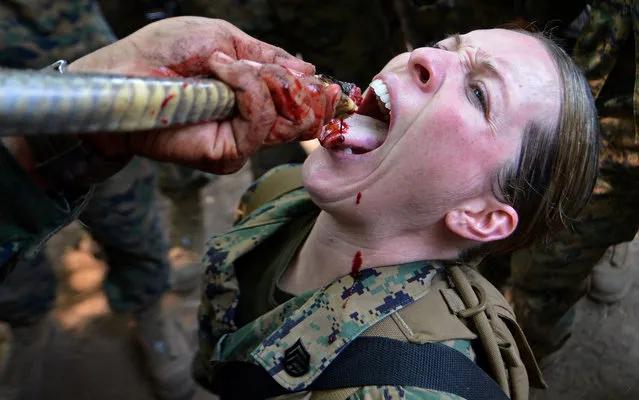
In a military base in the Thai province of Chon Buri February 20 U.S. Marines Navy with Thailand began their studies in jungle survival. The event is held in joint military exercises “Cobra Gold 2013”. During a jungle survival program February 20, 2013 taught by Royal Thai Special Forces in Sannapit, Thailand, U.S. Marines learned to catch cobras and drink their fresh blood, not to mention eat forest insects and pull the heads off of chicken. The training was part of Operation Cobra Gold 13, the 32nd edition of international military exercises hosted by the Thai. According to a U.S. Marines press release, Cobra Gold is the largest exercise of its kind in Asia and incorporates troops from five other nations in addition to the U.S. and Thailand. The Daily Mail reports that the Marines were invited to experience the local custom of drinking cobra blood after being taught to catch and kill cobras in the wild. As CNN notes, Cobra blood is believed to be a panacea and aphrodiasic in parts of Southeast Asia. In Jakarta, vendors can earn over $100 a night selling shots of cobra blood mixed with liquor. (Photo by Pornchai Kittiwongsakul/AFP Photo)

During a jungle survival program February 20, 2013 taught by Royal Thai Special Forces in Sannapit, Thailand, U.S. Marines learned to catch cobras and drink their fresh blood, not to mention eat forest insects and pull the heads off of chicken. The training was part of Operation Cobra Gold 13, the 32nd edition of international military exercises hosted by the Thai. According to a U.S. Marines press release, Cobra Gold is the largest exercise of its kind in Asia and incorporates troops from five other nations in addition to the U.S. and Thailand. The Daily Mail reports that the Marines were invited to experience the local custom of drinking cobra blood after being taught to catch and kill cobras in the wild. As CNN notes, Cobra blood is believed to be a panacea and aphrodiasic in parts of Southeast Asia. In Jakarta, vendors can earn over $100 a night selling shots of cobra blood mixed with liquor. (Photo by Pornchai Kittiwongsakul/AFP Photo)
Details
23 Feb 2013 11:52:00


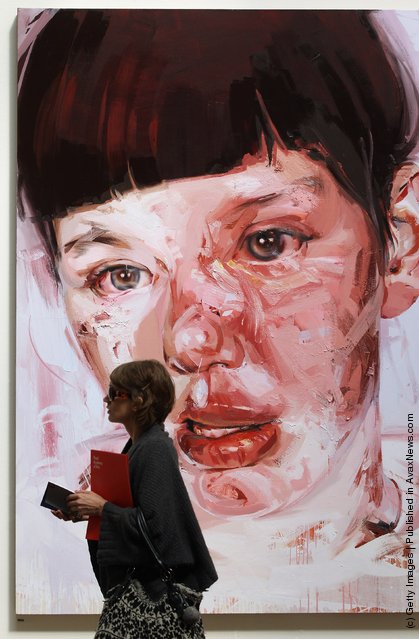
A woman walks past a painting by Jenny Saville entitled “Red Stare Head IV” on display in the Royal Academy of Arts' Summer Exhibition on June 2, 2011 in London, England. The Summer Exhibition is the world's largest open submission contemporary art show, now in its 243rd year, with over 12,000 entries received from 27 countries. The exhibition features over 1100 works of art including: painting, sculpture, photography, architecture and film, it officially opens to the public on June 7, 2011. (Photo by Oli Scarff/Getty Images)
Details
03 Jun 2011 08:34:00
View at one of the sculptures by Swiss artist H.R. Giger during the opening of the Ars Electronica 2013 exhibition “HR Giger. The Art of Biomechanics” in Linz, Austria, 04 September 2013. (Photo by EPA/RUBRA)

View at one of the sculptures by Swiss artist H.R. Giger during the opening of the Ars Electronica 2013 exhibition “HR Giger. The Art of Biomechanics” in Linz, Austria, 04 September 2013. (Photo by EPA/RUBRA)

SEE ALSO: «Surreal Art by Alien Creator H. R. Giger»

Details
15 May 2014 12:05:00
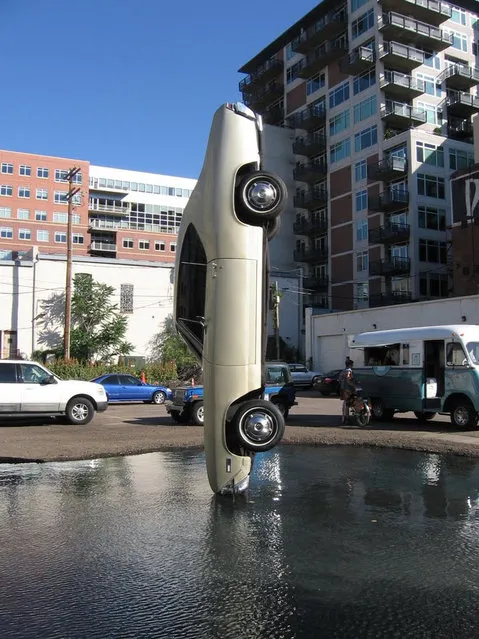
History of Suspended Time By Gonzalo Lebrija

Guadalajara-based artist Gonzalo Lebrija created a public art installation in the parking lot (1430 Delgany Street, Denver, CO 80202) across from the Museum of Contemporary Art Denver (MCA Denver) in the summer of 2010. The installation, entitled History of Suspended Time: Monument for the Impossible, was developed as a dual collaboration with MCA Denver's museum-wide exhibition, Energy Effects: Art & Artifacts from the Landscape of Glorious Excess, as well as Denver's inaugural 2010 Biennial of the Americas, an international event that celebrated the culture, ideas and people of the Western Hemisphere.
Details
31 Aug 2014 13:37:00
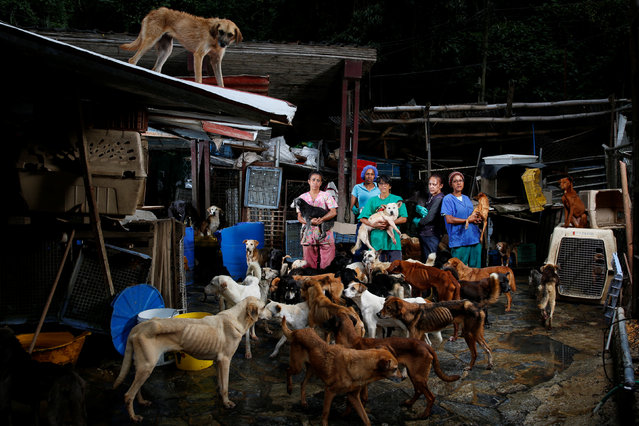
(L-R) Maria Silva, Milena Cortes, Maria Arteaga, Jackeline Bastidas and Gissy Abello pose for a picture at the Famproa dogs shelter where they work, in Los Teques, Venezuela, August 25, 2016. Venezuelans struggling to feed their families let alone their pets are dumping animals on the streets, in parks and at makeshift homes overrun with scrawny animals amid an economic crisis. An hour from Caracas in Los Teques, hundreds of dogs bark and run around the streets scavenging for food outside a makeshift shelter. People come by every few hours to hand over scrawny dogs which are fed by volunteers every day. Venezuela is undergoing a major economic and social crisis, with shortages of basic foods and medicines. Triple digit inflation is hitting everybody hard, including those who own pets. (Photo by Carlos Garcia Rawlins/Reuters)

(L-R) Maria Silva, Milena Cortes, Maria Arteaga, Jackeline Bastidas and Gissy Abello pose for a picture at the Famproa dogs shelter where they work, in Los Teques, Venezuela, August 25, 2016. Venezuelans struggling to feed their families let alone their pets are dumping animals on the streets, in parks and at makeshift homes overrun with scrawny animals amid an economic crisis. An hour from Caracas in Los Teques, hundreds of dogs bark and run around the streets scavenging for food outside a makeshift shelter. (Photo by Carlos Garcia Rawlins/Reuters)
Details
08 Sep 2016 10:01:00
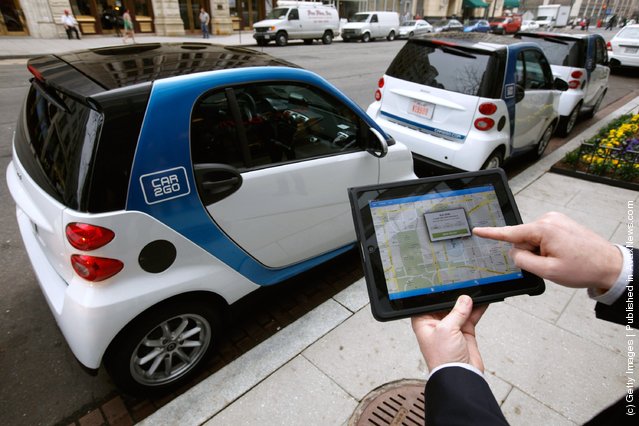
A car2go employee shows how members can use a smartphone or iPad app to locate and reservec car2go vehicles March 22, 2012 in Washington, DC

“Car2go fleet is located throughout the greater downtown area and can be accessed on-demand or booked 24 hours in advance. The members may use the vehicle for as long as they like, without committing to a specific return time or return location”. – Wikipedia

Photo: A car2go employee shows how members can use a smartphone or iPad app to locate and reservec car2go vehicles March 22, 2012 in Washington, DC. Beginning March 24, car2go will offer the first free-floating car-sharing service in Washington and Portland, Oregon, where customers can use the smartphone app within the 34-square-mile “Home Area”. After paying a one-time $35 membership fee, drivers can then rent the Smart Fortwo vehicles by the minute, paying only for the time they use the vehicle, with discounted rates for hourly and daily use. (Photo by Chip Somodevilla/Getty Images)
Details
23 Mar 2012 10:58:00