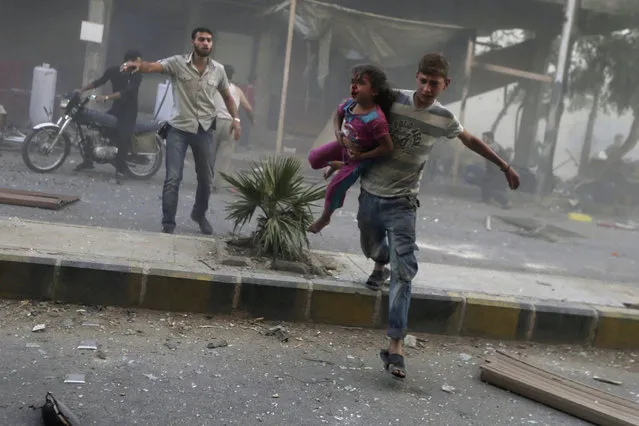
A man carries an injured girl after what activists said were five air strikes by forces loyal to Syria's President Bashar al-Assad in Douma, eastern al-Ghouta, near Damascus September 11, 2014. (Photo by Bassam Khabieh/Reuters)
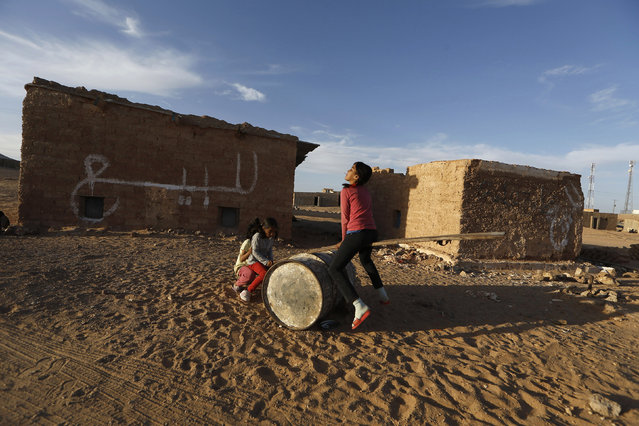
Indigenous Sahrawi girls play on an improvised see-saw at a refugee camp of Boudjdour in Tindouf, southern Algeria March 3, 2016. UN Secretary General Ban Ki-moon is scheduled to visit the Sahrawi refugees in south-west Algeria's Tindouf region. (Photo by Zohra Bensemra/Reuters)
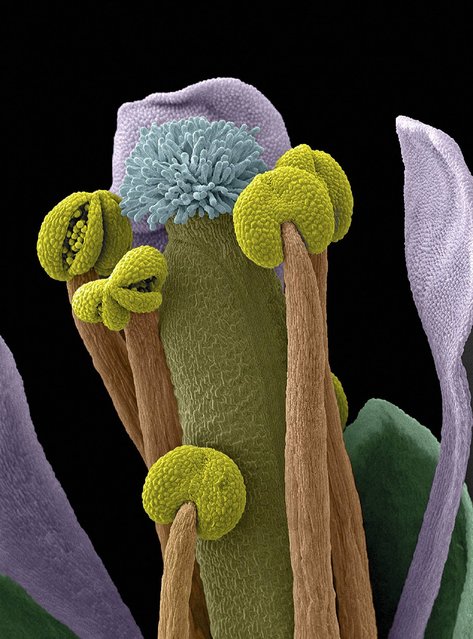
Beautiful, strange and occasionally alarming pictures from the shortlist for this year’s Wellcome image awards – which celebrate the very best in science photography and imaging – from an x-ray of a bat to a micrograph of a kidney stone. The exhibition opens on 12 March at three science centres and the Museum of Science and Industry in Manchester. Photo: Scanning electron micrograph (SEM) of an Arabidopsis thaliana flower, also commonly known as thale cress. Some of the anthers are open, revealing pollen grains ready for dispersal. Arabidopsis was the first plant to have its entire genome sequenced and is widely used as a model organism in molecular and plant biology. Horizontal width of image is 1200 microns. Magnification 100x. (Photo by Stefan Eberhard/Wellcome Images)
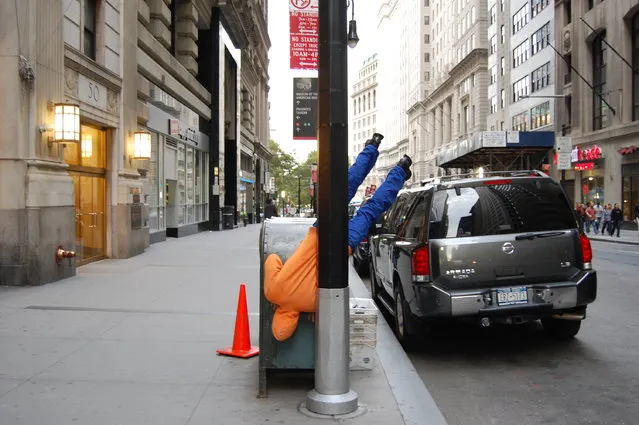
“Bodies in urban spaces” is a temporarily intervention in diversified urban architectonical environment. The intention of “bodies in urban spaces” is to point out the urban functional structure and to uncover the restricted movement possibilities and behavior as well as rules and limitations. Photo: “Bodies in Urban Spaces”, September 26, 2010. (Photos by Andrew Russeth)
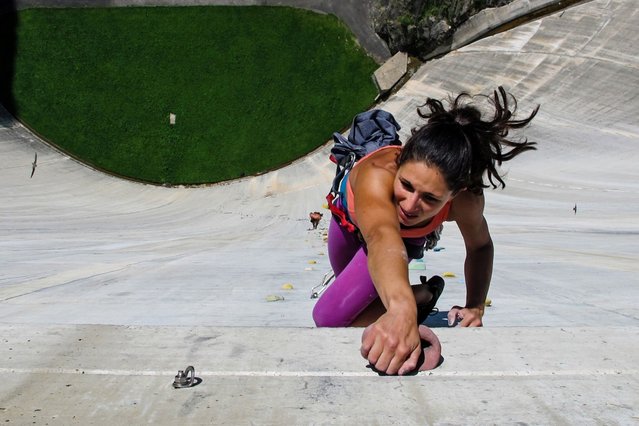
Fearless daredevils clamber up the worlds highest man-made climbing wall – running up the face of a 540ft dam. The Diga di Luzzone in Switzerland is considered by climbers as the Everest of wall climbing. (Photo by Ilana Marcus/Caters News)