Loading...
Done
A general view of Copacabana beach during the coronavirus disease (COVID-19) outbreak in Rio de Janeiro, Brazil, March 22, 2020. (Photo by Ricardo Moraes/Reuters)

A general view of Copacabana beach during the coronavirus disease (COVID-19) outbreak in Rio de Janeiro, Brazil, March 22, 2020. (Photo by Ricardo Moraes/Reuters)
Details
31 Mar 2020 00:03:00
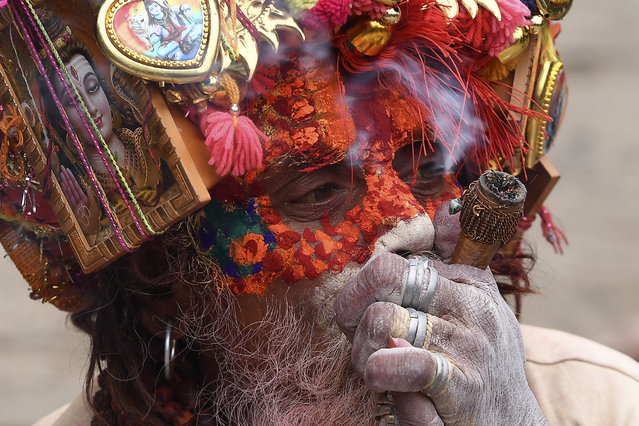
A sadhu (Hindu holy man) smokes marijuana using a “chillum”, a traditional clay pipe, as a holy offering during the Hindu festival “Maha Shivaratri” in Kathmandu on February  21, 2020. (Photo by Prakash Mathema/AFP Photo)

A sadhu (Hindu holy man) smokes marijuana using a “chillum”, a traditional clay pipe, as a holy offering during the Hindu festival “Maha Shivaratri” in Kathmandu on February 21, 2020. (Photo by Prakash Mathema/AFP Photo)
Details
08 Apr 2020 00:05:00
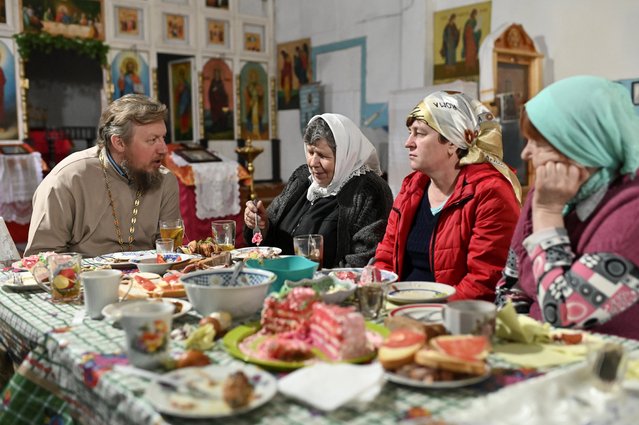
Russian Orthodox priest, Father Nikolai Gensitsky, speaks with believers while having a festive meal during the Easter celebrations in a church in the village of Yekaterininskoye in Omsk Region, Russia on April 19, 2020. (Photo by Alexey Malgavko/Reuters)

Russian Orthodox priest, Father Nikolai Gensitsky, speaks with believers while having a festive meal during the Easter celebrations in a church in the village of Yekaterininskoye in Omsk Region, Russia on April 19, 2020. (Photo by Alexey Malgavko/Reuters)
Details
02 May 2020 00:01:00
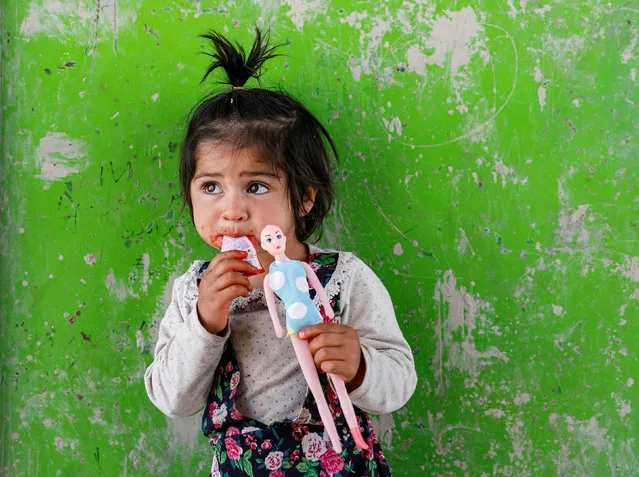
An internally displaced Afghan girl plays outside her shelter, amid the spread of the coronavirus disease (COVID-19), in Kabul, Afghanistan on May 7, 2020. (Photo by Mohammad Ismail/Reuters)

An internally displaced Afghan girl plays outside her shelter, amid the spread of the coronavirus disease (COVID-19), in Kabul, Afghanistan on May 7, 2020. (Photo by Mohammad Ismail/Reuters)
Details
11 May 2020 00:05:00
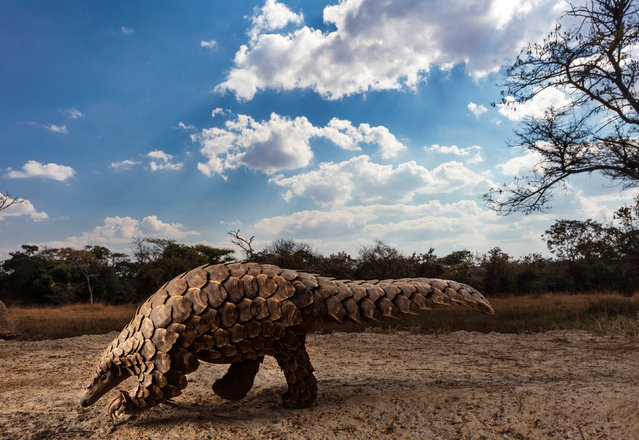
Pangolins in Crisis: Brent Stirton, South Africa; 1st place, Natural world and wildlife. “Pangolins are the world’s most illegally trafficked mammals, with an estimated one million trafficked to Asia in the last 10 years. Their scales are used in traditional Chinese and Vietnamese medicine, and their meat is sold as a high-priced delicacy. As a result, pangolins are listed as critically endangered and anyone who trades or consumes them is breaking the law. This body of work exposes the trade, while exploring aspects of illegality and celebrating the people who are trying to save these animals”. (Photo by Brent Stirton/Sony World Photography Awards 2020)

Pangolins in Crisis: Brent Stirton, South Africa; 1st place, Natural world and wildlife. “Pangolins are the world’s most illegally trafficked mammals, with an estimated one million trafficked to Asia in the last 10 years. Their scales are used in traditional Chinese and Vietnamese medicine, and their meat is sold as a high-priced delicacy. As a result, pangolins are listed as critically endangered and anyone who trades or consumes them is breaking the law. This body of work exposes the trade, while exploring aspects of illegality and celebrating the people who are trying to save these animals”. (Photo by Brent Stirton/Sony World Photography Awards 2020)
Details
11 Jun 2020 00:05:00
A man and a woman jump over a bonfire during Ivan Kupala Day celebrations held by the Belarusian State Museum of Folk Architecture and Rural Lifestyle in the village of Ozertso near Minsk, Belarus on July 4, 2020. Ivan Kupala Day, also known as Ivana-Kupala or Kupala Night, is a traditional pagan holiday celebrated in eastern Slavic cultures. Various rituals are traditionally performed on Kupala Night, including making flower wreaths, fortune-telling, jumping over bonfires, and burning a wheel-like effigy symbolizing the sun. (Photo by Natalia Fedosenko/TASS)


A man and a woman jump over a bonfire during Ivan Kupala Day celebrations held by the Belarusian State Museum of Folk Architecture and Rural Lifestyle in the village of Ozertso near Minsk, Belarus on July 4, 2020. Ivan Kupala Day, also known as Ivana-Kupala or Kupala Night, is a traditional pagan holiday celebrated in eastern Slavic cultures. Various rituals are traditionally performed on Kupala Night, including making flower wreaths, fortune-telling, jumping over bonfires, and burning a wheel-like effigy symbolizing the sun. (Photo by Natalia Fedosenko/TASS)
Details
07 Jul 2020 00:07:00
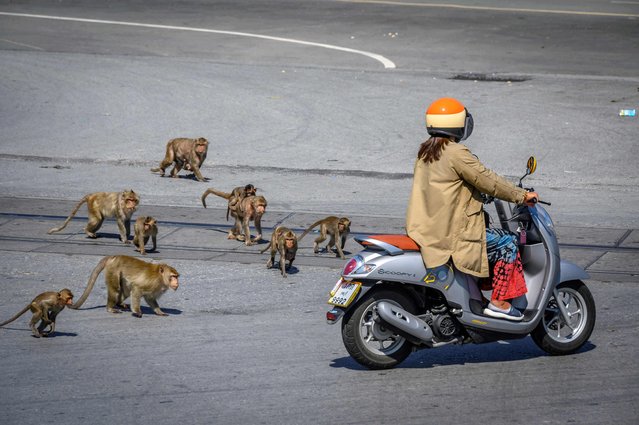
This picture taken on June 20, 2020 shows longtail macaques chasing a woman on a scooter in the town of Lopburi, some 155km north of Bangkok. Residents barricaded indoors, rival gang fights and no-go zones for humans. Welcome to Lopburi, an ancient Thai city overrun by monkeys super-charged on junk food, whose population is growing out of control. (Photo by Mladen Antonov/AFP Photo)

This picture taken on June 20, 2020 shows longtail macaques chasing a woman on a scooter in the town of Lopburi, some 155km north of Bangkok. Residents barricaded indoors, rival gang fights and no-go zones for humans. Welcome to Lopburi, an ancient Thai city overrun by monkeys super-charged on junk food, whose population is growing out of control. (Photo by Mladen Antonov/AFP Photo)
Details
12 Jul 2020 00:05:00
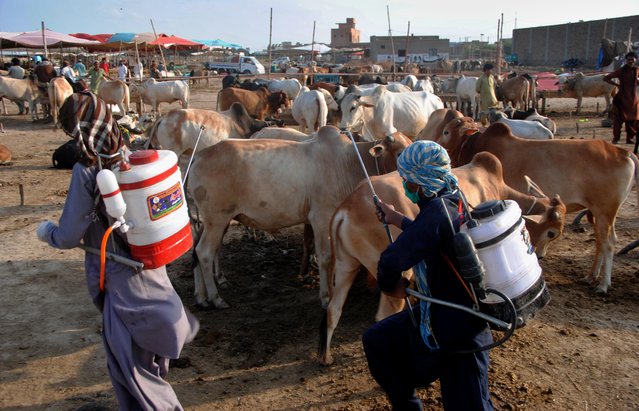
Health workers wearing face masks spray disinfectant liquid on sacrificial animals amid concerns over the spread of the SARS-CoV-2 coronavirus that causes the pandemic COVID-19 disease ahead of the Muslim festival of Eid al-Adha at an animal market in Hyderabad, southern Pakistan, 21 July 2020. Eid al-Adha, also known as the Festival of the Sacrifice, is the second and holiest of the two main Islamic holidays celebrated each year (the other one being Eid al-Fitr). Every year, on the 10th day of the Islamic lunar month of Dhu al-Hijjah, Muslims around the world ritually slaughter a sacrificial animal and split the meat into three parts: one is reserved for the family, another for friends and relatives, and the third is given to the poor and needy. The Saudi Supreme Court has declared that the first day of Eid al-Adha this year falls on 31 July. (Photo by Nadeem Khawar/EPA/EFE)

Health workers wearing face masks spray disinfectant liquid on sacrificial animals amid concerns over the spread of the SARS-CoV-2 coronavirus that causes the pandemic COVID-19 disease ahead of the Muslim festival of Eid al-Adha at an animal market in Hyderabad, southern Pakistan, 21 July 2020. (Photo by Nadeem Khawar/EPA/EFE)
Details
23 Jul 2020 00:07:00