Loading...
Done
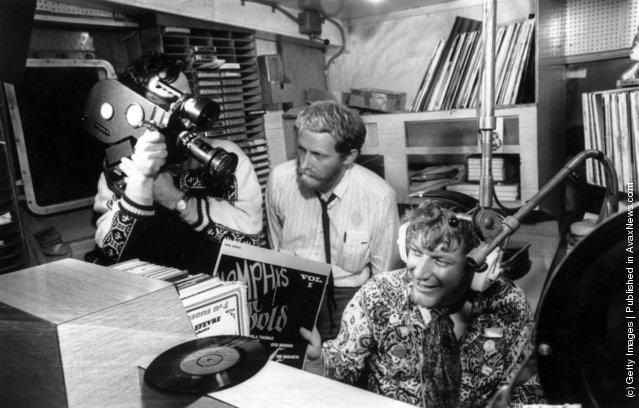
The World in Action team making a program about the pirate radio ship Caroline, filmed by Paddy Searle, and produced by Mike Hodges. The DJ being filmed is Robbie Dale, and Hodges is standing behind him

“«Pirate radio» in the UK first became widespread in the early 1960s when pop music stations such as Radio Caroline and Radio London started to broadcast on medium wave to the UK from offshore ships or disused sea forts. At the time these stations were not illegal because they were broadcasting from international waters. The stations were set up by entrepreneurs and music enthusiasts to meet the growing demand for pop and rock music, which was not catered for by the legal BBC Radio services”. – Wikipedia

Photo: The “World in Action” team making a program about the pirate radio ship Caroline, filmed by Paddy Searle, and produced by Mike Hodges. The DJ being filmed is Robbie Dale, and Hodges is standing behind him. (Photo by James Jackson/Evening Standard/Getty Images). 6th September 1967
Details
09 Sep 2011 08:54:00
NASA's New Space Launch System

“The Space Launch System, or SLS, is a Shuttle-Derived heavy launch vehicle being designed by NASA, following the cancellation of the Constellation Program, to replace the Space Shuttle after its retirement. The NASA Authorization Act of 2010 envisions the transformation of the Ares I and Ares V vehicle designs into a single launch vehicle usable for both crew and cargo. It is to be upgraded over time with more powerful versions. The proposed SLS is visually similar to the legacy Saturn V booster and in particular the proposed, two-stage, Saturn INT-20”. – Wikipedia

Photo: In this illustration provided by NASA, the design for a new space rocket system, the Space Launch System, is seen. NASA's new rocket design will reportedly cost about $35 billion and be ready to for test launch in 2017. According to NASA, the rocket will be used to carry Orion Multi-Purpose Crew Vehicle as well as cargo and science experiments to earth's orbit, as a backup for the space station and possibly destinations beyond that. (Illustration by NASA via Getty Images)
Details
15 Sep 2011 10:50:00
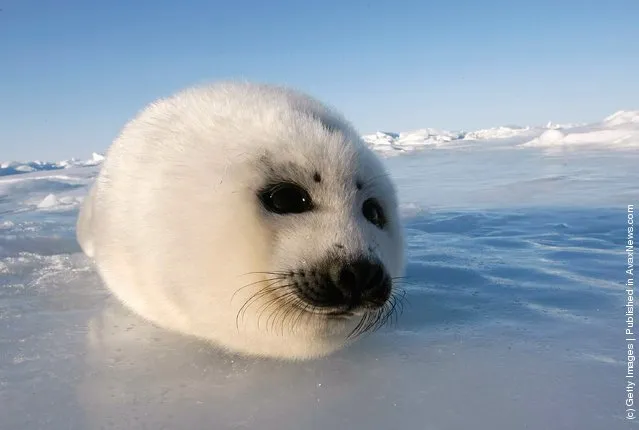
A harp seal pup

“The harp seal or saddleback seal is a species of earless seal native to the northernmost Atlantic Ocean and adjacent parts of the Arctic Ocean. Newborn pups weigh around 11 kilograms (24 lb) and are 80–85 centimetres (31–33 in) long. After birth, the mother only feeds that pup. During the 12 day nursing period, the mother does not eat, losing up to 3 kilograms (7 lb) per day. Harp seal milk contains up to 48% fat, so pups gain over 2.2 kilograms (4.9 lb) per day. During this time, the juvenile's “greycoat” grows in beneath the white neonatal coat, and it weighs 80 pounds (36 kg)”. – Wikipedia

Photo: A harp seal pup lies on an ice floe in the Gulf of Saint Lawrence March 24, 2008 in Charlottetown, Canada. (Photo by Joe Raedle/Getty Images)
Details
19 Sep 2011 15:49:00
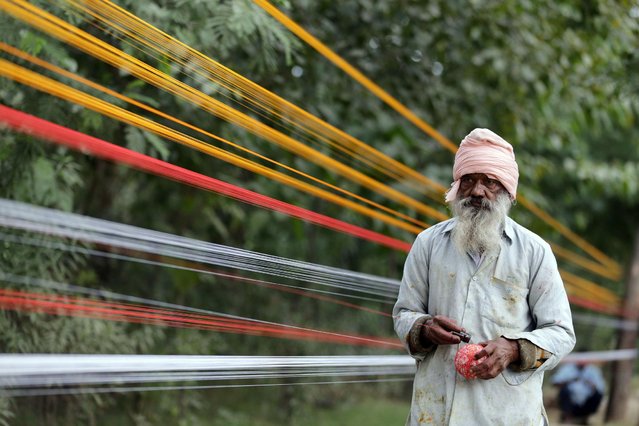
An Indian worker makes a roll of the kite thread being prepared on a roadside on the outskirts of Amritsar, India, 24 November 2020. The kite string or the “Dor”, in the local language, is made of crushed glass, glue, colors, and egg to make it strong enough to hold the kite. With the onset of the winter season, kite flying enthusiasts especially in northern Punjab, ranging from children to aged people, start flying kites as a leisure activity from their homes' rooftops and from open spaces, enjoying warmth of the winter sun at the same time. Kite flying season peaks in Amritsar on Lohri festival which marks the culmination of winter and is celebrated in the month of January every year. (Photo by Raminder Pal Singh/EPA/EFE)

An Indian worker makes a roll of the kite thread being prepared on a roadside on the outskirts of Amritsar, India, 24 November 2020. The kite string or the “Dor”, in the local language, is made of crushed glass, glue, colors, and egg to make it strong enough to hold the kite. (Photo by Raminder Pal Singh/EPA/EFE)
Details
07 Dec 2020 00:01:00
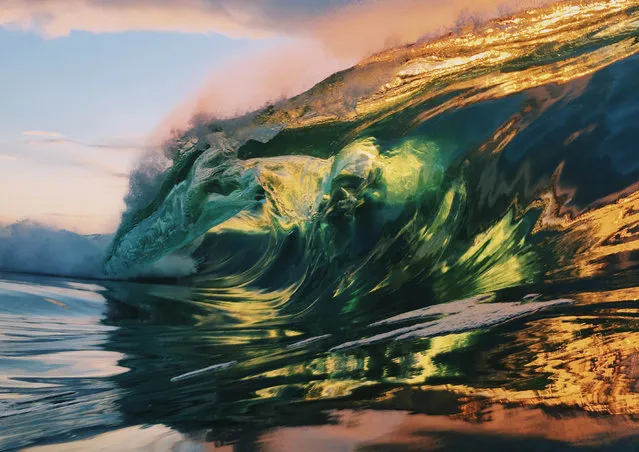
“Whether that means getting up way before the sun, like I do most days, going out somewhere that I’m not comfortable or just trying to get different angles or styles of photos, I am trying to display the crazy beauty of the ocean, and usually moments that literally last less than a split second”. (Photo by Ryan Pernoski/Caters News Agency)

These kaleidoscopic images are the work of one persistent photographer’s efforts to capture vibrant hues at the exact moment a wave breaks. Ryan Pernofski‘s stunning shots feature brilliant yellows, reds, blues and purples as an array of sunlight hits the water at the perfect time. What’s even more impressive: Ryan, a 27-year-old Australian, began shooting his popular masterpieces without using a professional camera, taking his iPhone out into the water instead. Ryan began experimenting with this method in 2012, using an underwater housing to protect his phone, as he could not afford a professional camera. (Photo by Ryan Pernoski/Caters News Agency)
Details
09 Jun 2018 00:05:00
Medical staff in Belgrade, Serbia on February 5, 2021. Vaccination of employees in the city's social protection institutions has begun at the Belgrade Fair, who have expressed interest in receiving the Russian Sputnik V vaccine, and according to the city secretary for social protection Natasa Stanisavljevic, about 150 employees in those institutions will receive the vaccine today and tomorrow. (Photo by Zoran Zestic/Tanjug)

Medical staff in Belgrade, Serbia on February 5, 2021. Vaccination of employees in the city's social protection institutions has begun at the Belgrade Fair, who have expressed interest in receiving the Russian Sputnik V vaccine, and according to the city secretary for social protection Natasa Stanisavljevic, about 150 employees in those institutions will receive the vaccine today and tomorrow. (Photo by Zoran Zestic/Tanjug)
Details
07 Feb 2021 07:44:00
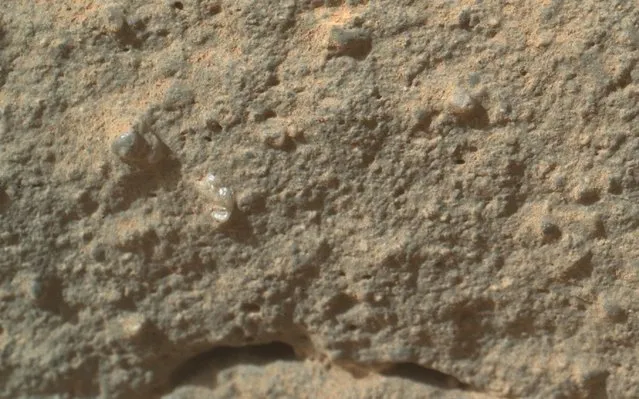
Scientists say that a “Martian flower”, seen here in an image from the Curiosity rover's Mars Hand Lens Imager, is a 2-millimeter-wide grain or pebble that's embedded in the surrounding rock. Another, darker-colored mineral grain can be seen above and to the left. (Photo by NASA)

“The scientists behind NASA's $2.5 billion Curiosity rover mission on Mars on Tuesday explained the nature of a tiny, gleaming "flower" embedded in Red Planet rock, and revealed where they'll be using the SUV-sized robot's drill for the first time”. – Alan Boyle via NBCNews.com

Photo: Scientists say that a “Martian flower”, seen here in an image from the Curiosity rover's Mars Hand Lens Imager, is a 2-millimeter-wide grain or pebble that's embedded in the surrounding rock. Another, darker-colored mineral grain can be seen above and to the left. (Photo by NASA)
Details
16 Jan 2013 11:12:00
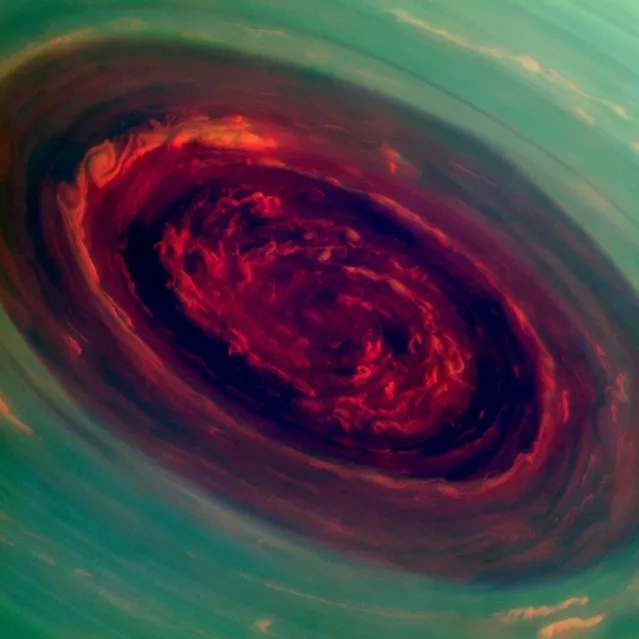
The spinning vortex of Saturn's north polar storm resembles a deep red rose of giant proportions surrounded by green foliage in this false-color image from NASA's Cassini spacecraft. (Photo by NASA/JPL-Caltech/SSI)

NASA's Cassini spacecraft has provided scientists the first close-up, visible-light views of a behemoth hurricane swirling around Saturn's north pole. In high-resolution pictures and video, scientists see the hurricane's eye is about 1,250 miles (2,000 kilometers) wide, 20 times larger than the average hurricane eye on Earth. Thin, bright clouds at the outer edge of the hurricane are traveling 330 mph(150 meters per second). The hurricane swirls inside a large, mysterious, six-sided weather pattern known as the hexagon. Photo: The spinning vortex of Saturn's north polar storm resembles a deep red rose of giant proportions surrounded by green foliage in this false-color image from NASA's Cassini spacecraft. (Photo by NASA/JPL-Caltech/SSI)
Details
31 May 2015 09:11:00