Loading...
Done
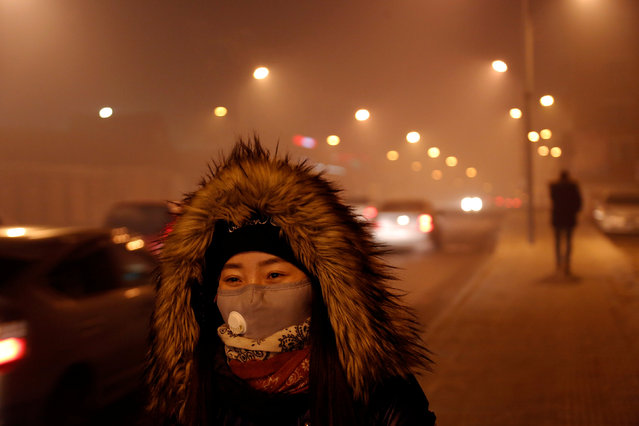
A woman wears a face mask in the part of the city near neighbourhoods known for burning coal for heating in Ulaanbaatar, Mongolia January 26, 2017. Not many people in Ulaanbaatar wear masks to protect themselves against pollution. (Photo by B. Rentsendorj/Reuters)

A woman wears a face mask in the part of the city near neighbourhoods known for burning coal for heating in Ulaanbaatar, Mongolia January 26, 2017. Not many people in Ulaanbaatar wear masks to protect themselves against pollution. (Photo by B. Rentsendorj/Reuters)
Details
09 Feb 2017 00:00:00
A hand of a labourer pushes bricks at a traditional brick factory in Arab Mesad district of Helwan, northeast of Cairo, May 14, 2015. (Photo by Amr Abdallah Dalsh/Reuters)

A hand of a labourer pushes bricks at a traditional brick factory in Arab Mesad district of Helwan, northeast of Cairo, May 14, 2015. About 45 labourers are employed at the brick factory and most work 10 hours a day. Adult workers earn a daily wage of 70 Egyptian pounds ($9) and child workers earn 40 Egyptian pounds ($5). The labourers, who are usually temporary or seasonally employed in Egypt's brick-making industry, experience unsafe work conditions, according to local media. (Photo by Amr Abdallah Dalsh/Reuters)
Details
19 May 2015 11:37:00
Military policemen try to open a path ahead for the funeral of 21-year-old Mohamed Adel, one of the army officers who died in yesterday's Sinai attacks, in Al-Kaliobeya, near Cairo, Egypt, July 2, 2015. (Photo by Mohamed Abd El Ghany/Reuters)

Military policemen try to open a path ahead for the funeral of 21-year-old Mohamed Adel, one of the army officers who died in yesterday's Sinai attacks, in Al-Kaliobeya, near Cairo, Egypt, July 2, 2015. Egypt launched air strikes on Islamist militant targets in the Sinai peninsula on Thursday, killing 23 fighters a day after the deadliest clashes in the region in years, security sources said. The sources said those killed had taken part in Wednesday's fighting in which 100 militants and 17 soldiers, including four officers, were killed, according to the army spokesman. (Photo by Mohamed Abd El Ghany/Reuters)
Details
03 Jul 2015 13:19:00
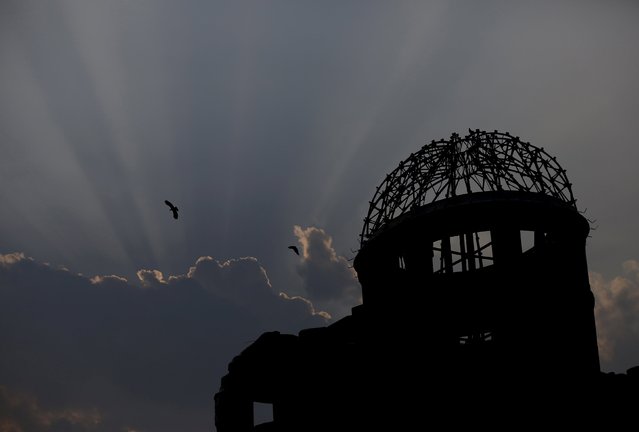
Birds fly over the Atomic Bomb Dome in Hiroshima, western Japan July 29, 2015. On August 6, 1945, the U.S. dropped the atomic bomb on Hiroshima, killing about 140,000 by the end of the year in a city of 350,000 residents, in the world's first nuclear attack. (Photo by Issei Kato/Reuters)

Birds fly over the Atomic Bomb Dome in Hiroshima, western Japan July 29, 2015. On August 6, 1945, the U.S. dropped the atomic bomb on Hiroshima, killing about 140,000 by the end of the year in a city of 350,000 residents, in the world's first nuclear attack. Three days later, a second atomic bomb was dropped on Nagasaki. Influenced by the shadows scorched into outdoor surfaces by the heat of the blasts 70 years ago, Reuters photographer Issei Kato pays homage to survivors, residents and historic buildings in both cities in a personal project that captures the shadows of today. (Photo by Issei Kato/Reuters)
Details
04 Aug 2015 12:01:00
Supporters celebrate as they watch official results from the Union Election Commission on an LED screen in front of the National League for Democracy Party (NLD) head office in Yangon, November 9, 2015. (Photo by Soe Zeya Tun/Reuters)

Supporters celebrate as they watch official results from the Union Election Commission on an LED screen in front of the National League for Democracy Party (NLD) head office in Yangon, November 9, 2015. Myanmar's ruling party conceded defeat in the country's general election on Monday, as the opposition led by democracy figurehead Aung San Suu Kyi appeared on course for a landslide victory that would ensure it can form the next government. "We lost," Union Solidarity and Development Party (USDP) acting chairman Htay Oo told Reuters in an interview a day after the Southeast Asian country's first free nationwide election in a quarter of a century. (Photo by Soe Zeya Tun/Reuters)
Details
11 Nov 2015 08:01:00
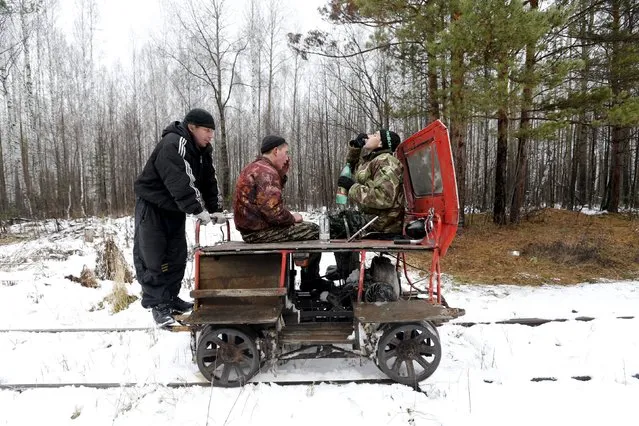
(L-R) A man nicknamed "Barcelona", Alexey Bolotov and Alexey Jakushin drink vodka as they travel by a pioneer motorised railcar on their way to Kalach, Sverdlovsk region, Russia October 18, 2015. The "pioneer," a light auxiliary rail vehicle, is a popular form of transport among people who live along the Alapayevsk railway. (Photo by Maxim Zmeyev/Reuters)

(L-R) A man nicknamed "Barcelona", Alexey Bolotov and Alexey Jakushin drink vodka as they travel by a pioneer motorised railcar on their way to Kalach, Sverdlovsk region, Russia October 18, 2015. The "pioneer," a light auxiliary rail vehicle, is a popular form of transport among people who live along the Alapayevsk railway. In a remote corner of the Urals region at the end of a narrow-gauge railway is Kalach, population about a dozen. Three decades ago 600 people called the village home, but the local forestry industry suffered as the former Soviet Union imploded and people moved away in search of work. In Kalach today there are no telephones, no mobile reception and only a few hours of electricity a day. (Photo by Maxim Zmeyev/Reuters)
Details
15 Nov 2015 08:06:00
Crowds look on as Xolo the Giant Dog, one of the giant Royal De Luxe street puppets taking part in Liverpool's World War I centenary commemorations, walks through the streets of Liverpool on July 25, 2014 in Liverpool, England. (Photo by Christopher Furlong/Getty Images)

Crowds look on as Xolo the Giant Dog, one of the giant Royal De Luxe street puppets taking part in Liverpool's World War I centenary commemorations, walks through the streets of Liverpool on July 25, 2014 in Liverpool, England. French street theatre company Royal de Luxe are putting on a show throughout the city as part of Liverpool's World War I centenary commemorations from July 23-27. The giant puppet grandmother has slept in the hall for two days as part of “Memories of August 1914”. As the giants tour the city the Little Girl Giant and her dog Xolo will meet up with the giant Grandmother telling the story of life leading up to World War One. (Photo by Christopher Furlong/Getty Images)
Details
27 Jul 2014 10:52:00
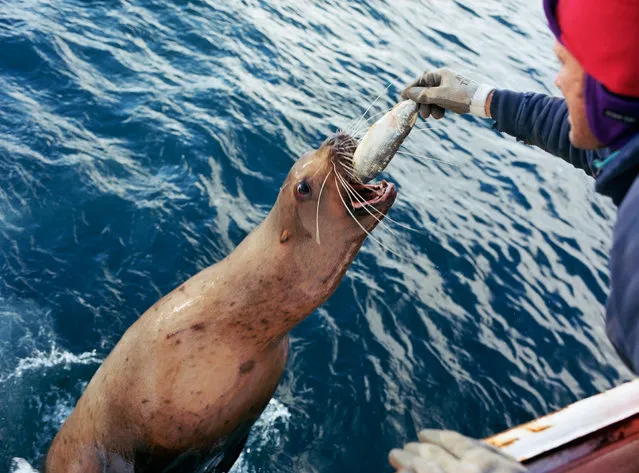
Before heading up to Alaska, the ship loads up with 3 months worth of food. Even so, it's hardly necessary. The ship's cook is constantly steaming fresh crab legs and seafood caught during the day. The hard labour of fishing requires a diet heavy in fat, protein, and omega-3s. Here, a sea lion gets a bite of the grub. (Photo by Corey Arnold)

In 2002 photographer Corey Arnold left behind a poor economy in San Francisco and headed up to Alaska to try his luck at his longtime passion of fishing. Arnold, who had worked summers during college on a salmon boat in Alaska, signed onto the f/v Rollo, a crabbing boat that fishes in the dangerous Bering Sea. While working long, strenuous hours on the Rollo, Arnold often stole away with the captain’s permission to grab his camera and photograph the crew and the ship. Arnold eventually put together “Fish Work: Bering Sea”, a documentation of his seven adventurous and dicey crab seasons aboard the Rollo. (Photo by Corey Arnold)
Details
20 Aug 2014 10:05:00