Loading...
Done
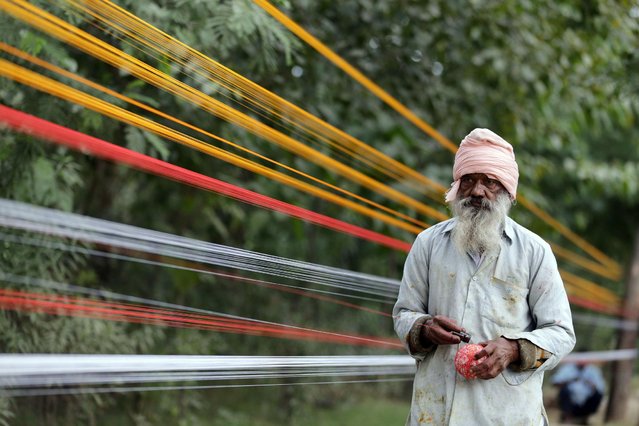
An Indian worker makes a roll of the kite thread being prepared on a roadside on the outskirts of Amritsar, India, 24 November 2020. The kite string or the “Dor”, in the local language, is made of crushed glass, glue, colors, and egg to make it strong enough to hold the kite. With the onset of the winter season, kite flying enthusiasts especially in northern Punjab, ranging from children to aged people, start flying kites as a leisure activity from their homes' rooftops and from open spaces, enjoying warmth of the winter sun at the same time. Kite flying season peaks in Amritsar on Lohri festival which marks the culmination of winter and is celebrated in the month of January every year. (Photo by Raminder Pal Singh/EPA/EFE)

An Indian worker makes a roll of the kite thread being prepared on a roadside on the outskirts of Amritsar, India, 24 November 2020. The kite string or the “Dor”, in the local language, is made of crushed glass, glue, colors, and egg to make it strong enough to hold the kite. (Photo by Raminder Pal Singh/EPA/EFE)
Details
07 Dec 2020 00:01:00
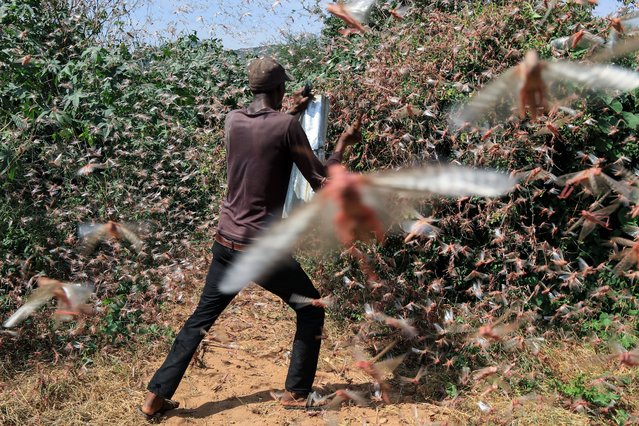
A man uses iron sheet to make noises, as a way of trying to disperse desert locusts that had invaded their farms during the second wave invasion in Kakongo village, in Nuu-Mwingi East, in Kitui, Kenya, 06 February 2021. The second wave invasion of the desert locusts in the country comes at a time where most famers are expecting to harvest their farm produce in the country. According to the United Nations Food and Agriculture Organization (FAO), on 04 February, warned numerous immature desert locust swarms persist in southern Ethiopia and Kenya. Some of the swarms are in community areas and therefore cannot be treated. In Kenya, immature swarms continue to spread westwards across northern and central counties where there are currently about 20 small swarms present, mostly about 50 hectares in size, it said. (Photo by Daniel Irungu/EPA/EFE)

A man uses iron sheet to make noises, as a way of trying to disperse desert locusts that had invaded their farms during the second wave invasion in Kakongo village, in Nuu-Mwingi East, in Kitui, Kenya, 06 February 2021. The second wave invasion of the desert locusts in the country comes at a time where most famers are expecting to harvest their farm produce in the country. (Photo by Daniel Irungu/EPA/EFE)
Details
25 Feb 2021 08:17:00
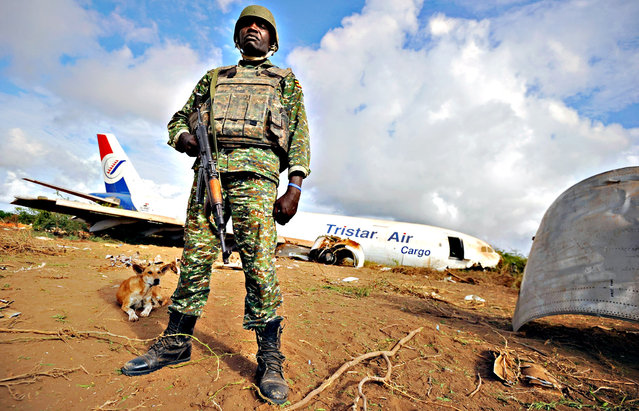
A soldier from the African Union (AU) peacekeeping force stands guard at the site where a cargo plane carrying supplies for AU troops crash-landed outside Somalia's capital, on October 13, 2015 at Abirska, some 18 kilometres outside Somalian capital, Mogadishu. The officials said the Egyptian-owned transport plane went down after making several unsuccessful passes over the seafront airport. (Photo by Mohamed Abdiwahab/AFP Photo)

A soldier from the African Union (AU) peacekeeping force stands guard at the site where a cargo plane carrying supplies for AU troops crash-landed outside Somalia's capital, on October 13, 2015 at Abirska, some 18 kilometres outside Somalian capital, Mogadishu. The officials said the Egyptian-owned transport plane went down after making several unsuccessful passes over the seafront airport. Two of the six crew members suffered light injuries in the crash, the officials said, but added that the plane and those on board were safe having landed in an area controlled by the Somali government and the African Union's AMISOM force. (Photo by Mohamed Abdiwahab/AFP Photo)
Details
16 Oct 2015 08:02:00
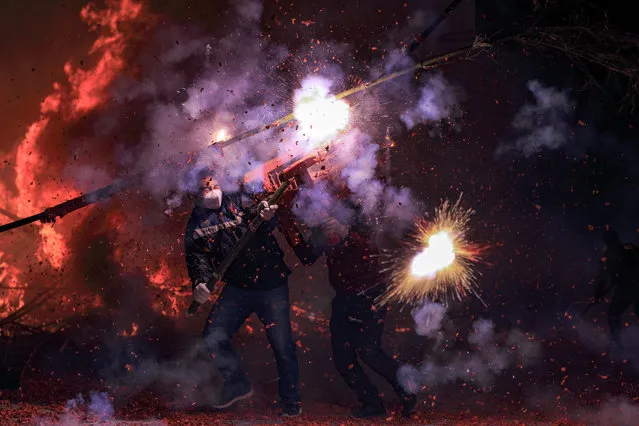
Villagers from Jiexi Jiantan village perform a ritual of “Zha Laoye”, or “Cracking local spirits”, in Chaoshan, Guangdong Province, China, 10 February 2019. Jiexi Jiantan Village celebrates the annual custom of “Zha Laoye” where Laoye are local spirits. Every third day of the lunar New Year, statues of local spirits known as the “Thousand-mile Eye” Laoye and “Ear Following the Wind” Laoye are brought out to the village committee to receive incensed tea offered by believers. By the sixth day of the year, the “Zha Laoye” activities begin with each man holding one of the statues on a chair above his head while run around a bonfire. Two other men light firecrackers strung up on a long bamboo poles and chase the spirit around the bonfire, signifying a bountiful new year. (Photo by EPA/EFE/ZNSEN)

Villagers from Jiexi Jiantan village perform a ritual of “Zha Laoye”, or “Cracking local spirits”, in Chaoshan, Guangdong Province, China, 10 February 2019. Jiexi Jiantan Village celebrates the annual custom of “Zha Laoye” where Laoye are local spirits. Every third day of the lunar New Year, statues of local spirits known as the “Thousand-mile Eye” Laoye and “Ear Following the Wind” Laoye are brought out to the village committee to receive incensed tea offered by believers. (Photo by EPA/EFE/ZNSEN)
Details
23 Feb 2019 00:07:00
Aerial view of the “Viracocha III”, a boat made only from the totora reed, as it is being prepared to cross the Pacific from Chile to Australia on an expected six-month journey, La Paz, Bolivia, October 19, 2016. An expedition in a boat made only of reeds crafted by indigenous Bolivians is getting ready to cross the Pacific from South America to Australia, in a fresh attempt to prove that ancient mariners were capable of making the journey. Phil Buck, a 51-year-old explorer from the United States, already has led two similar expeditions and will captain the “Viracocha III” set to depart from northern Chile in February on an expected six-month journey. (Photo by David Mercado/Reuters)

Aerial view of the “Viracocha III”, a boat made only from the totora reed, as it is being prepared to cross the Pacific from Chile to Australia on an expected six-month journey, La Paz, Bolivia, October 19, 2016. An expedition in a boat made only of reeds crafted by indigenous Bolivians is getting ready to cross the Pacific from South America to Australia, in a fresh attempt to prove that ancient mariners were capable of making the journey. (Photo by David Mercado/Reuters)
Details
20 Oct 2016 10:53:00


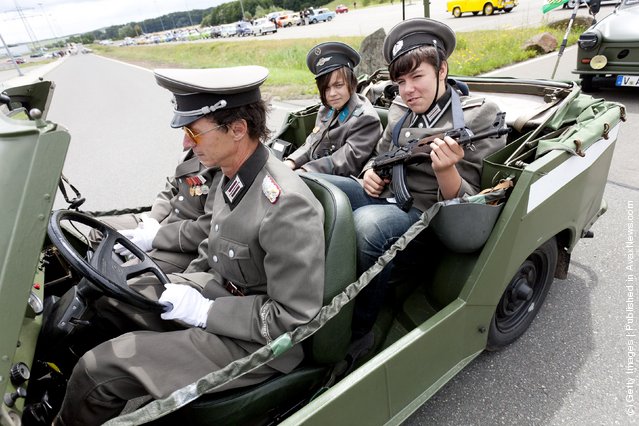
“The Trabant is a car that was produced by former East German auto maker VEB Sachsenring Automobilwerke Zwickau in Zwickau, Sachsen. It was the most common vehicle in East Germany, and was also exported to countries both inside and outside the communist bloc. The main selling points was that it had room for four adults and luggage in a compact, light and durable shell and that it was fast (when introduced) and durable. With its mediocre performance, smoky two-stroke engine, and production shortages, the Trabant is often cited as an example of the disadvantages of centralized planning; on the other hand, it is regarded with derisive affection as a symbol of the failed former East Germany and of the fall of communism (in former West Germany, as many East Germans streamed into West Berlin and West Germany in their Trabants after the opening of the Berlin Wall in 1989). It was in production without any significant changes for nearly 30 years with 3,096,099 Trabants produced in total”. – Wikipedia

Photo: Enthusiasts weared in uniforms of the former eastern german army trive in a military Trabant car as fans and owners of East German-era Trabant cars gather at the 2011 International Trabantfahrer Treffen (International Trabant Drivers Meeting) on June 26, 2011 in Zwickau, Germany. The Trabant, also known as the Trabi, was among the main cars produced in communist East Germany and built by VEB Sachsenring Automobilwerke in Zwickau for 30 years until 1989. Today the car has cult status for many followers and one company, IndiKar, is even seeking to revive the brand in a modern, electric version. (Photo by Carsten Koall/Getty Images)
Details
27 Jun 2011 12:21:00
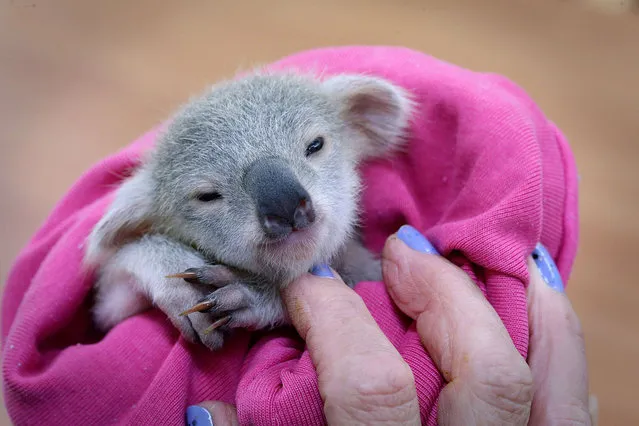
An adorable baby koala is seen enjoying a snooze after a traumatic start to life. The baby koala, nicknamed “Blondie Bumstead”, is being cared for by a volunteer from the Ipswich Koala protection society in Queensland after her mother was killed by a dog. (Photo by Jamie Hanson/Newspix/REX Features)

An adorable baby koala is seen enjoying a snooze after a traumatic start to life. The baby koala, nicknamed “Blondie Bumstead”, is being cared for by a volunteer from the Ipswich Koala protection society in Queensland after her mother was killed by a dog. Blondie, who was named for her light fur, was given just a 50-50 chance of pulling through after the attack. But after a course of antibiotics and some tender loving car from volunteer Marilyn Spletter she has now been given a clean bill of health. According to Marilyn she has hand-reared around 40 baby koalas but says that Blondie, who will be released back into the wild after 15 months, is one of her favourites. She said: “She's got a little character all of her own and she knows what she wants and what she doesn't. When she's stressed I kiss her on the nose or I rub my nose on hers and it relaxes her”. (Photo by Jamie Hanson/Newspix/REX Features)
Details
07 Aug 2014 10:26:00


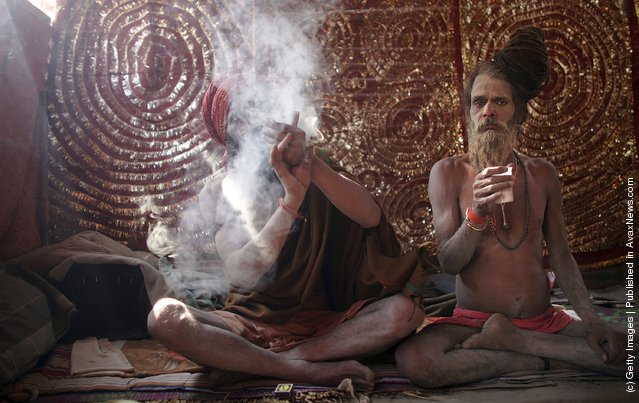
“Kumbh Mela is a mass Hindu pilgrimage in which Hindus gather at the Ganges river. The normal Kumbh Mela is celebrated every 3 years, the Ardh (half) Kumbh Mela is celebrated every six years at Haridwar and Prayag, the Purna (complete) Kumbh takes place every twelve years, at four places (Prayag (Allahabad), Haridwar, Ujjain, and Nashik). The Maha (great) Kumbh Mela which comes after 12 “Purna Kumbh Melas”, or 144 years, is held at Allahabad.

The last Ardh Kumbh Mela was held over a period of 45 days beginning in January 2007, more than 70 million Hindu pilgrims took part in the Ardh Kumbh Mela at Prayag, and on January 15, the most auspicious day of the festival of Makar Sankranti, more than 5 million participated. The previous Maha Kumbh Mela, held in 2001, was attended by around 60 million people, making it at the time the largest gathering anywhere in the world in recorded history”. – Wikipedia

Photo: Sadhus (holy men) smoke at their camp near the ritual site at Sangam, the confluence of the Ganges, Yamuna and mythical Saraswati rivers during the Ardh Kumbh Mela festival (Half Pitcher festival) January 18, 2007 in Allahabad, India. Millions of Hindu pilgrims have flocked to the largest religious gathering in the world which lasts for 45 days in northern India. The festival commemorates the mythical conflict between gods and demons over a pitcher filled with the “nectar of immortality”. Devotees believe that taking a holy dip in the Ganges at this time washes away their sins and paves the path to salvation. (Photo by Mario Tama/Getty Images)

Details
30 Jun 2011 10:27:00