Loading...
Done
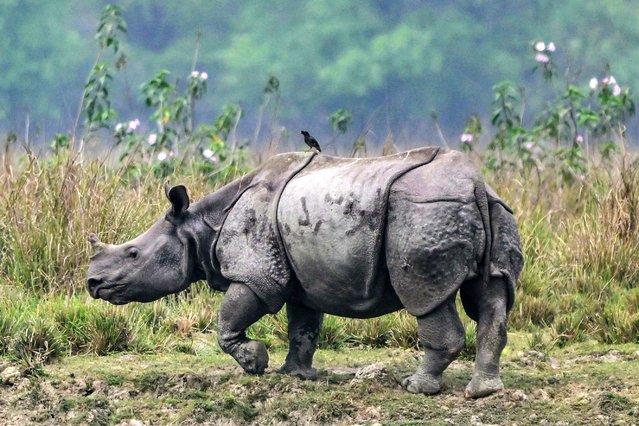
An Indian one-horned rhinoceros grazes on a dry wetland at the Pobitora Wildlife Sanctuary on the southern bank of the Brahmaputra River in Morigaon district of India's Assam state on April 4, 2025. (Photo by Biju Boro/AFP Photo)

An Indian one-horned rhinoceros grazes on a dry wetland at the Pobitora Wildlife Sanctuary on the southern bank of the Brahmaputra River in Morigaon district of India's Assam state on April 4, 2025. (Photo by Biju Boro/AFP Photo)
Details
20 Apr 2025 02:59:00
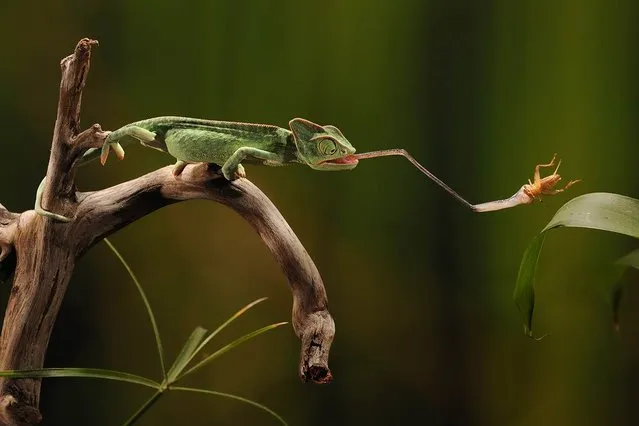
A veiled chameleon extends its tongue to catch a cricket

“Scott Linstead is an internationally published, freelance wildlife photographer/writer. His clients include Natural History Magazine, Hewlett Packard, Ranger Rick Magazine and a number of wildlife publications in North America and Europe. Scott's column on the techniques of bird photography appears in every issue of Outdoor Photography Canada”.

Photo: A veiled chameleon extends its tongue to catch a cricket. Canadian wildlife photographer Scott Linstead, formerly an aerospace engineer and high school teacher, uses a device called Phototrap “to not only photograph the elusive, but also the unimaginably quick”. (Photo by Scott Linstead)
Details
22 May 2012 11:32:00
Young monks laugh at their own photos taken by a German photojournalist in the main courtyard of the Dzong

Young monks laugh at their own photos taken by a German photojournalist in the main courtyard of the Dzong on October 13, 2011 in Punakha, Bhutan. King Jigme Khesar Namgyel Wangchuck, 31 and Queen of Bhutan Ashi Jetsun Pema Wangchuck, 21 wed in Bhutan's historic 17th century Punakha Dzong the same venue that hosted the King's historical coronation ceremony in 2008. (Photo by Triston Yeo/Getty Images)
Details
18 Oct 2011 08:19:00


A four-year-old bulldog named Goldie wearing spectacles and a nightcap. (Photo by Fox Photos/Getty Images). 9th January 1960
Details
28 Mar 2011 09:49:00
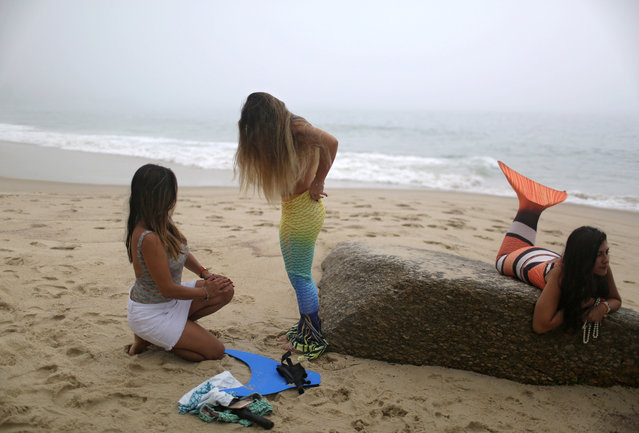
Girls prepare to take part in a mermaid lesson in Rio de Janeiro, Brazil May 28, 2017. (Photo by Pilar Olivares/Reuters)

Girls prepare to take part in a mermaid lesson in Rio de Janeiro, Brazil May 28, 2017. Women in Brazil are not unique in their affinity for mermaiding. Classes are held as far away as Texas and some folks wonder if mermaiding will be the next fitness craze. (Photo by Pilar Olivares/Reuters)
Details
14 Aug 2017 07:11:00
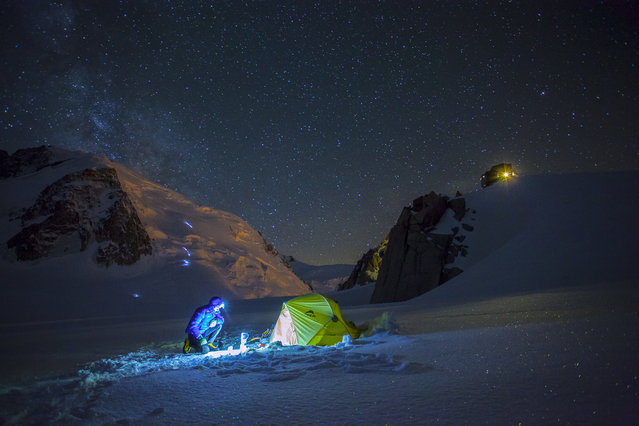
“A snapshot from mountaineer's life”. Have you ever wondered how does a mountaineer's day start? (Photo and caption by Kamil Tamiola/National Geographic Traveler Photo Contest)

“A snapshot from mountaineer's life”. Have you ever wondered how does a mountaineer's day start? I will give you a hint: you wake up at 3 am, set the stove, wake up your partner, pretend it is warm, quickly consume a high-calorie breakfast, watch your friends slowly ascending the icy slopes of your dream summit with their tiny head torches glimmering against perfectly blue ice, and hope for the good weather. One would ask: why all this trouble? The answer is easy: for the love of the adventure and the unknown. Location: Chamonix, Haute Savoye, France. (Photo and caption by Kamil Tamiola/National Geographic Traveler Photo Contest)

ATTENTION! All pictures are presented in high resolution. To see Hi-Res images – just TWICE click on any picture. In other words, click small picture – opens the BIG picture. Click BIG picture – opens VERY BIG picture.

Details
27 Jun 2013 12:47:00
White Rainbow Or Fog Bow

A fog bow is a similar phenomenon to a rainbow; however, as its name suggests, it appears as a bow in fog rather than rain. Because of the very small size of water droplets that cause fog—smaller than 0.05 millimeters (0.0020 in)—the fog bow has only very weak colors, with a red outer edge and bluish inner edge.
Details
05 Oct 2013 11:09:00
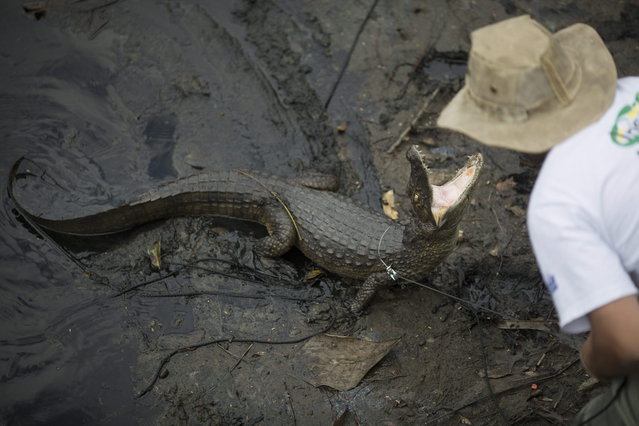
In this October 14, 2013 photo, ecology professor Ricardo Freitas catches a broad-snouted caiman to examine, then release back into the water channel in the affluent Recreio dos Bandeirantes suburb of Rio de Janeiro, Brazil. (Photo by Felipe Dana/AP Photo)

In this October 14, 2013 photo, ecology professor Ricardo Freitas catches a broad-snouted caiman to examine, then release back into the water channel in the affluent Recreio dos Bandeirantes suburb of Rio de Janeiro, Brazil. Caimans are like tanks, a very old species with a remarkable capacity for renovation that allows them to survive under extreme conditions where others couldn't, said Freitas, who runs the Instituto Jacare, or the Caiman Institute, which aims to protect the reptiles. (Photo by Felipe Dana/AP Photo)
Details
18 Oct 2013 09:05:00