Loading...
Done
Wonderland By Kirsty Mitchell Part 2

Kirsty Mitchell is a former fashion designer who worked under both Alexander McQueen and Hussein Chalayan as a student. However, she found her ultimate calling in photography. Her imaginative series 'Wonderland' takes you to alternate worlds where umbrellas drip with lavenders, backs sprout wings and limbs get lost in tree branches
Details
09 Nov 2013 10:49:00
Participants dressed as Santa Claus take part in the Great Edinburgh Santa Run on December 11, 2011 in Edinburgh, Scotland

Participants dressed as Santa Claus take part in the Great Edinburgh Santa Run on December 11, 2011 in Edinburgh, Scotland. Around a thousand people took part in the annual fundraising event, with all money raised being donated to the charity “When You Wish Upon a Star”. (Photo by Jeff J. Mitchell/Getty Images)
Details
12 Dec 2011 12:11:00
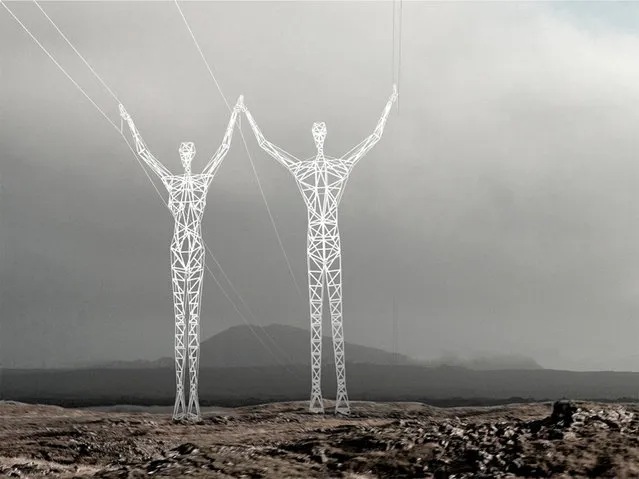
The Land Of Giants By Choi + Shine Architects

Power to the people! Giant transmission tower people that is… We can all agree that transmission towers (that’s an electricity pylon or ironman for you European and Aussie folk) are very necessary yet completely unsightly. These suspension towers dot our landscapes, typically soaring 15-55 meters (49 – 180 ft) high.
Details
07 Jun 2015 09:27:00
Protesters drag a female police officer accused of shooting a protester in the Buterere neighbourhood of Bujumbura, Burundi, May 12, 2015. (Photo by Goran Tomasevic/Reuters)

From house breaking in Johannesburg to hippos on the loose in Tbilisi to rioters attacking a policewoman in Burundi, Reuters photographers tell the story behind some of the most iconic pictures of the year. Here: Protesters drag a female police officer accused of shooting a protester in the Buterere neighbourhood of Bujumbura, Burundi, May 12, 2015. Goran Tomasevic: Protesters started throwing stones at a group of police, who then started to run away. The policewoman in the photo, Medikintos Inabeza, 33, got left behind and then some protesters started to push her, saying that she had shot a female protestor in the stomach with an AK47 rifle. I didn't see anything of that. There were 5 or 10 protesters pushing the policewoman at first, then others came and joined in. Up to 20 or 30 protesters were surrounding her at one point. The protesters kicked and beat her very badly; I also saw a couple of knives. I thought they were going to kill her... (Photo by Goran Tomasevic/Reuters)

Details
11 Dec 2015 08:06:00
“Warming up”. This photo I capture in the early afternoon, the animal species of lemurs fly. Photo location: Sambas, West Kalimantan, Indonesia. (Photo and caption by Hendy Mp/National Geographic Photo Contest)

“Warming up”. This photo I capture in the early afternoon, the animal species of lemurs fly. Photo location: Sambas, West Kalimantan, Indonesia. (Photo and caption by Hendy Mp/National Geographic Photo Contest)
Details
03 Oct 2014 11:52:00
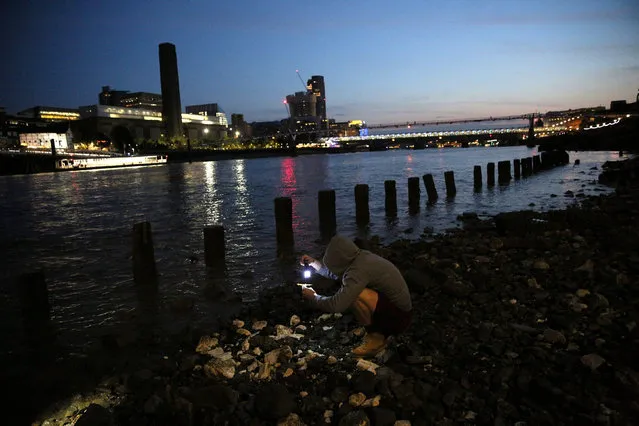
A mudlark uses a torch to look for items on the bank of the River Thames in London, Britain June 06, 2016. Mudlarking is believed to trace its origins to the 18th and 19th century, when scavengers searched the Thames' shores for items to sell. These days, history and archaeology fans are the ones hoping to find old relics such as coins, ceramics, artifacts or everyday items from across centuries. They wait for the low tide and then scour specific areas of exposed shores. "If you're in a field you could be out all day long, with the river you're restricted to about two or three hours," mudlark Nick Stevens said. While many just use the naked eye for their searches, others rely on metal detectors for which a permit from the Port of London Authority is needed. Digging also requires consent. (Photo by Neil Hall/Reuters)

A mudlark uses a torch to look for items on the bank of the River Thames in London, Britain June 06, 2016. Mudlarking is believed to trace its origins to the 18th and 19th century, when scavengers searched the Thames' shores for items to sell. These days, history and archaeology fans are the ones hoping to find old relics such as coins, ceramics, artifacts or everyday items from across centuries. their finds with the Portable Antiquities Scheme. Any item over 300 years old must be recorded. (Photo by Neil Hall/Reuters)
Details
27 Aug 2016 10:43:00
A team of Irish dancers celebrate after winning the under 12's group kaylee World Irish Dance Championship on April 2, 2016 in Brighton, England. The 8th World and 11th European Irish Dance Championships sees over 1500 dancers from 26 countries, speaking over 20 languages, competing in a variety of contests at the Brighton Centre on the city's beachfront. The event is organised by the World Irish Dance Association and is billed as the “Irish Dance Spectacular”. (Photo by Chris Ratcliffe/Getty Images)

A team of Irish dancers celebrate after winning the under 12's group kaylee World Irish Dance Championship on April 2, 2016 in Brighton, England. The 8th World and 11th European Irish Dance Championships sees over 1500 dancers from 26 countries, speaking over 20 languages, competing in a variety of contests at the Brighton Centre on the city's beachfront. The event is organised by the World Irish Dance Association and is billed as the “Irish Dance Spectacular”. (Photo by Chris Ratcliffe/Getty Images)
Details
03 Apr 2016 12:23:00
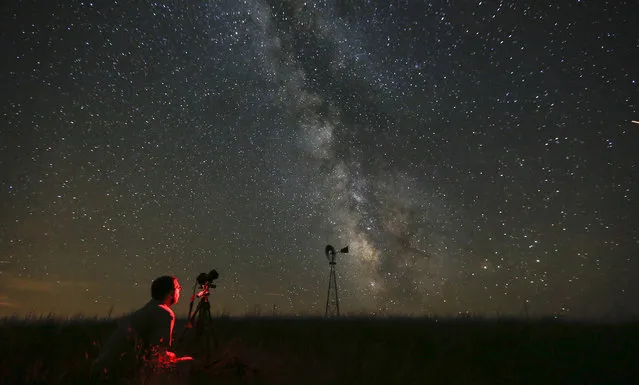
In this Wednesday, July 23, 2014 file photo, Omaha photographer Lane Hickenbottom photographs the night sky in a pasture near Callaway, Neb. With no moon in the sky, the Milky Way was visible to the naked eye. More than one-third of the world’s population can no longer see the Milky Way because of man-made lights, according to a scientific paper by Light Pollution Science and Technology Institute's Fabio Falchi and his team members, published on Friday, June 10, 2016. (Photo by Travis Heying/The Wichita Eagle via AP Photo)

In this Wednesday, July 23, 2014 file photo, Omaha photographer Lane Hickenbottom photographs the night sky in a pasture near Callaway, Neb. With no moon in the sky, the Milky Way was visible to the naked eye. More than one-third of the world’s population can no longer see the Milky Way because of man-made lights, according to a scientific paper by Light Pollution Science and Technology Institute's Fabio Falchi and his team members, published on Friday, June 10, 2016. (Photo by Travis Heying/The Wichita Eagle via AP Photo)
Details
11 Jun 2016 12:37:00