Loading...
Done
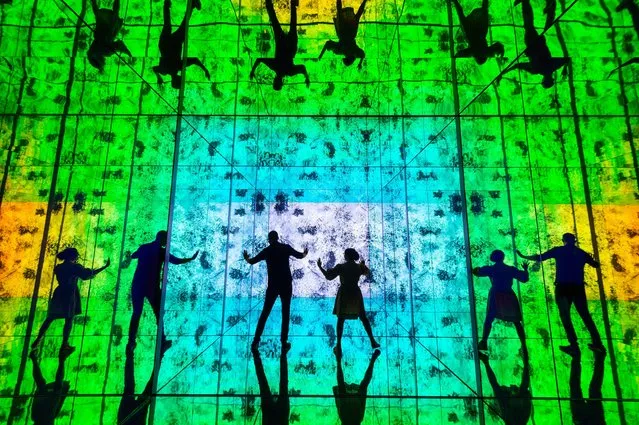
People experience INTO SIGHT, a large-scale installation by Sony Design, where audience behaviour influences the visuals and soundscape in London on 16 September 2022. It combines Sony's Crystal LED display systems, which recently replaced green screen technology in one of the biggest developments in film production, with generative sound, see-through glass walls and mirrors. The work is on show at Cromwell Place, South Kensington, as part of the 20th London Design Festival, 17-25 September 2022. (Photo by Stephen Chung/Alamy Live News)

People experience INTO SIGHT, a large-scale installation by Sony Design, where audience behaviour influences the visuals and soundscape in London on 16 September 2022. It combines Sony's Crystal LED display systems, which recently replaced green screen technology in one of the biggest developments in film production, with generative sound, see-through glass walls and mirrors. (Photo by Stephen Chung/Alamy Live News)
Details
27 Oct 2022 03:48:00
A woman poses for her husband alongside a giant camera Thursday, November 7, 2013 outside the Historic Green County Courthouse in Monroe, Wis. Chicago photographer Dennis Manarchy created what's being called the world's largest camera. (Photo by Mark Hoffman)

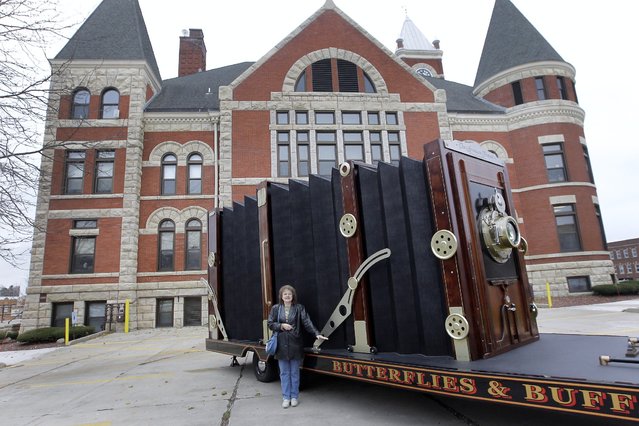
A woman poses for her husband alongside a giant camera Thursday, November 7, 2013 outside the Historic Green County Courthouse in Monroe, Wis. Chicago photographer Dennis Manarchy created what's being called the world's largest camera. It's 35-feet long and 12-feet tall it's a working replica of a vintage accordion-style camera that produces 16- by 24-foot prints, the equivalent of a two-story building. The giant camera is on display in Monroe through November 17 because a Monroe company manufactured the specially-built trailer. Manarchy plans to tow the camera around the country to shoot photos of indigenous cultures. (Photo by Mark Hoffman)
Details
16 Nov 2013 09:33:00
A green rosella and a wallaby, known as a Pademelon, eye off as they drink from a water bowl put out for thirsty wild animals at a back-yard in Kayena, in northern Tasmania, 01 February 2019. Australia recorded its hottest month on record in January; it was also the hottest and driest month on record for the Australian island state of Tasmania. (Photo by Barbara Walton/EPA/EFE)

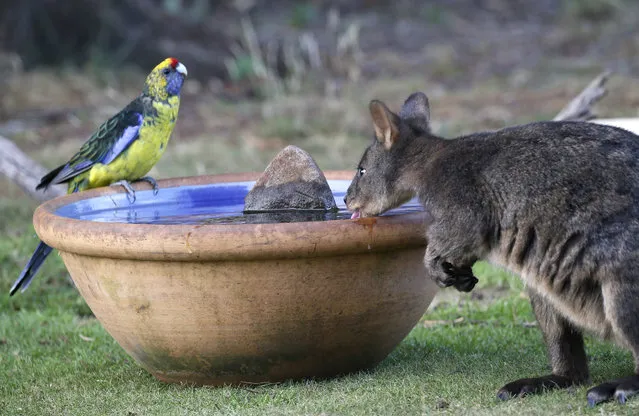
A green rosella and a wallaby, known as a Pademelon, eye off as they drink from a water bowl put out for thirsty wild animals at a back-yard in Kayena, in northern Tasmania, 01 February 2019. Australia recorded its hottest month on record in January; it was also the hottest and driest month on record for the Australian island state of Tasmania. (Photo by Barbara Walton/EPA/EFE)
Details
03 Feb 2019 00:03:00
In this 2017 photo provided by Simon Pierce, Jonathan Green checks on a fin-mounted satellite tag on a whale shark in the Galapagos Islands area of Ecuador.  Despite typically being bigger than a double-decker bus, the elusive whale shark has only tiny, almost useless teeth. It's also one of the least understood animals in the ocean. (Photo by Simonjpierce.com via AP Photo)

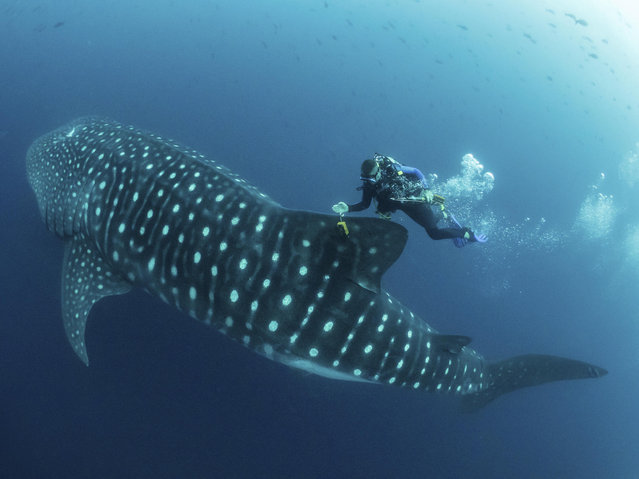
In this 2017 photo provided by Simon Pierce, Jonathan Green checks on a fin-mounted satellite tag on a whale shark in the Galapagos Islands area of Ecuador. Despite typically being bigger than a double-decker bus, the elusive whale shark has only tiny, almost useless teeth. It's also one of the least understood animals in the ocean. (Photo by Simonjpierce.com via AP Photo)
Details
02 Mar 2018 00:03:00
The Dubai Miracle Garden

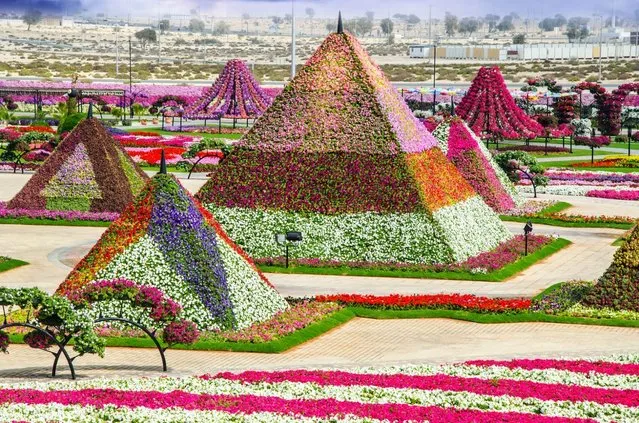
The Dubai Miracle Garden is unique in that it was essentially built on a desert. Head landscaper Akar says that the grounds are a great example of how it is possible to “green the desert” by reusing waste water. Designers took additional precautions to protect the beautiful garden arrangements from the environment. For instance, the garden’s perimeter is lined with trees that are used as windbreakers. Unlike most of the gardens around the world, the Dubai Miracle Garden closes during the summer due to severe weather conditions.
Details
17 May 2015 09:00:00
Lemurs Enjoy Thanksgiving Feast At San Francisco Zoo

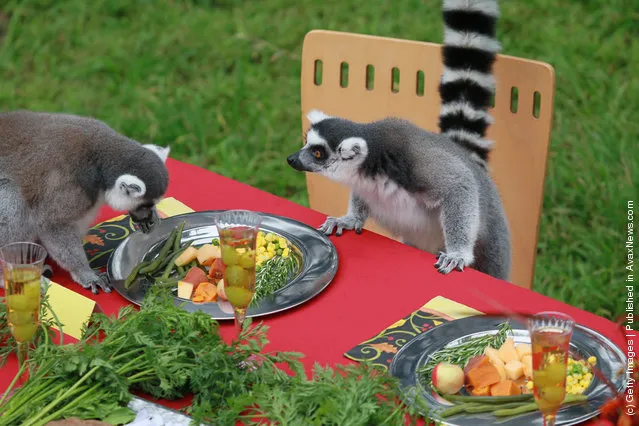
A group of Ring Tailed Lemurs eat from a Thanksgiving spread at the San Francisco Zoo on November 23, 2011 in San Francisco, California. Fifteen lemurs at the San Francisco Zoo were treated to a Thanksgiving feast of green beans, a fruit salad made up of apples, bananas, grapes sweet potatoes and a turkey made out of monkey chow. (Photo by Justin Sullivan/Getty Images)
Details
24 Nov 2011 15:24:00
This computer image provided Monday March 17, 2014 by the Press Office of socialist candidate to Paris Mayor Anne Hidalgo, shows a tunnel of abandoned railway from the 19th century, now ramshackle and overgrown, turned into a cinema. Hidalgo’s plan envisions not just a green space but in the tunnels, places for farming fish and mushrooms. (Photo by AP Photo/Anne Hidalgo's Press Office)

This computer image provided Monday March 17, 2014 by the Press Office of socialist candidate to Paris Mayor Anne Hidalgo, shows a tunnel of abandoned railway from the 19th century, now ramshackle and overgrown, turned into a cinema. Hidalgo’s plan envisions not just a green space but in the tunnels, places for farming fish and mushrooms. (Photo by AP Photo/Anne Hidalgo's Press Office)
Details
26 Mar 2014 08:43:00
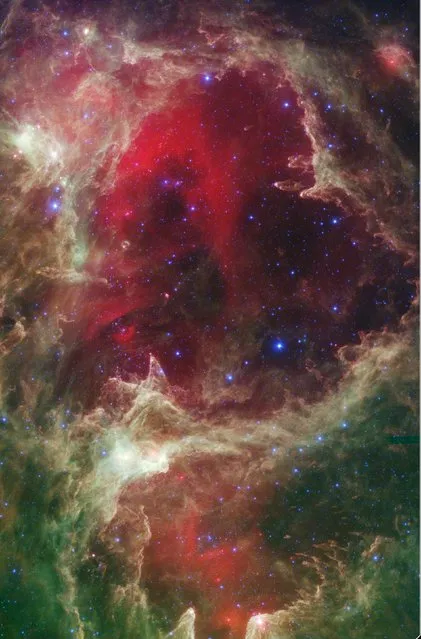
An infrared portrait from NASA's Spitzer Space Telescope which shows generations of stars is seen in this undated NASA handout image released February 14, 2013. In this wispy star-forming region, called W5, the oldest stars can be seen as blue dots in the centers of the two hollow cavities (other blue dots are background and foreground stars not associated with the region). Red shows heated dust that pervades the region's cavities, while green highlights dense clouds. (Photo by NASA/Reuters/JPL-Caltech/Harvard-Smithsonian/Handout)

An infrared portrait from NASA's Spitzer Space Telescope which shows generations of stars is seen in this undated NASA handout image released February 14, 2013. In this wispy star-forming region, called W5, the oldest stars can be seen as blue dots in the centers of the two hollow cavities (other blue dots are background and foreground stars not associated with the region). Red shows heated dust that pervades the region's cavities, while green highlights dense clouds. (Photo by NASA/Reuters/JPL-Caltech/Harvard-Smithsonian/Handout)
Details
03 Mar 2013 08:44:00