Loading...
Done
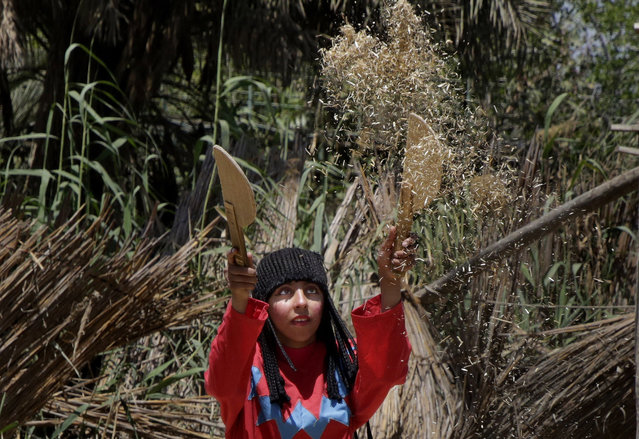
An Egyptian actress working at the Pharaonic Village simulates ancient agriculture scenes during a show marking Sham el-Nessim, or “smelling the breeze”, in Giza, Egypt, Monday, April 13, 2015. (Photo by Amr Nabil/AP Photo)

An Egyptian actress working at the Pharaonic Village simulates ancient agriculture scenes during a show marking Sham el-Nessim, or “smelling the breeze”, in Giza, Egypt, Monday, April 13, 2015. The holiday signifies the arrival of Spring, a uniquely Egyptian tradition practiced since the days of the Pharaohs. (Photo by Amr Nabil/AP Photo)
Details
14 Apr 2015 11:31:00
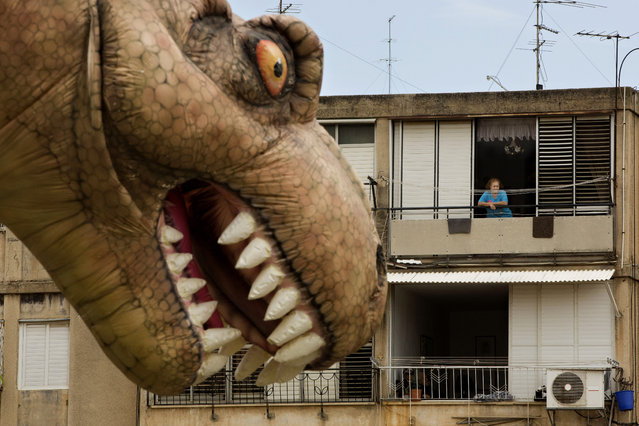
An Israeli spectator watches a giant T-Rex balloon during the Purim parade festival in Petah Tikva, Israel,  Thursday, March 24, 2016. The Jewish holiday of Purim commemorates the Jews' salvation from genocide in ancient Persia, as recounted in the Book of Esther. (Photo by Oded Balilty/AP Photo)

An Israeli spectator watches a giant T-Rex balloon during the Purim parade festival in Petah Tikva, Israel, Thursday, March 24, 2016. The Jewish holiday of Purim commemorates the Jews' salvation from genocide in ancient Persia, as recounted in the Book of Esther. (Photo by Oded Balilty/AP Photo)
Details
25 Mar 2016 13:49:00
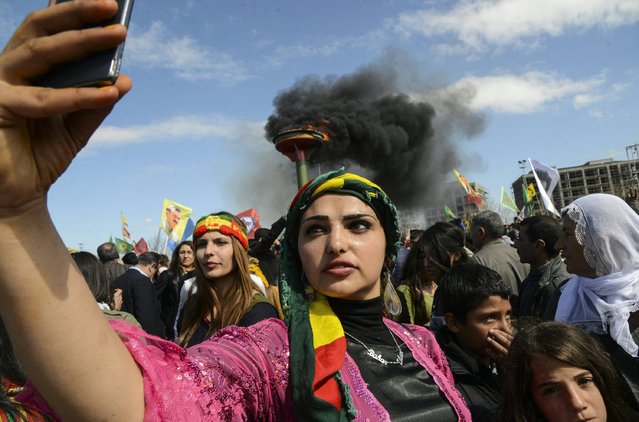
A woman takes a selfie picture as Turkish Kurds gather as part of Newroz celebrations in Diyarbakir, on March 21, 2016. Nowruz, the Farsi-language word for “New Year”, is an ancient Persian festival, celebrated on the first day of spring, on March 21, in Central Asian republics, Iraq, Turkey, Afghanistan and Iran. (Photo by Ilyas Akengin/AFP Photo)

A woman takes a selfie picture as Turkish Kurds gather as part of Newroz celebrations in Diyarbakir, on March 21, 2016. Nowruz, the Farsi-language word for “New Year”, is an ancient Persian festival, celebrated on the first day of spring, on March 21, in Central Asian republics, Iraq, Turkey, Afghanistan and Iran. (Photo by Ilyas Akengin/AFP Photo)
Details
10 Apr 2016 11:58:00
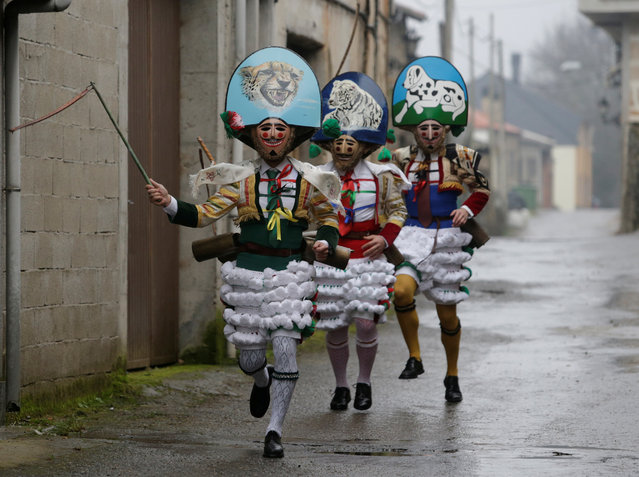
Carnival revellers dressed as “Peliqueiros” run along a street in the village of Laza, Spain February 11, 2018. “Peliqueiros”, or ancient tax collectors, pursued villagers through the streets ringing their cowbells and hitting villagers with their sticks. (Photo by Miguel Vidal/Reuters)

Carnival revellers dressed as “Peliqueiros” run along a street in the village of Laza, Spain February 11, 2018. “Peliqueiros”, or ancient tax collectors, pursued villagers through the streets ringing their cowbells and hitting villagers with their sticks. (Photo by Miguel Vidal/Reuters)
Details
12 Feb 2018 07:41:00
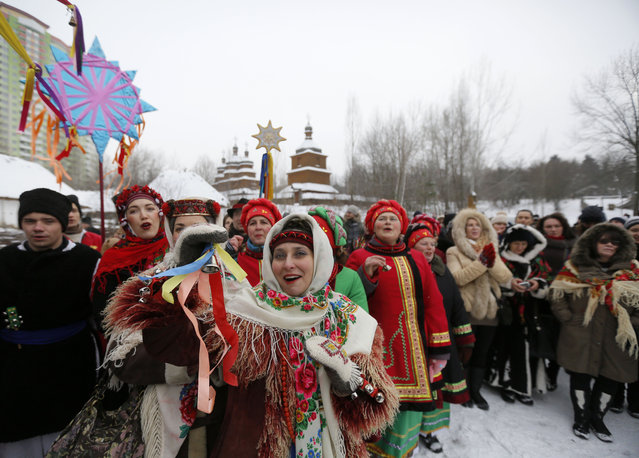
Ukrainians wearing traditional costumes sing Kolyadky or Ukrainian Christmas Carols, as a part of Orthodox Christmas in Kiev, Ukraine, Thursday, January 7 2016. Orthodox Christians mark their traditional Christmas Day Jan. 7, with many ancient symbolic events. (Photo by Sergei Chuzavkov/AP Photo)

Ukrainians wearing traditional costumes sing Kolyadky or Ukrainian Christmas Carols, as a part of Orthodox Christmas in Kiev, Ukraine, Thursday, January 7 2016. Orthodox Christians mark their traditional Christmas Day Jan. 7, with many ancient symbolic events. (Photo by Sergei Chuzavkov/AP Photo)
Details
09 Jan 2016 08:06:00
Conaster Iongimanus AKA The Icon Star Or Double Star

Iconaster longimanus, the icon star or double star, is a species of starfish in the family Goniasteridae. It is found in the west and central Indo-Pacific Ocean. The genus name comes from the Greek eikon, meaning portrait or image and possibly referring to the way the marginal plates frame the disc, and aster, meaning star. The specific name comes from the Latin longus manus and refers to the long, slender arms.
Details
14 Jul 2014 12:50:00
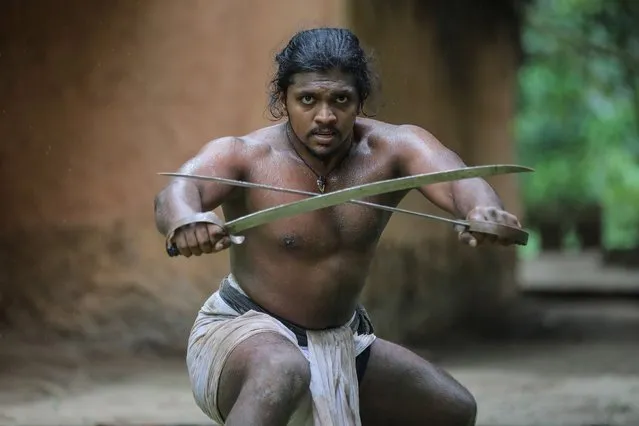
A student of the Sri Lankan ancient martial art “Angampora” performs during a practice session at the angam maduwa or fighting field, in Korathota, a suburb of Colombo, Sri Lanka, 07 September 2022. Sri Lanka's ancient martial art, Angampora, is thought to be thousands of years old. Anga translates to “body parts” and Angampora is a fighting art that uses body parts. Martial arts practitioners in Angampora were mostly in the king's service, and they were tasked with protecting the king and his kingdom. Angampora was practiced in secret for most centuries because the British, who colonized Sri Lanka, banned it in 1818 after seeing it as a threat. (Photo by Chamila Karunarathne/EPA/EFE)

A student of the Sri Lankan ancient martial art “Angampora” performs during a practice session at the angam maduwa or fighting field, in Korathota, a suburb of Colombo, Sri Lanka, 07 September 2022. Sri Lanka's ancient martial art, Angampora, is thought to be thousands of years old. Anga translates to “body parts” and Angampora is a fighting art that uses body parts. Martial arts practitioners in Angampora were mostly in the king's service, and they were tasked with protecting the king and his kingdom. Angampora was practiced in secret for most centuries because the British, who colonized Sri Lanka, banned it in 1818 after seeing it as a threat. (Photo by Chamila Karunarathne/EPA/EFE)
Details
14 Oct 2022 04:47:00
purim

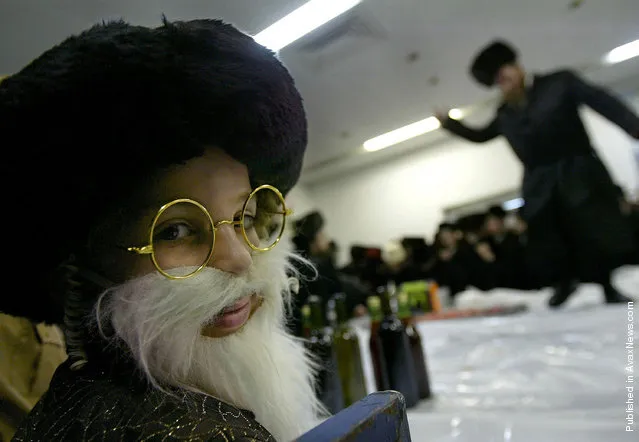
An Israeli girl in costume, celebrates the Jewish festival of Purim on March 5, 2004, in Tel Aviv, Israel. The Festival commemorates the rescue of Jews from genocide in ancient Persia.
Details
18 Mar 2011 08:09:00