Loading...
Done
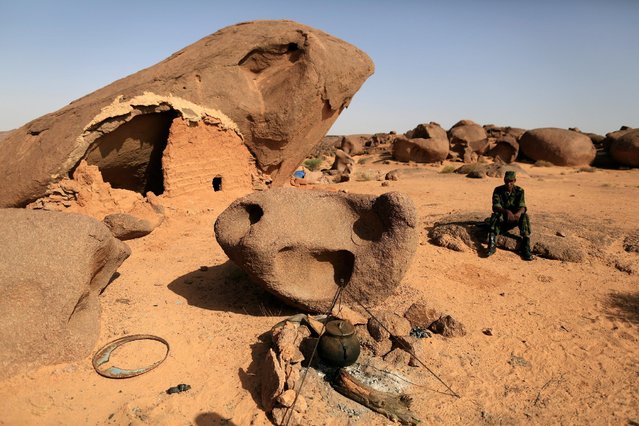
A Polisario fighter sits on a rock at a forward base on the outskirts of Tifariti, Western Sahara, September 9, 2016. At a rocky outpost in Western Sahara, a new generation of soldiers who have never known war are mobilising as tensions resurface in one of Africa's oldest disputes after a quarter century of uneasy peace. Young Sahrawi troops man new desert posts for the Polisario Front, which for more than 40 years has sought independence for the vast desert region - first in a guerrilla war against Morocco and then politically since a ceasefire deal in 1991. Now a standoff with Morocco, which controls the majority of Western Sahara, is renewing pressure for a diplomatic solution to ensure foot soldiers don't return to fighting as the last generation of commanders once did. The standoff since August has brought Moroccan and Polisario forces within 200 metres of each other in a narrow strip of land near the Mauritanian border. Rich in phosphate, Western Sahara has been contested since 1975 when Spanish colonial powers left. Morocco claimed the territory and fought the 16-year war with Polisario. (Photo by Zohra Bensemra/Reuters)

A Polisario fighter sits on a rock at a forward base on the outskirts of Tifariti, Western Sahara, September 9, 2016. At a rocky outpost in Western Sahara, a new generation of soldiers who have never known war are mobilising as tensions resurface in one of Africa's oldest disputes after a quarter century of uneasy peace. (Photo by Zohra Bensemra/Reuters)
Details
04 Nov 2016 12:09:00
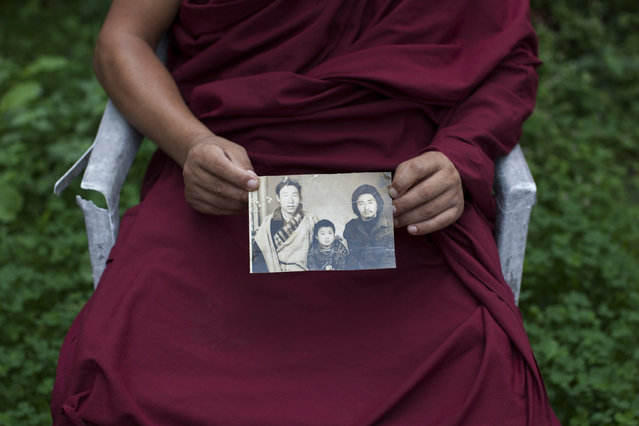
In this Saturday, September 27, 2014 photo, Tibetan monk Dorjee, 38, displays a photograph of his father, left, and himself, center, taken in Tibet, in Dharamsala, India. Dorjee said he held back his tears when he spoke with his parents on the phone after a separation period of 27 years. He exchanged a few words with his father but said his mother fainted on hearing his voice. (Photo by Tsering Topgyal/AP Photo)

“When I was 8 years old, my parents paid a smuggler to take me across the Himalayas, a weekslong walk over the mountains from Tibet to India. It was a trek that tens of thousands of other Tibetans have taken since the Dalai Lama fled a failed 1959 uprising against Chinese rule. My parents must have had their reasons to send me here; they must have had the best of intentions. But 18 years later, I still don't know why they did it. They are not political people. They are small farmers who raise barley and a few yak in a rural area not far from Lhasa, the Tibetan capital. I have not seen them since I left...”. – Tsering Topgyal via The Associated Press. (Photo by Tsering Topgyal/AP Photo)
Details
05 Nov 2014 12:27:00
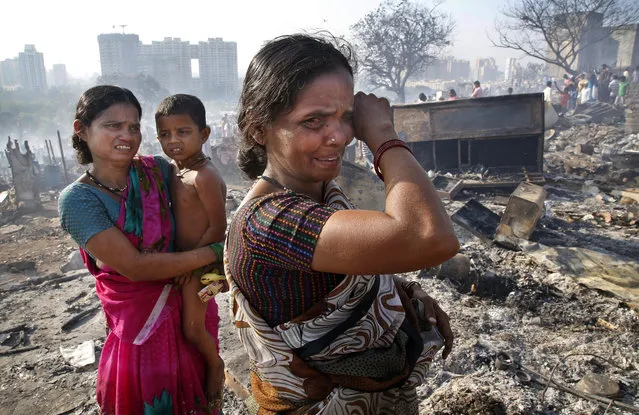
Women cry as they look for reusable household materials after fire broke at slums in Kadivali area of Mumbai, India, Monday, Dec. 7, 2015. Hundreds of homes were reportedly destroyed as fire tenders labored to reach the source in the heavily congested area. (AP Photo/Rajanish Kakade)

Women cry as they look for reusable household materials after fire broke at slums in Kadivali area of Mumbai, India, Monday, December 7, 2015. Hundreds of homes were reportedly destroyed as fire tenders labored to reach the source in the heavily congested area. (Photo by Rajanish Kakade/AP Photo)
Details
09 Dec 2015 08:01:00
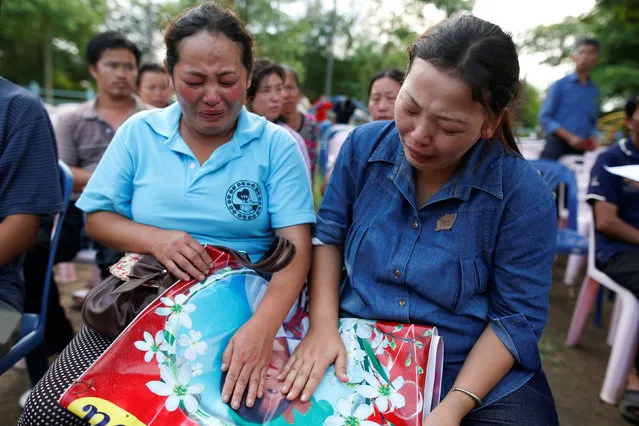
Malawian Saw-wa, 33, (L) and Yupin Saw-wa, 28 who lost their daughters, cry near a burnt building at the Pitakkiat Wittaya School in the northern province of Chiang Rai, Thailand, May 23, 2016. (Photo by Athit Perawongmetha/Reuters)

Malawian Saw-wa, 33, (L) and Yupin Saw-wa, 28 who lost their daughters, cry near a burnt building at the Pitakkiat Wittaya School in the northern province of Chiang Rai, Thailand, May 23, 2016. (Photo by Athit Perawongmetha/Reuters)
Details
24 May 2016 09:29:00
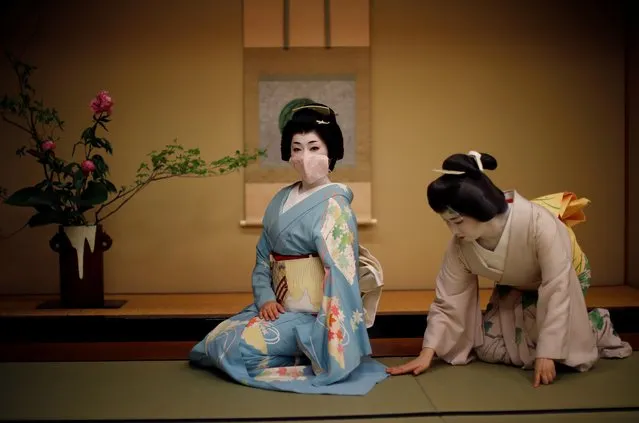
Mayu adjusts Koiku’s kimono, as Koiku wears a protective face mask while posing for a photograph, before they work at a party where they will entertain with other geisha at Japanese luxury restaurant Asada in Tokyo, Japan, June 23, 2020. The coronavirus pandemic has made Tokyo's geisha fear for their centuries-old profession as never before. Though the number of geisha - famed for their witty conversation, beauty and skill at traditional arts - has been falling for years, they were without work for months due to Japan's state of emergency and now operate under awkward social distancing rules. Engagements are down 95 percent, and come with new rules: no pouring drinks for customers or touching them even to shake hands, and sitting 2 meters apart. Masks are hard to wear with their elaborate wigs, so they mostly don't. “I was just full of anxiety”, said Mayu, 47. “I went through my photos, sorted my kimonos ... The thought of a second wave is terrifying”. (Photo by Kim Kyung-Hoon/Reuters)

Mayu adjusts Koiku’s kimono, as Koiku wears a protective face mask while posing for a photograph, before they work at a party where they will entertain with other geisha at Japanese luxury restaurant Asada in Tokyo, Japan, June 23, 2020. (Photo by Kim Kyung-Hoon/Reuters)
Details
23 Jul 2020 00:03:00
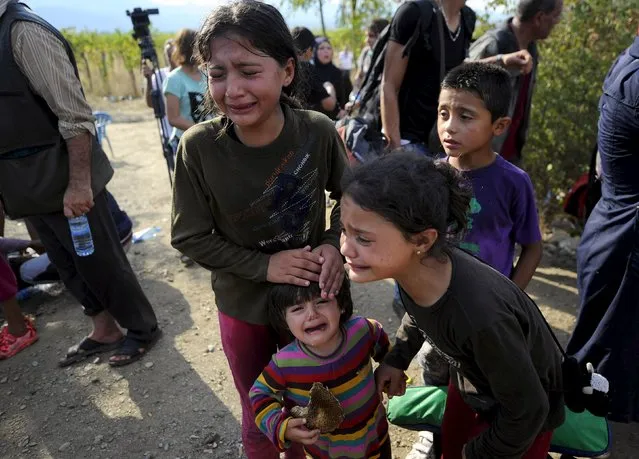
Girls cry as they get separated from their family at the border line dividing Macedonia and Greece August 21, 2015. (Photo by Ognen Teofilovski/Reuters)

Girls cry as they get separated from their family at the border line dividing Macedonia and Greece August 21, 2015. At least 1,000 migrants and refugees pressed against Macedonian police lines on the Greek-Macedonian border on Friday and at least 10 people appeared to faint in the crush. People could be heard screaming and medical workers raced to treat those who passed out or were hurt. The crush ensued after police let several hundred through into Macedonia, having kept them out since Thursday under an emergency decree. (Photo by Ognen Teofilovski/Reuters)
Details
22 Aug 2015 12:26:00
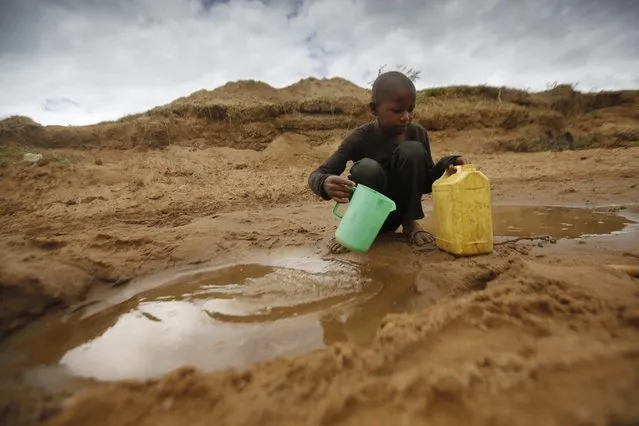
A young boy scoops water from a hand-dug well in the dry riverbed near Matinyani, in the semi-arid Kitui County in southeastern Kenya, 22 March 2015, the World Water Day. Residents of Kitui County and other arid and semi-arid areas of the country have been hard-hit by extremely poor rainfall this year while the government said in previous month that some 1.6 million people countrywide are facing acute starvation due to the drought and will need relief food over the next six months. (Photo by Dai Kurokawa/EPA)

A young boy scoops water from a hand-dug well in the dry riverbed near Matinyani, in the semi-arid Kitui County in southeastern Kenya, 22 March 2015, the World Water Day. Residents of Kitui County and other arid and semi-arid areas of the country have been hard-hit by extremely poor rainfall this year while the government said in previous month that some 1.6 million people countrywide are facing acute starvation due to the drought and will need relief food over the next six months. Residents of Matinyani say they haven't seen a drop of rain in nearly four months. Thousands of Kenyans in rural areas walk tens of kilometers just to fetch water to drink and to be used in their homes. According to an estimate by UNESCO (United Nations Educational, Scientific and Cultural Organization), 17 million people lack access to safe water in Kenya, where the drought is a perennial problem. (Photo by Dai Kurokawa/EPA)
Details
23 Mar 2015 11:01:00
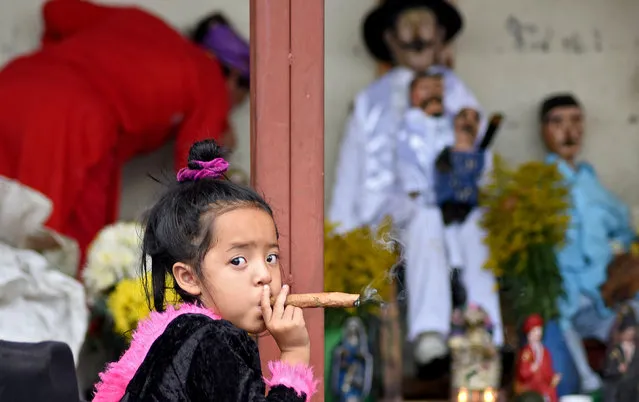
A three-year-old girl smokes a cigar during the Saint Simon celebrations in San Andres Itzapa, Guatemala, on October 28, 2019. Thousands believe that the saint helps people find work, solves family problems and cures illnesses. (Photo by Orlando Estrada/AFP Photo)

A three-year-old girl smokes a cigar during the Saint Simon celebrations in San Andres Itzapa, Guatemala, on October 28, 2019. Thousands believe that the saint helps people find work, solves family problems and cures illnesses. (Photo by Orlando Estrada/AFP Photo)
Details
18 Dec 2019 00:01:00