Loading...
Done
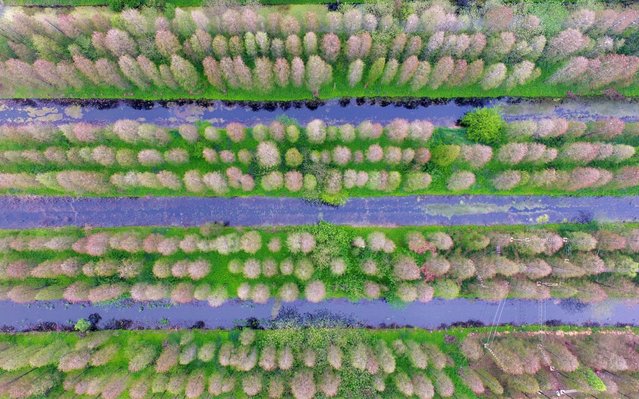
Overlooking qingshuitan Wetland Park in the air, thousands of Chinese fir trees turn green. Gaoyou City, Jiangsu Province, China, April 20, 2020. April 22 is world earth day. (Photo credit should read Costfoto/Barcroft Media via Getty Images)

Overlooking qingshuitan Wetland Park in the air, thousands of Chinese fir trees turn green. Gaoyou City, Jiangsu Province, China, April 20, 2020. April 22 is world earth day. (Photo credit should read Costfoto/Barcroft Media via Getty Images)
Details
27 Apr 2020 00:05:00
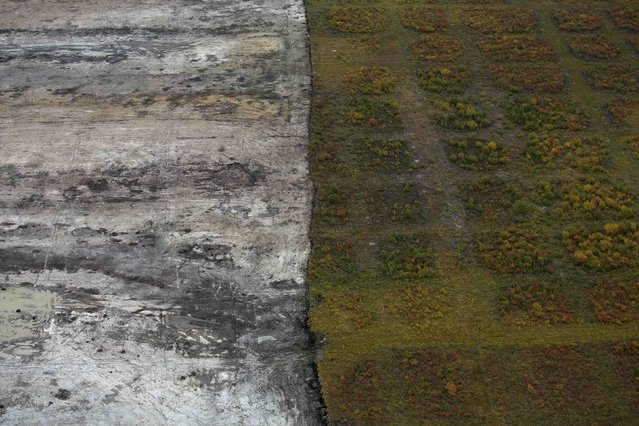
The top layer of muskeg and earth (L) is removed at the Syncrude tar sands operations near Fort McMurray, Alberta, September 17, 2014. Syncrude currently produces 350,000 barrels per day of high quality light, low sulphur crude oil according to company reports. (Photo by Todd Korol/Reuters)

The top layer of muskeg and earth (L) is removed at the Syncrude tar sands operations near Fort McMurray, Alberta, September 17, 2014. Syncrude currently produces 350,000 barrels per day of high quality light, low sulphur crude oil according to company reports. (Photo by Todd Korol/Reuters)
Details
21 Sep 2014 11:06:00
Mina Sue Choi (L) from South Korea reacts after winning the Miss Earth 2022 pageant during the coro​nation night in Manila, Philippines, 29 November 2022. (Photo by Francis R. Malasig/EPA/EFE)

Mina Sue Choi (L) from South Korea reacts after winning the Miss Earth 2022 pageant during the coro​nation night in Manila, Philippines, 29 November 2022. (Photo by Francis R. Malasig/EPA/EFE)
Details
09 Dec 2022 05:05:00
LAPD chopper flies in a foregraund of the Super Moon in Los Angeles, California on May 05, 2012

LAPD chopper flies in a foregraund of the Super Moon in Los Angeles, California on May 05, 2012. Tonight's moon is set to appear 14 percent larger and 30 percent brighter from our perspective on Earth. The Supermoon lines up much closely with perigee – the moon's closest point to Earth. The 2012 May full moon falls some six minutes after perigee, the moon's closest point to Earth for this month. At perigee, the moon lies only 221,802 miles (356,955 kilometers ) away. Later this month, on May 19, the moon will swing out to apogee – its farthest point for the month – at 252,555 miles (406,448 kilometers) distant. (Photo by AFP/File, Joe Klamar)
Details
08 May 2012 10:54:00
These incredible pictures look like a bird's-eye view of a faraway alien planet – but they're actually hot springs. The amazing snaps are up-close shots of Iceland's hot springs, and the point-blank pictures produce a breathtaking array of colors and effects. Here: The amazing snaps are up-close shots of Icelandic hot springs. (Photo by Johann Vilhjalmsson/Caters News)

These incredible pictures look like a bird's-eye view of a faraway alien planet – but they're actually hot springs. The amazing snaps are up-close shots of Iceland's hot springs, and the point-blank pictures produce a breathtaking array of colors and effects. Here: The amazing snaps are up-close shots of Icelandic hot springs. (Photo by Johann Vilhjalmsson/Caters News)
Details
18 Jan 2016 08:04:00
A serene turquoise glow glimmers from underneath these powerful icebergs. Stood in the middle of Antarctica, the giant icebergs appear to be from an unearthly world. These stunning photographs were captured by American photographer Michael Leggero. “My images show pure nature, as that is how I describe Antarctica, simply pure nature”, says the 43 year old, of Carthage, New York. “It is the only place on our planet that humans have not left a presence behind”. (Photo by Michael Leggero/Hotspotmedia/Visual Press Agency)

A serene turquoise glow glimmers from underneath these powerful icebergs. Stood in the middle of Antarctica, the giant icebergs appear to be from an unearthly world. These stunning photographs were captured by American photographer Michael Leggero. “My images show pure nature, as that is how I describe Antarctica, simply pure nature”, says the 43 year old, of Carthage, New York. “It is the only place on our planet that humans have not left a presence behind”. (Photo by Michael Leggero/Hotspotmedia/Visual Press Agency)
Details
07 Aug 2014 10:32:00
Csilla Orgel, a geologist of Crew 125 EuroMoonMars B mission, makes her way back to the Mars Desert Research Station (MDRS) in the Utah desert March 3, 2013. (Photo by Jim Urquhart/Reuters)

NASA says it could be another 20 years before humans touch down on Mars, but in a sense, the Mars Society has been exploring the red planet for more than a decade – in Utah. Photo: Csilla Orgel, a geologist of Crew 125 EuroMoonMars B mission, makes her way back to the Mars Desert Research Station (MDRS) in the Utah desert March 3, 2013. The MDRS aims to investigate the feasibility of a human exploration of Mars and uses the Utah desert's Mars-like terrain to simulate working conditions on the red planet. Scientists, students and enthusiasts work together developing field tactics and studying the terrain. All outdoor exploration is done wearing simulated spacesuits and carrying air supply packs and crews live together in a small communication base with limited amounts of electricity, food, oxygen and water. Everything needed to survive must be produced, fixed and replaced on site. (Photo by Jim Urquhart/Reuters)
Details
14 Mar 2013 12:11:00
In one of the planet’s most desolate and harsh terrains, the Altai Mountains which run from Siberia in Russia down to Mongolia’s Gobi Desert, hunting with eagles is currently only practiced by a handful of Kyrgyz and Kazakhs. This form of falconry, the practice of hunting with the aid of birds of prey, can be traced back as far as 4,000 years in Central Asia. (Photo by Tariq Zaidi/The Washington Post)

In one of the planet’s most desolate and harsh terrains, the Altai Mountains which run from Siberia in Russia down to Mongolia’s Gobi Desert, hunting with eagles is currently only practiced by a handful of Kyrgyz and Kazakhs. This form of falconry, the practice of hunting with the aid of birds of prey, can be traced back as far as 4,000 years in Central Asia. Here: after a successful hunt, a proud hunter rewards his eagle by feeding it the lungs of the prey, which is considered the most highly prized part of the animal. (Photo by Tariq Zaidi/The Washington Post)
Details
22 Aug 2015 12:46:00