Loading...
Done
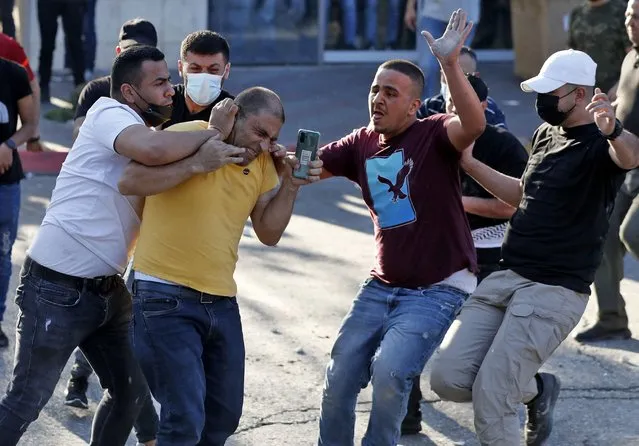
Palestinian plain-clothed security officers detain a man during a demonstration in the city of Ramallah in the occupied West Bank, on June 26, 2021, to protest the death of human rights activist Nizar Banat while in the custody of Palestinian Authority (PA) security forces. Thousands of mourners attended on June 25 the funeral of the 43-year-old Banat, a day after he died in custody following his violent arrest by Palestinian security forces, which sparked outrage in the occupied West Bank. He was known for social media videos denouncing alleged corruption within the PA. (Photo by Ahmad Gharabli/AFP Photo)

Palestinian plain-clothed security officers detain a man during a demonstration in the city of Ramallah in the occupied West Bank, on June 26, 2021, to protest the death of human rights activist Nizar Banat while in the custody of Palestinian Authority (PA) security forces. Thousands of mourners attended on June 25 the funeral of the 43-year-old Banat, a day after he died in custody following his violent arrest by Palestinian security forces, which sparked outrage in the occupied West Bank. He was known for social media videos denouncing alleged corruption within the PA. (Photo by Ahmad Gharabli/AFP Photo)
Details
08 Jul 2021 10:22:00


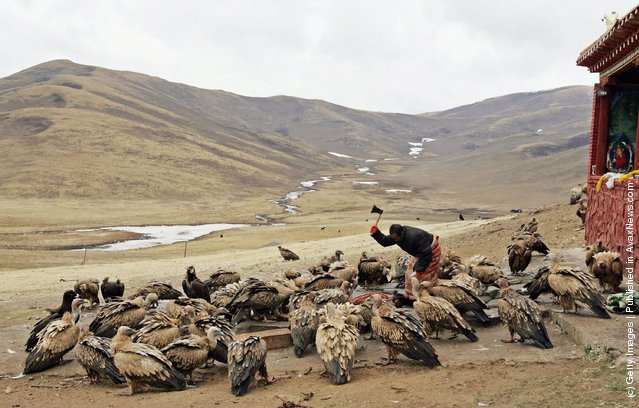
“Sky burial or ritual dissection was once a common funerary practice in Tibet wherein a human corpse is cut in specific locations and placed on a mountaintop, exposing it to the elements or the mahabhuta and animals – especially to birds of prey. The location of the sky burial preparation and place of execution are understood in the Vajrayana traditions as charnel grounds. In Tibet the practice is known as jhator, which literally means, «giving alms to the birds»”. – Wikipedia

Photo: A burial master chops bones of a body to feed vultures during a celestial burial ceremony on April 19, 2006 in Dari County of Guoluo Prefecture, Qinghai Province, northwest China. Celestial burial is a traditional funeral of Tibetan people, which began in the 7th century. (Photo by China Photos/Getty Images)
Details
18 Jun 2011 12:12:00
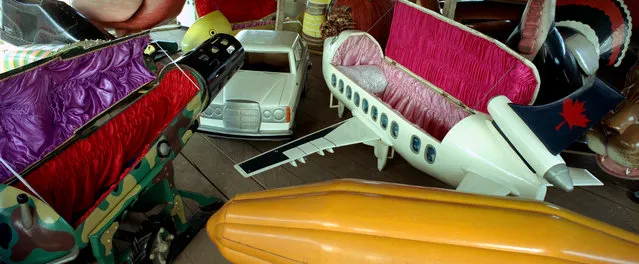
The Fantasy Coffins From Ghana

Some people joke about having clowns at their funeral, but how about having a coffin that looks like a gigantic cellphone? It is impossible to tell at the first glance that these colorful sculptures are actually coffins. The coffins were made by Kane Kwei and his assistant Paa Joe more than twenty years ago and have been a somewhat grim tourist attraction ever since. These coffins were probably made as an advertisement for the actual business, since it would hard to imagine someone actually ordering a coffin such as this.
Details
07 Apr 2015 10:40:00
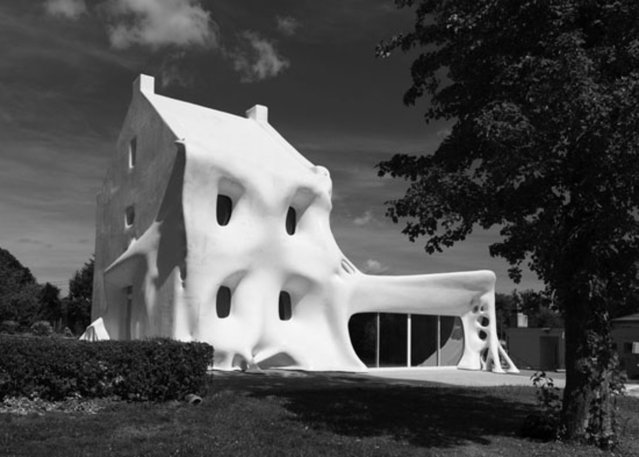
Gue(ho)st House In France

Architects Christophe Berdaguer and Marie Péjus get scary with this sculptural,bogey-inspired arts center in France. Situated behind the severe Synagogue de Delme, the center's design transforms an old house, which previously served as a prison, a school, and most recently a funeral home. The new intervention draws inspiration from the latter, cloaking the structure in a white veil of molded concrete that creates a "living body" which expands into the surrounding areas of the house.
Details
26 Jan 2014 12:05:00
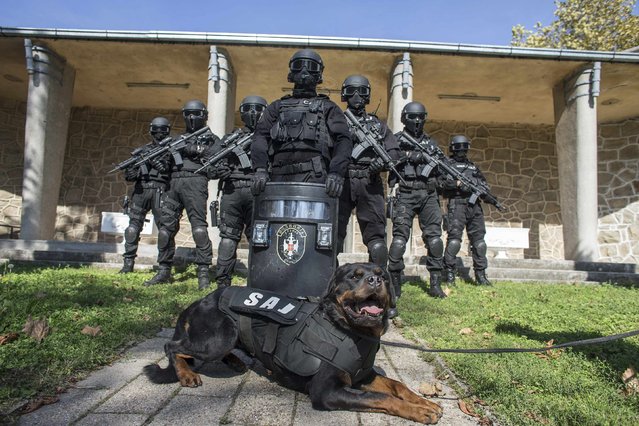
Serbian police officers of the Special Anti-Terrorist Unit pose for a picture in their base outside Belgrade October 8, 2014. (Photo by Marko Djurica/Reuters)

Serbian police officers of the Special Anti-Terrorist Unit pose for a picture in their base outside Belgrade October 8, 2014. When the killing of an unarmed black teenager by a white policeman in Ferguson, Missouri, in August sparked sometimes violent protests, the response of police in camouflage gear and armoured vehicles wielding stun grenades and assault rifles seemed more like a combat operation than a public order measure. Some U.S. police departments have recently acquired U.S. military-surplus hardware from wars abroad, but there are many law enforcers around the world whose rules of engagement also allow the use of lethal force with relatively few restrictions. But for every regulation that gives police wide scope to use firearms, there is another code that sharply limits their use. In Serbia, police may use measures ranging from batons to special vehicles, water cannon and tear gas on groups of people who have gathered illegally and are behaving in a way that is violent or could cause violence, but they may use firearms only when life is endangered. (Photo by Marko Djurica/Reuters)
Details
27 Nov 2014 14:53:00


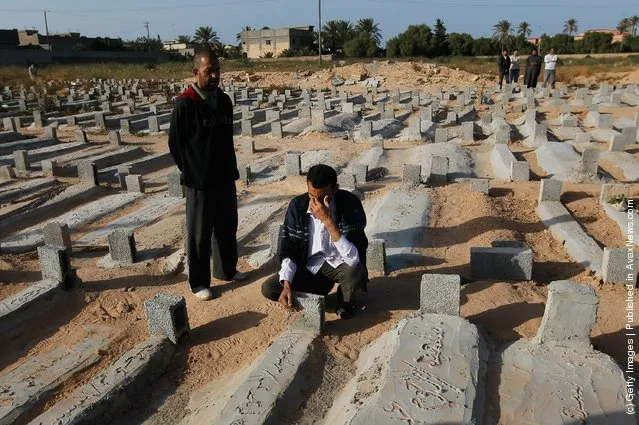
A man cries in a graveyard during the funeral of Nasser Ali Afglio, a young Libyan rebel killed during battle with government troops loyal to Libyan ruler Moammar Gaddafi April 19, 2011 in Misrata, Libya. The graveyard where Nasser was buried has hundreds of simple concrete graves; many dozens are those that have been killed during the last two months of fighting in the besieged town. Thousands of civilians are trapped in Misrata as fighting continues between Libyan government forces that have surrounded the city and anti-government rebels there. (Photo by Chris Hondros/Getty Images)
Details
22 Apr 2011 08:22:00
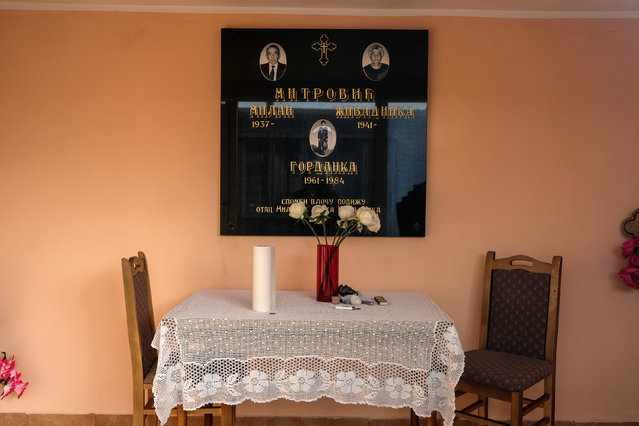
Pictures of deceased people are seen inside a chapel at a cemetery in the village of Smoljinac, Serbia, October 25, 2016. (Photo by Marko Djurica/Reuters)

Pictures of deceased people are seen inside a chapel at a cemetery in the village of Smoljinac, Serbia, October 25, 2016. From a distance, the cemetery in the eastern Serbian village of Smoljinac looks like a residential neighbourhood eerily placed among graves. But once inside the grounds, after passing a section with the usual stone slabs, visitors find rows of small bungalows painted in pastel colours. They have one or two rooms, large windows and ornate plaques – some inside, some outside – memorialising the deceased. These are the burial chapels of Smoljinac, cosy cabins with a furnished room inside, a storage place for wreaths and funeral paraphernalia, and the family crypt below. Some even have electric power inside. (Photo by Marko Djurica/Reuters)
Details
12 Nov 2016 10:37:00
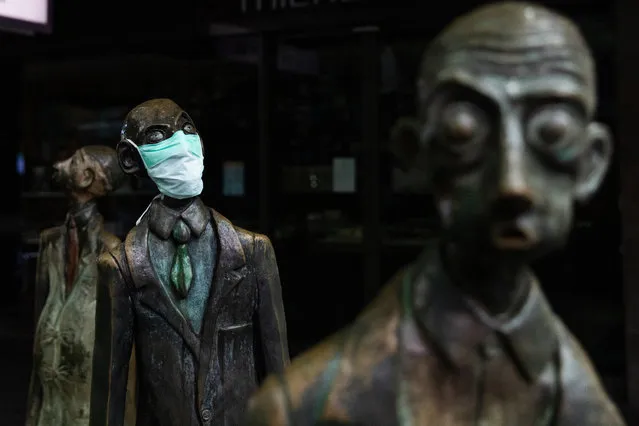
A face mask is placed on one of the 'Three business men who brought lunch' statues on Swanston street on March 29, 2020 in Melbourne, Australia. All international arrivals into Australia from midnight on Saturday will be placed into mandatory quarantine in hotels for 14 days as the Federal Government increases restrictions to stop the spread of COVID-19. All libraries, museums, galleries, beauty salons, tattoo parlours, shopping centre food courts, auctions, open houses, amusement parks, arcades, indoor and outdoor play centres, swimming pools are closed and indoor exercise activities are now banned. This is in addition to the closure of bars, pubs and nightclubs which came into effect on Monday. Restaurants and cafes are restricted to providing takeaway only. Weddings will now be restricted to five people including the couple while funerals are limited to 10 mourners. All Australians are now expected to stay at home except for essential outings such as work, grocery shopping and medical appointments. Exercising outdoors alone is still permitted. Australia now has more than 3,600 confirmed cases of COVID-19 while the death toll now stands at 16. (Photo by Asanka Ratnayake/Getty Images)

A face mask is placed on one of the 'Three business men who brought lunch' statues on Swanston street on March 29, 2020 in Melbourne, Australia. All international arrivals into Australia from midnight on Saturday will be placed into mandatory quarantine in hotels for 14 days as the Federal Government increases restrictions to stop the spread of COVID-19. (Photo by Asanka Ratnayake/Getty Images)
Details
31 Mar 2020 00:07:00