Loading...
Done


The Ray and Maria Stata Center is shown on the campus of the Massachusetts Institute of Technology February 22, 2006 in Cambridge, Massachusetts. The Institute admitted its first students in 1865 and continues with the mission to advance knowledge and educate students in science, technology, and other areas of scholarship. (Photo by Joe Raedle/Getty Images)
Details
05 Apr 2011 08:54:00


The Lady Boys of Bangkok have fun at the Meadows August 1, 2006 in Edinburgh, Scotland. (Photo by Jeff J Mitchell/Getty Images)
Details
05 May 2011 11:32:00
s*xy singer Donni Rai

Singer Donni Rai arrives at the 48th Annual Grammy Awards at the Staples Center on February 8, 2006 in Los Angeles, California. (Photo by Stephen Shugerman/Getty Images)
Details
03 Aug 2011 11:22:00
Animal Eyes by Suren Manvelyan

Born in 1976, Suren started to photograph when he was sixteen and became a professional photographer in 2006. His photographic interests span from Macro to Portraits, Creative photo projects, Landscape, and much more.
Details
14 Sep 2012 12:22:00
A girl by Ron Mueck

A visitors to the National Galleries of Scotland view the work “A girl” of sculptor Ron Mueck on August 4, 2006 Edinburgh in Scotland. (Photo by Jeff J Mitchell/Getty Images)
Details
03 Oct 2011 09:54:00
Stray dogs at the 'Ping An A Fu' (safe and happy) Homeless Animals Rescue Center in Nanjing

A dog welcomes a volunteer at the “Ping An A Fu” (“Safe and Happy”) Homeless Animals Rescue Center on September 11, 2006 in Nanjing of Jiangsu Province, China. (Photo by China Photos/Getty Images)
Details
02 Mar 2012 10:33:00
Michael Quinn By Pathways in Arches

Images from my travels with John Paul Caponigro in the spring of 2011. During that week JP inspired me to create this body of work. This is my path, my pathways in arches.

Michael Quinn
Details
18 Dec 2013 14:11:00


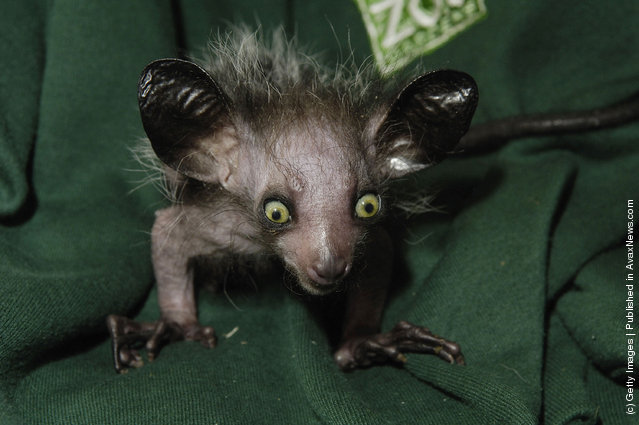
“The aye-aye (Daubentonia madagascariensis) is a lemur, a strepsirrhine primate native to Madagascar that combines rodent-like teeth and a special thin middle finger to fill the same ecological niche as a woodpecker. It is the world's largest nocturnal primate, and is characterized by its unusual method of finding food; it taps on trees to find grubs, then gnaws holes in the wood and inserts its narrow middle finger to pull the grubs out. The only other animal species known to find food in this way is the striped possum. From an ecological point of view the aye-aye fills the niche of a woodpecker as it is capable of penetrating wood to extract the invertebrates within”. – Wikipedia

Photo: In this handout image from Bristol Zoo is seen the first captive bred aye-aye in the UK named “Kintana” (meaning star in Malagasy) April 15, 2005 at Bristol Zoo Gardens, England. The zoo announced today only the second baby aye-aye to be hand-reared in the world (the first was in Jersey Zoo) and has now made his first public appearance since his birth on 11 February 2005. (Photo by Rob Cousins/Bristol Zoo via Getty Images)

Details
13 Apr 2011 13:33:00