Loading...
Done
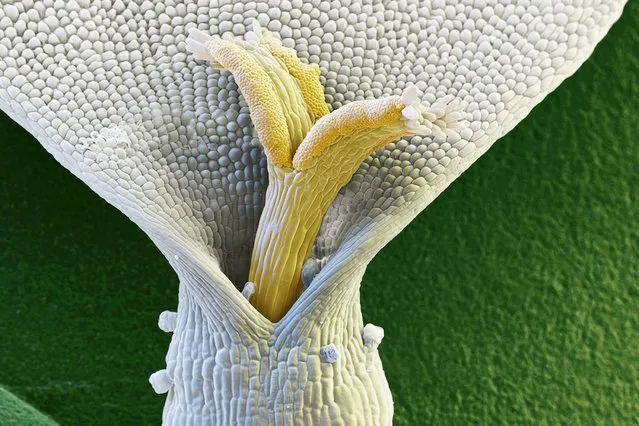
The floret of a Chamomile flower up close and personal. (Photo by Oliver Meckes/Barcroft Media)

These images have been created using a colour scanning electron microscope (SEM) by the award-winning Eye of Science, comprised of snapper Oliver Meckes and biologist Nicole Ottawa. For a decade the pair, based in Reutlingen in the south of Germany, worked with an old SEM they saved from the scrapheap, but for the last five years they have used a £250,000 FEI Quanta Series Field Emission SEM. Oliver said: “Flowers are beautiful in 'normal' view, but when you look closer, some parts get very bizarre and unexpected structures appear – flowers within flowers, worlds within worlds”. Photo: The floret of a Chamomile flower up close and personal. (Photo by Oliver Meckes/Barcroft Media)
Details
26 May 2014 13:51:00


A member of staff stands in front of a CRH high-speed train at Shanghai Hongqiao Railway Station during its test run on May 11, 2011 in Shanghai, China. After 3 years construction, from April in 2008, with total investment estimated at 220.9 billion yuan (around 32.5 billion U.S. dollars), the Beijing-Shanghai high-speed railway begins a one-month trial operation. It is expected to start operation in June this year, with the travel time between the two cities reducing to five hours from the previous 10. (Photo by ChinaFotoPress/Getty Images)
Details
11 May 2011 09:59:00
Students play in their school yard on the first day of the new school term at a primary school in Baghdad, October 18, 2015. (Photo by Ahmed Saad/Reuters)

Students play in their school yard on the first day of the new school term at a primary school in Baghdad, October 18, 2015. (Photo by Ahmed Saad/Reuters)
Details
21 Oct 2015 08:04:00
Students of the "Escola de Papai Noel do Brasil" (Brazil's school of Santa Claus)  travel on a ferry through Guanabara bay, during their graduation ceremony in Rio de Janeiro, Brazil, November 10, 2015. (Photo by Pilar Olivares/Reuters)

Students of the "Escola de Papai Noel do Brasil" (Brazil's school of Santa Claus) travel on a ferry through Guanabara bay, during their graduation ceremony in Rio de Janeiro, Brazil, November 10, 2015. The school holds 4 days' lessons in Santa-training, teaching Christmas carols, how to interact with children, and also how to wear the heavy red suit in Rio's typical 104-degree (40 degrees celsius) summer weather that is common around the holidays. (Photo by Pilar Olivares/Reuters)
Details
13 Nov 2015 08:01:00


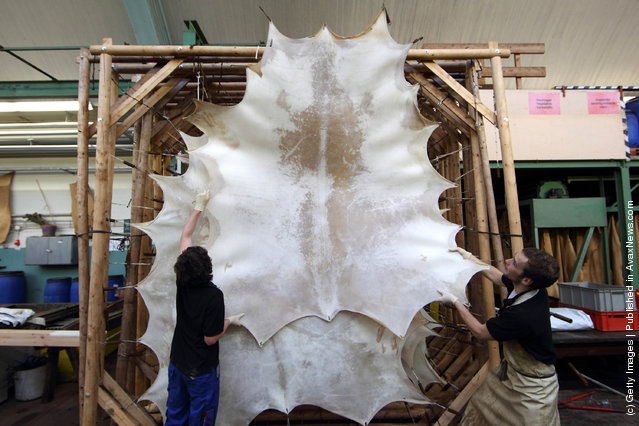
REUTLINGEN, GERMANY - NOVEMBER 17: Students hang out finished parchment leather at the LGR (Lederinstitut Gerberschule Reutlingen) tannery school on November 17, 2010 in Reutlingen, Germany. Even in early antiquity and up their hair or dried goat and sheep skins were used as material for documents. In the small Asian city Pergamon these skins were processed in large quantities for this purpose, so they formed the main trading arm of the city, of which the name is parchment is derived. In medieval times, reached the parchment is of great importance, it was such as France's production under the supervision of the University of Paris. Even now, important documents, placed on their unlimited shelf life as possible large value (eg diplomas, addresses, memory, writings, documents for primary and keystones) written on parchment...
Details
20 Nov 2011 18:17:00
Spanish Riding School Of Vienna, white lipizzaner Stallion

A white lipizzaner Stallion performs during the Spanish Riding School of Vienna Gala Performance at Wembley Arena on November 24, 2011 in London, England. (Photo by Chris Jackson/Getty Images)
Details
25 Nov 2011 14:03:00
Models prepare for the Glasgow School of Art Fashion show

Models prepare for the Glasgow School of Art Fashion show on March 13, 2012 in Glasgow, Scotland. Third year textiles and fashion students unveil their striking new collections, inspired by the idea of movement. The Glasgow School of Art has produced some of the most celebrated designers of recent years, notably Jonathan Saunders. (Photo by Jeff J. Mitchell/Getty Images)
Details
14 Mar 2012 08:00:00
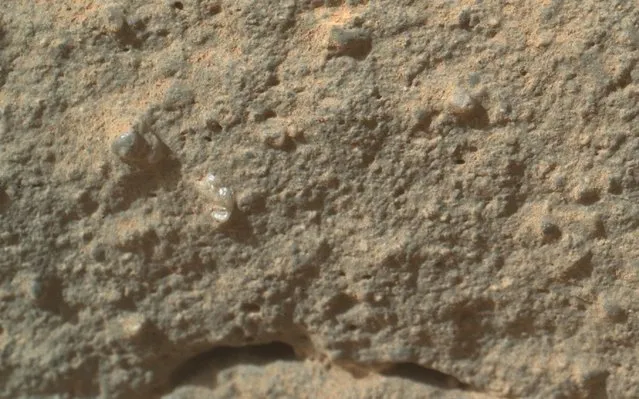
Scientists say that a “Martian flower”, seen here in an image from the Curiosity rover's Mars Hand Lens Imager, is a 2-millimeter-wide grain or pebble that's embedded in the surrounding rock. Another, darker-colored mineral grain can be seen above and to the left. (Photo by NASA)

“The scientists behind NASA's $2.5 billion Curiosity rover mission on Mars on Tuesday explained the nature of a tiny, gleaming "flower" embedded in Red Planet rock, and revealed where they'll be using the SUV-sized robot's drill for the first time”. – Alan Boyle via NBCNews.com

Photo: Scientists say that a “Martian flower”, seen here in an image from the Curiosity rover's Mars Hand Lens Imager, is a 2-millimeter-wide grain or pebble that's embedded in the surrounding rock. Another, darker-colored mineral grain can be seen above and to the left. (Photo by NASA)
Details
16 Jan 2013 11:12:00