Loading...
Done
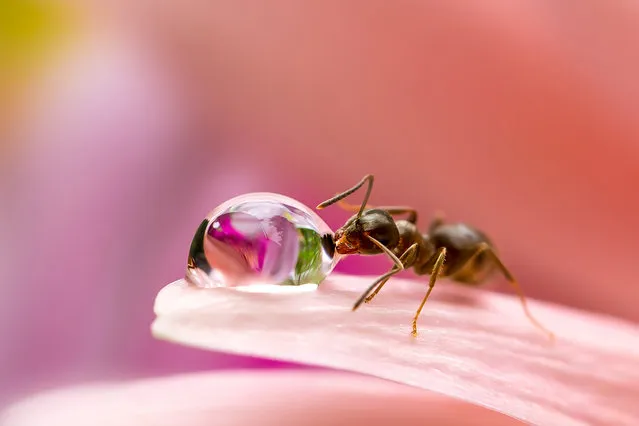
A macro view of an ant taking a sip from a water droplet on the edge of a flower in Obihiro, Japan. Animal-Lover Miki Asai has gone a step beyond feeding bread to the ducks – by syringe-feeding water to tiny ants. The office worker from Obihiro City, Japan, squirts droplets near the tiny insects and then uses a macro lens to capture quenching their thirst. The amateur photographer started capturing these images near her house in July 2013 after spotting an ant struggling in the rain. (Photo by Miki Asai/Barcroft Media)

A macro view of an ant taking a sip from a water droplet on the edge of a flower in Obihiro, Japan. Animal-Lover Miki Asai has gone a step beyond feeding bread to the ducks – by syringe-feeding water to tiny ants. The office worker from Obihiro City, Japan, squirts droplets near the tiny insects and then uses a macro lens to capture quenching their thirst. The amateur photographer started capturing these images near her house in July 2013 after spotting an ant struggling in the rain. (Photo by Miki Asai/Barcroft Media)
Details
09 Sep 2014 08:34:00
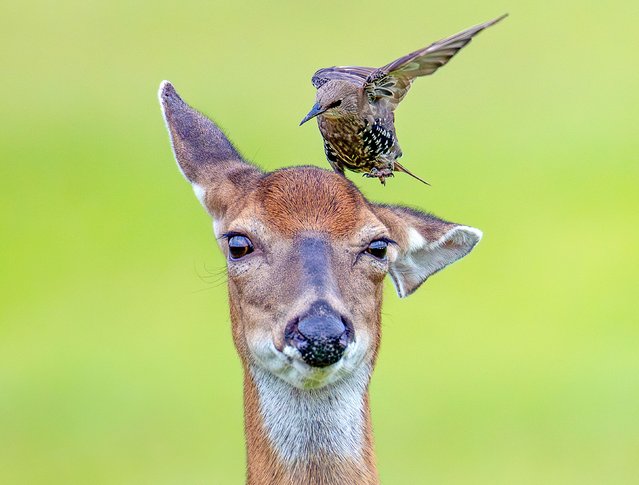
A juvenile European starling hops from deer to deer eating insects. The white-tailed deer did not seem at all bothered by the bird - who can be seen cleaning it of ticks and bugs. The starling was one of a flock near the herd of deer in Sandy Hook, New Jersey, USA in the last decade of November 2025. (Photo by Erik Kessler/Solent News & Photo Agency)

A juvenile European starling hops from deer to deer eating insects. The white-tailed deer did not seem at all bothered by the bird - who can be seen cleaning it of ticks and bugs. The starling was one of a flock near the herd of deer in Sandy Hook, New Jersey, USA in the last decade of November 2025. (Photo by Erik Kessler/Solent News & Photo Agency)
Details
14 Dec 2025 07:17:00
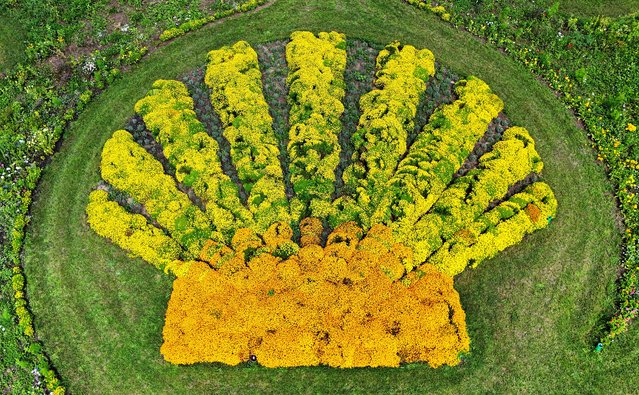
A picture taken with a drone shows a huge work of art created with various flowers and flowering plants in Jacobsdorf, Germany, 29 July 2024. Artist Michael Uy has transformed a piece of fallow land into an insect paradise for bees, bumblebees and butterflies. Using plants, the artist has planted and sown oversized images in the shape of a shell and a winding path of life on a large meadow in Jacobsdorf. (Photo by Hannibal Hanschke/EPA/EFE)

A picture taken with a drone shows a huge work of art created with various flowers and flowering plants in Jacobsdorf, Germany, 29 July 2024. Artist Michael Uy has transformed a piece of fallow land into an insect paradise for bees, bumblebees and butterflies. Using plants, the artist has planted and sown oversized images in the shape of a shell and a winding path of life on a large meadow in Jacobsdorf. (Photo by Hannibal Hanschke/EPA/EFE)
Details
04 Sep 2024 02:53:00
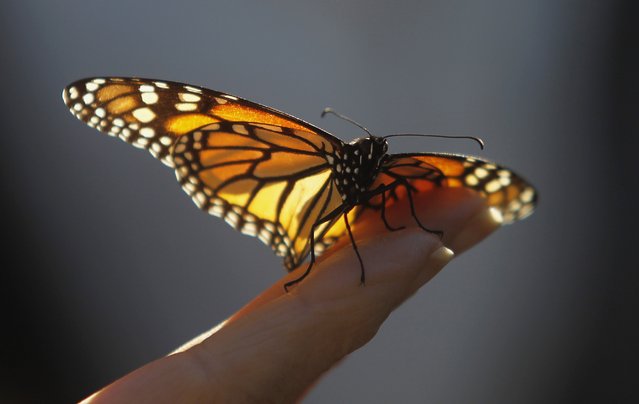
A monarch butterfly rests on a visitor's hand at the Monarch Grove Sanctuary in Pacific Grove, California December 30, 2014. Monarch butterflies may warrant U.S. Endangered Species Act protection because of farm-related habitat loss blamed for sharp declines in cross-country migrations of the orange-and-black insects, the U.S. Fish and Wildlife Service said. (Photo by Michael Fiala/Reuters)

A monarch butterfly rests on a visitor's hand at the Monarch Grove Sanctuary in Pacific Grove, California December 30, 2014. Monarch butterflies may warrant U.S. Endangered Species Act protection because of farm-related habitat loss blamed for sharp declines in cross-country migrations of the orange-and-black insects, the U.S. Fish and Wildlife Service said. (Photo by Michael Fiala/Reuters)
Details
01 Jan 2015 14:08:00
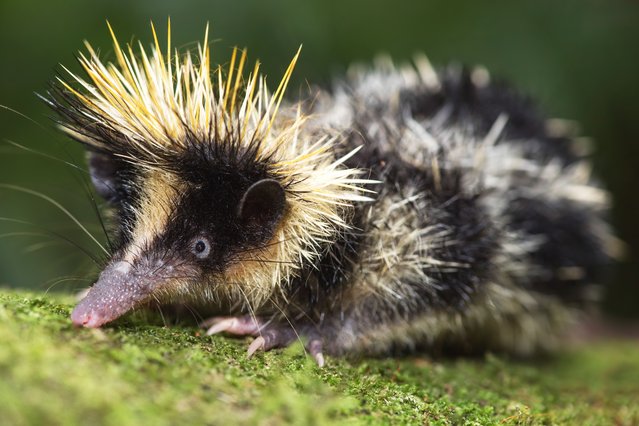
This spiky tenrec was spotted in Madagascar’s Mantadia National Park in the last decade of September 2025. Mostly nocturnal and rarely seen, it puffs out its spines when threatened. Spiky tenrecs are excellent swimmers — unlike most spiny mammals, some species of tenrec can forage in streams and rivers, using their spines for protection while hunting aquatic insects and small prey. (Photo by Dale Morris/Solent News & Photo Agency)

This spiky tenrec was spotted in Madagascar’s Mantadia National Park in the last decade of September 2025. Mostly nocturnal and rarely seen, it puffs out its spines when threatened. Spiky tenrecs are excellent swimmers — unlike most spiny mammals, some species of tenrec can forage in streams and rivers, using their spines for protection while hunting aquatic insects and small prey. (Photo by Dale Morris/Solent News & Photo Agency)
Details
05 Oct 2025 04:02:00
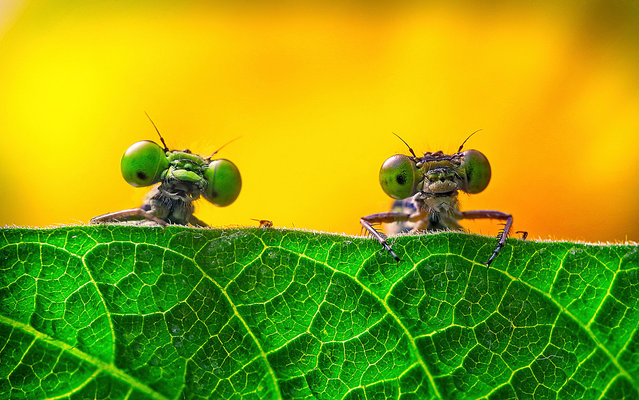
Shortlisted: “Two big eyes” by Miao Yong (Zejiang province, China). Damselflies look over the leaves. “I was photographing insects in a park near my home when suddenly I found two damselflies in the grass. They kept flying and it was very difficult to focus until suddenly they parked behind a leaf”. (Photo by Miao Yong/2017 Royal Society of Biology Photographer of the Year)

Shortlisted: “Two big eyes” by Miao Yong (Zejiang province, China). Damselflies look over the leaves. “I was photographing insects in a park near my home when suddenly I found two damselflies in the grass. They kept flying and it was very difficult to focus until suddenly they parked behind a leaf”. (Photo by Miao Yong/2017 Royal Society of Biology Photographer of the Year)
Details
16 Oct 2017 09:04:00
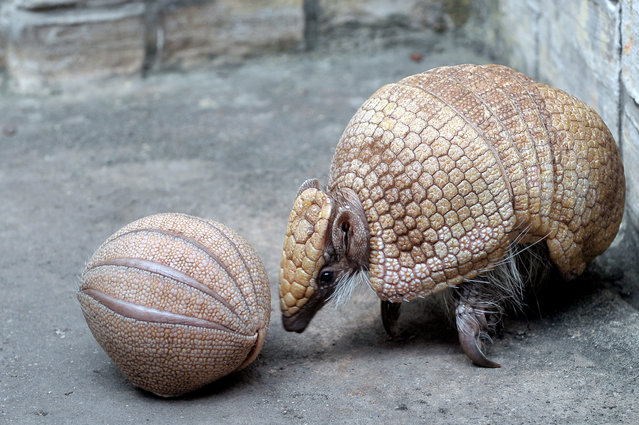
A four-week old southern three-banded armadillo (Tolypeutes matacus) is rolled up into a ball next to its mother in the tropical house of Budapest Zoo in Budapest, Hungary on May 3, 2019. The South American insect-eating mammal and its close relative, the Brasilian three-banded armadillo (Tolypeutes tricinctus) are the only two species of armadillos capable of rolling into a complete ball to defend themselves when feeling threatened. (Photo by Attila Kovács/EPA/EFE)

A four-week old southern three-banded armadillo (Tolypeutes matacus) is rolled up into a ball next to its mother in the tropical house of Budapest Zoo in Budapest, Hungary on May 3, 2019. The South American insect-eating mammal and its close relative, the Brasilian three-banded armadillo (Tolypeutes tricinctus) are the only two species of armadillos capable of rolling into a complete ball to defend themselves when feeling threatened. (Photo by Attila Kovács/EPA/EFE)
Details
05 May 2019 00:03:00
Lord Roscoe the cat runs through the crocuses on the lawns at the National Trust's 17th-century Ham House and Garden in Richmond, London on Monday, March 6, 2023. In recent years more than 500,000 bulbs have been planted to create a spectacle for visitors and to attract bees, butterflies and other pollinating insects. (Photo by Kirsty O'Connor/PA Images via Getty Images)

Lord Roscoe the cat runs through the crocuses on the lawns at the National Trust's 17th-century Ham House and Garden in Richmond, London on Monday, March 6, 2023. In recent years more than 500,000 bulbs have been planted to create a spectacle for visitors and to attract bees, butterflies and other pollinating insects. (Photo by Kirsty O'Connor/PA Images via Getty Images)
Details
26 Apr 2023 02:59:00