Loading...
Done
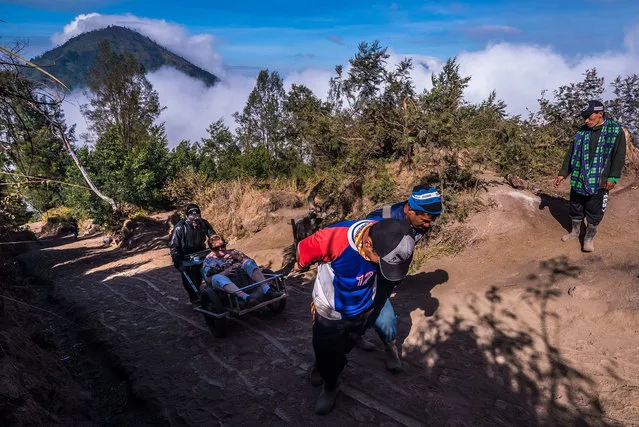
Miners pulling up lazy tourists to the rim of Kawah Ijen (Ijen Volcano), East Java, Indonesia on September 21, 2017. They will earn as much as they would bring down a load of sulfur. Nomadic Explorer, Cultural Lifestyle Photographer Claudio Sieber captured striking images of miners working at Ijen volcanic range in East Java, Indonesia. The sulphur miners risk their lives daily as they climb the active volcano carrying heavy loads, which they sell to sugar refineries. Shortly after midnight curious tourists are flocking in hundreds through the gate of Ijen's foothills to be right on time, driven by the images others took before them. Kawah Ijen is the one of the world's largest acidic volcanic crater lake; famous for its turquoise color as well as the unreal atmosphere it offers during darkness. A dusty path zigzags 3 kilometers up to the crater rim. This doesn't mean anything challenging; in particular, special sights have to be deserved anyway. The irritating smell of sulfur announces the near of the crater's existence. Arriving on the crater's rim the reward for the torture becomes visible. Blue fire darts its tongues through the fumes of sulfur dioxide. Somehow, the spectacle isn't as romantic as expected, since it is also the rough working space of approx. 150 sulfur miners who start their shift at 1 am. Lately, harvesting the abundance of devil's gold received international attention. This did obviously not really improve a miner's lifestyle; neither did it contribute to a better wage. (Photo by Claudio Sieber/Barcroft Images)

Miners pulling up lazy tourists to the rim of Kawah Ijen (Ijen Volcano), East Java, Indonesia on September 21, 2017. They will earn as much as they would bring down a load of sulfur. Nomadic Explorer, Cultural Lifestyle Photographer Claudio Sieber captured striking images of miners working at Ijen volcanic range in East Java, Indonesia. The sulphur miners risk their lives daily as they climb the active volcano carrying heavy loads, which they sell to sugar refineries. (Photo by Claudio Sieber/Barcroft Images)
Details
02 Oct 2017 08:31:00
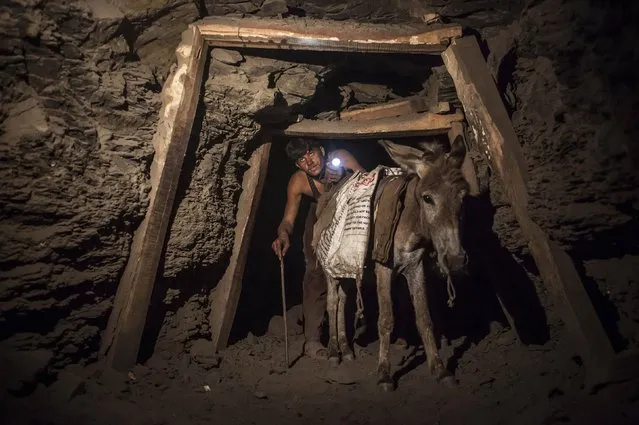
A miner with a donkey makes his way through the low and narrow tunnel leading out of a coal mine in Choa Saidan Shah in Punjab province, April 29, 2014. Workers at this mine in Choa Saidan Shah dig coal with pick axes, break it up and load it onto donkeys to be transported to the surface. (Photo by Sara Farid/Reuters)

A miner with a donkey makes his way through the low and narrow tunnel leading out of a coal mine in Choa Saidan Shah in Punjab province, April 29, 2014. Workers at this mine in Choa Saidan Shah dig coal with pick axes, break it up and load it onto donkeys to be transported to the surface. Employed by private contractors, a team of four workers can dig about a ton of coal a day, for which they earn around $10 to be split between them. The coalmine is in the heart of Punjab, Pakistan's most populous and richest province, but the labourers mostly come from the poorer neighbouring region of Khyber Pakhtunkhwa. (Photo by Sara Farid/Reuters)
Details
03 Aug 2014 07:35:00
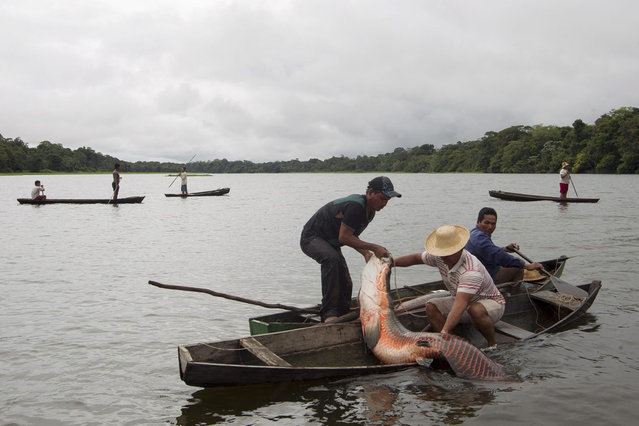
Villagers from the Porto Novo community load into their canoes arapaima or pirarucu, the largest freshwater fish species in South America and one of the largest in the world, while fishing in Poco Fundo lake along a branch of the Solimoes river, one of the main tributaries of the Amazon, in the Mamiraua nature reserve near Fonte Boa about 600 km (373 miles) west of Manaus, November 26, 2013. (Photo by Bruno Kelly/Reuters)

Villagers from the Porto Novo community load into their canoes arapaima or pirarucu, the largest freshwater fish species in South America and one of the largest in the world, while fishing in Poco Fundo lake along a branch of the Solimoes river, one of the main tributaries of the Amazon, in the Mamiraua nature reserve near Fonte Boa about 600 km (373 miles) west of Manaus, November 26, 2013. Catching the arapaima, a fish that is sought after for its meat and is considered by biologists to be a living fossil, is only allowed once a year by Brazil's environmental protection agency. The minimum size allowed for a fisherman to keep an arapaima is 1.5 meters (4.9 feet). (Photo by Bruno Kelly/Reuters)
Details
17 Dec 2013 08:03:00
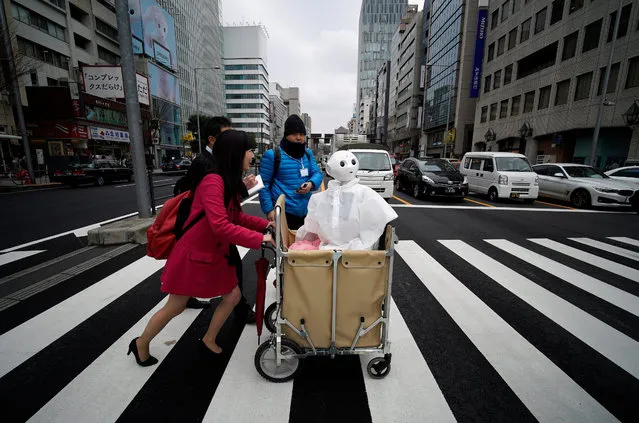
Tomomi Ota pushes a trolley loaded with her humanoid robot Pepper as she crosses a street in Omotesando shopping district in Tokyo, Japan, 24 March 2016. Telecommunications and mobile phone carrier SoftBank Corp. opened a robot-staffed store where 10 Pepper humanoid robots welcome customers looking to buy a mobile phone. The store will be opened until 30 March 2016. (Photo by Franck Robichon/EPA)

Tomomi Ota pushes a trolley loaded with her humanoid robot Pepper as she crosses a street in Omotesando shopping district in Tokyo, Japan, 24 March 2016. Telecommunications and mobile phone carrier SoftBank Corp. opened a robot-staffed store where 10 Pepper humanoid robots welcome customers looking to buy a mobile phone. The store will be opened until 30 March 2016. (Photo by Franck Robichon/EPA)
Details
28 Mar 2016 10:01:00
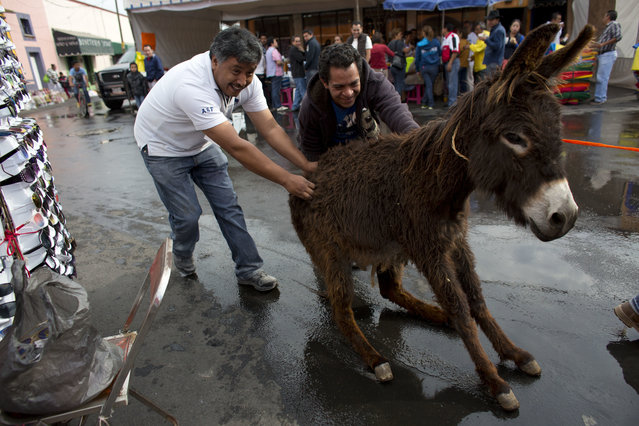
In this May 1, 2016 photo, a reluctant donkey is alternately pushed and pulled and enticed with carrots toward town hall in order to be dressed for the costume competition at the annual donkey festival in Otumba, Mexico state, Mexico. Otumba was an important donkey market during Spanish colonial times, standing at the crossroads of major roads leading to Mexico City, where the beasts pulled heavy loads and carried travelers. Today, however, farmers use tractors and pickup trucks, and the donkey population is in decline. (Photo by Rebecca Blackwell/AP Photo)

In this May 1, 2016 photo, a reluctant donkey is alternately pushed and pulled and enticed with carrots toward town hall in order to be dressed for the costume competition at the annual donkey festival in Otumba, Mexico state, Mexico. Otumba was an important donkey market during Spanish colonial times, standing at the crossroads of major roads leading to Mexico City, where the beasts pulled heavy loads and carried travelers. Today, however, farmers use tractors and pickup trucks, and the donkey population is in decline. (Photo by Rebecca Blackwell/AP Photo)
Details
04 May 2016 11:55:00
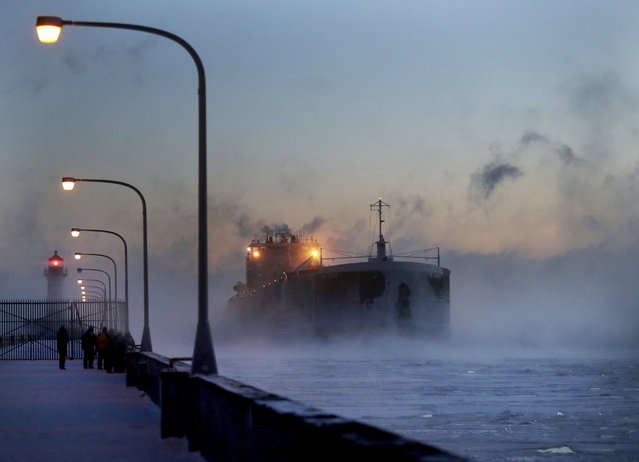
Steam rises from Lake Superior as the ship St. Clair comes to harbor during some of the coldest temps of the year, Sunday, December 31, 2017, at Canal Park in Duluth, Minn. The St. Clair is a self-unloader built in 1976 at Sturgeon Bay, Wis., and is 770 feet long and has 26 hatches that open into 5 cargo holds, providing a load capacity of 45,000 tons. (Photo by David Joles/Star Tribune via AP Photo)

Steam rises from Lake Superior as the ship St. Clair comes to harbor during some of the coldest temps of the year, Sunday, December 31, 2017, at Canal Park in Duluth, Minn. The St. Clair is a self-unloader built in 1976 at Sturgeon Bay, Wis., and is 770 feet long and has 26 hatches that open into 5 cargo holds, providing a load capacity of 45,000 tons. (Photo by David Joles/Star Tribune via AP Photo)
Details
05 Oct 2018 00:03:00
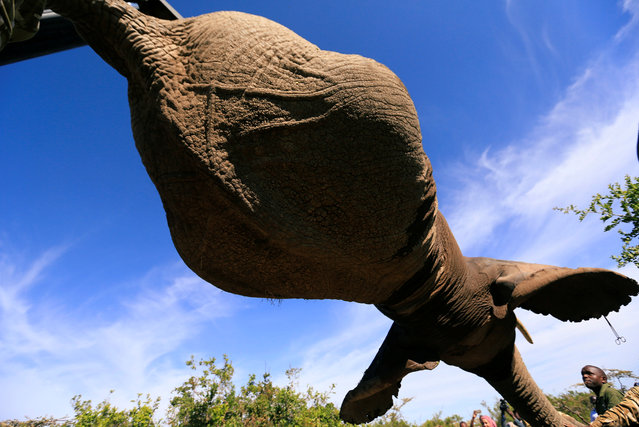
Kenya Wildlife Service (KWS) rangers load a tranquilized elephant onto a truck during a translocation exercise to Ithumba Camp in Tsavo East National Park, in Solio Ranch in Nyeri County, Kenya, February 21, 2018. Wildlife officials in Kenya kicked off a relocation operation for 30 elephants, fitting monitoring collars on the tranquilized animals before using cranes to swing them, inverted with bound feet and scything tusks, onto flatbed trucks. (Photo by Thomas Mukoya/Reuters)

Kenya Wildlife Service (KWS) rangers load a tranquilized elephant onto a truck during a translocation exercise to Ithumba Camp in Tsavo East National Park, in Solio Ranch in Nyeri County, Kenya, February 21, 2018. Wildlife officials in Kenya kicked off a relocation operation for 30 elephants, fitting monitoring collars on the tranquilized animals before using cranes to swing them, inverted with bound feet and scything tusks, onto flatbed trucks. (Photo by Thomas Mukoya/Reuters)
Details
23 Feb 2018 00:04:00
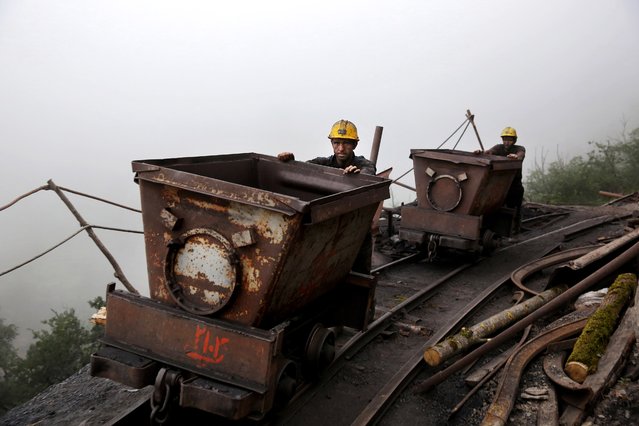
In this Thursday, May 8, 2014 photo, Iranian coal miners push metal carts to be loaded with coal at a mine near the city of Zirab 212 kilometers (132 miles) northeast of the capital Tehran, on a mountain in Mazandaran province, Iran. International sanctions linked to the decade-long dispute over Iran's nuclear program have hindered the import of heavy machinery and modern technology in all sectors, and coal mining is no exception. (Photo by Ebrahim Noroozi/AP Photo)

In this Thursday, May 8, 2014 photo, Iranian coal miners push metal carts to be loaded with coal at a mine near the city of Zirab 212 kilometers (132 miles) northeast of the capital Tehran, on a mountain in Mazandaran province, Iran. International sanctions linked to the decade-long dispute over Iran's nuclear program have hindered the import of heavy machinery and modern technology in all sectors, and coal mining is no exception. (Photo by Ebrahim Noroozi/AP Photo)
Details
28 Sep 2014 11:26:00