Loading...
Done
The Turquoise Ice Lake Baikal

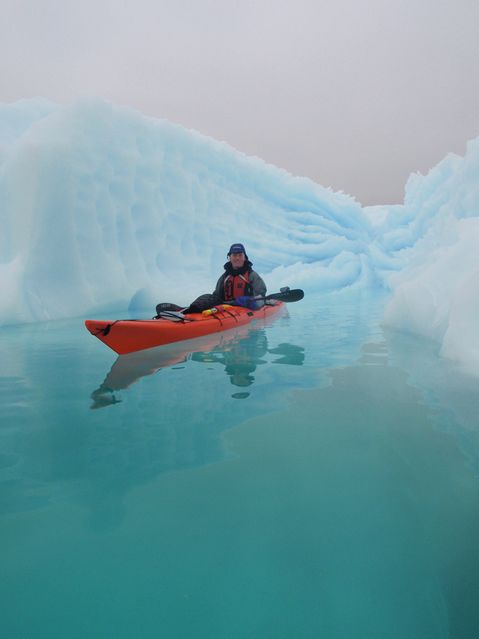
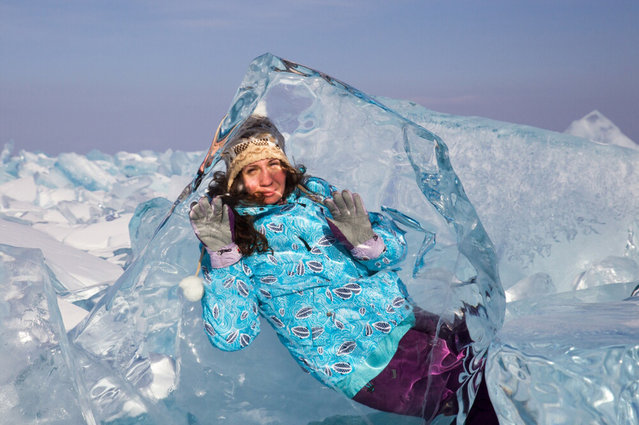
Located in Siberia, Laka Baikal is the largest freshwater lake on the planet that contains approximately 20 percent of the Earth’s freshwater. Apart from being the oldest lake in the world at over 25 million years old, Lake Baikal is also home to over two thousand varieties of flora and fauna, of which almost 1,600 are endemic to the lake. The water of Lake Baikal is renowned for being some of the clearest in the world. When the lake freezes during the winter, an amazing phenomena takes place: large shards of transparent ice form on the surface of the lake, giving the amazing appearance of turquoise ice.
Details
02 May 2014 09:21:00


In preparation for the Dubai Duty Free Men's Open, Andre Agassi and Roger Federer of Switzerland, couldn't resist the temptation to have a friendly “hit” on the world's most unique tennis court, the Helipad of the Burj Al Arab, the world's most luxurious hotel. Standing 321 metres high on a man made island, the majestic Burj Al Arab is without doubt the most recognizable hotel in the world. The hotel's helipad, which is situated 211 metres high covers a surface area of 415 square metres. The pictures were taken on February 22, 2005, in Dubai, United Arab Emirates. (Photo by Getty Images for Dubai Duty Free)
Details
18 Jul 2011 13:40:00
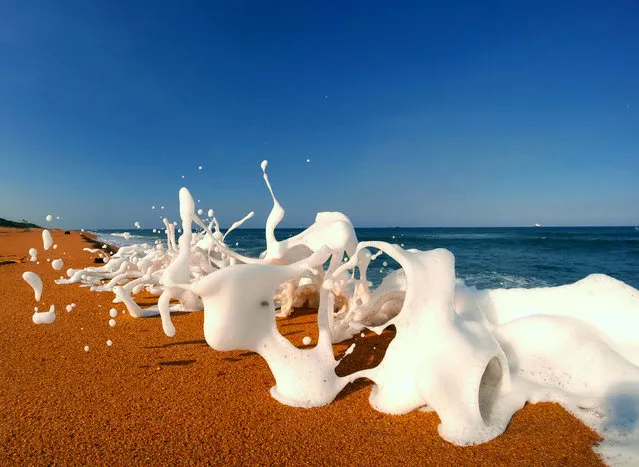
Foam party: Marck captured this moment in time from the shore on July, 30, 2015, in Durban, South Africa. (Photo by Marck Botha/Barcroft Media)

Beautiful seascapes capture the “raw power” of waves rising and crashing in the Indian Ocean. The stunning photos were taken off the coast of Durban in South Africa, and show formations from above and below the surface. Surfer and photographer Marck Botha took the images between April and July, and has always had a passion for the ocean. Here: Marck captured this moment in time from the shore on July, 30, 2015, in Durban, South Africa. (Photo by Marck Botha/Barcroft Media)
Details
30 Jan 2016 13:46:00
Chasing Ice in Greenland

The Greenland ice sheet is a vast body of ice covering 660,235 sq miles, roughly 80% of the surface of Greenland. It is the second largest ice body in the world, after the Antarctic Ice Sheet. Some scientists predict that climate change may be near a "tipping point" where the entire ice sheet will melt in about 2000 years. If the entire 2,850,000 cubic kilometres (683,751 cu mi) of ice were to melt, it would lead to a global sea level rise of 7.2 m (23.6 ft).
Details
30 Apr 2014 13:15:00
Cenote In Mexico

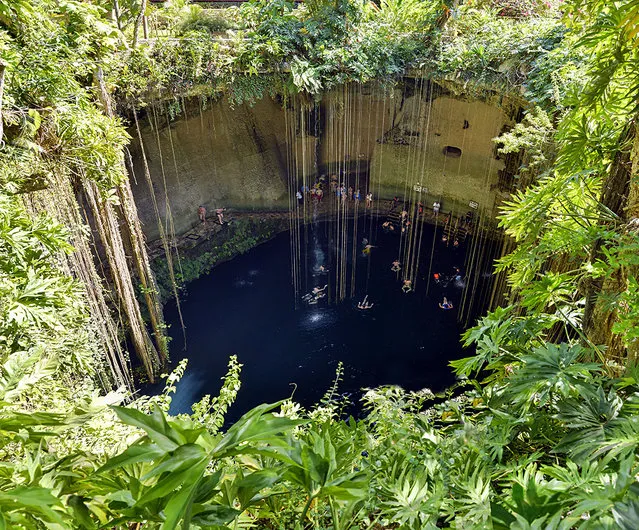
A cenote is a natural phenomenon, a sinkhole in the Earth’s surface. The Yucatan Peninsula in Mexico has an estimated 7,000 cenotes because it is primarily made up of porous limestone. For millions of years, rainfall slowly ate away at the limestone and a huge system of underground caves and caverns was formed. Many filled with water from rain or from the underground water table. When the roof of a water filled cave collapses, a cenote is born. The water found in a cenote may be fresh water, salt water, or both. Structurally it may be completely open, like a lake, almost completely closed with just a small opening at the top, or somewhere in between.
Details
06 Oct 2013 09:45:00
Moraine Lake Canada

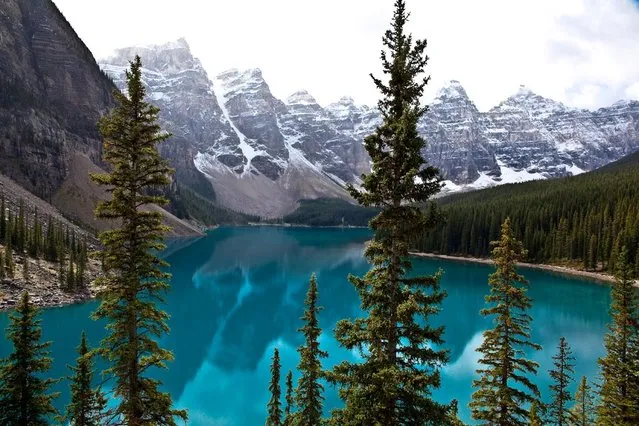
Moraine Lake is a glacially-fed lake in Banff National Park, 14 kilometres (8.7 mi) outside the Village of Lake Louise, Alberta, Canada. It is situated in the Valley of the Ten Peaks, at an elevation of approximately 6,183 feet (1,885 m). The lake has a surface area of .5 square kilometres (0.19 sq mi). The lake, being glacially fed, does not reach its crest until mid to late June. When it is full, it reflects a distinct shade of blue. The colour is due to the refraction of light off the rock flour deposited in the lake on a continual basis.
Details
15 Oct 2013 11:56:00
Kaindy Lake in Kazakhstan

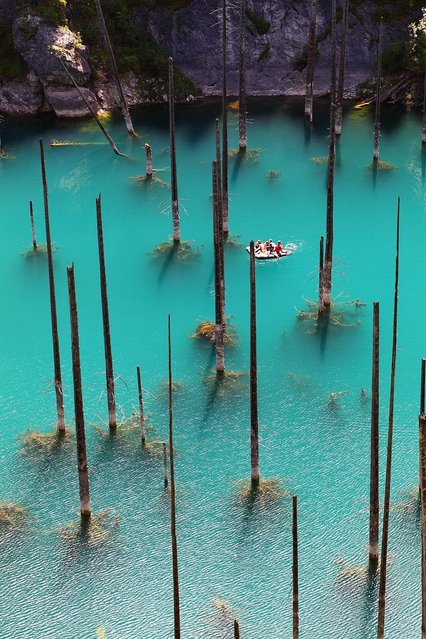
Kaindy Lake (Kazakh: Қайыңды көлі, Qayındı köli) is a 400 metre long lake in Kazakhstan that reaches depths near 30 metres in some areas. It is located 129 km ESE of the city of Almaty and is 2,000 metres above sea level. It was created by the result of an enormous limestone landslide, triggered by the 1911 Kebin earthquake. The track to Kaindy lake has many scenic views to the Saty Gorge, the Chilik River valley and the Kaindy Gorge. Dried-out trunks of submerged Picea schrenkiana trees rise above the surface.
Details
06 Aug 2012 09:58:00
Victoria amazonica

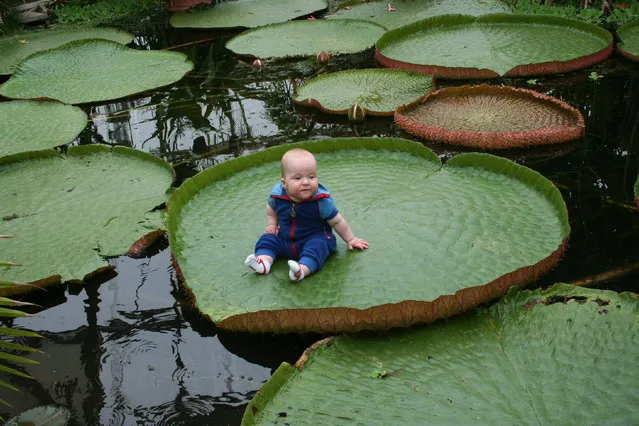
The species has very large leaves, up to 3 m in diameter, that float on the water's surface on a submerged stalk, 7–8 m in length. The species was once called Victoria regia after Queen Victoria, but the name was superseded. V. amazonica is native to the shallow waters of the Amazon River basin, such as oxbow lakes and bayous. It is depicted in the Guyanese coat of arms. The flowers are white the first night they are open and become pink the second night. They are up to 40 cm in diameter, and are pollinated by beetles.
Details
03 Sep 2012 06:58:00