Loading...
Done
Japanese children wear loincloths as they splash about in freezing cold water during Saidaiji Naked Festival, at Saidaiji Temple

“A Hadaka Matsuri (“Naked Festival”) is a type of Japanese festival, or matsuri, in which participants wear a minimum amount of clothing; usually just a Japanese loincloth (called fundoshi), sometimes with a short happi coat, and rarely completely naked. Whatever the clothing, it is considered to be above vulgar, or everyday, undergarments, and on the level of holy Japanese shrine attire. Naked festivals are held in dozens of places throughout Japan every year, usually in the summer or winter. The most famous festival is held in Okayama, where the festival originated. Every year, over 9,000 men participate in this festival”. – Wikipedia

Photo: Japanese men wear loincloths as they splash about in freezing cold water during Saidaiji Naked Festival, at Saidaiji Temple on February 18, 2012 in Okayama, Japan. (Photo by Buddhika Weerasinghe/Getty Images)
Details
19 Feb 2012 12:18:00
Gold medallist Kayla DiCello of the U.S. celebrates on the podium after winning the women's all-around final alongside silver medallist Brazil's Flavia Saraiva and bronze medallist Jordan Chiles of the U.S. at the Pan Am Games in Santiago, Chile on October 23, 2023. (Photo by Agustin Marcarian/Reuters)

Gold medallist Kayla DiCello of the U.S. celebrates on the podium after winning the women's all-around final alongside silver medallist Brazil's Flavia Saraiva and bronze medallist Jordan Chiles of the U.S. at the Pan Am Games in Santiago, Chile on October 23, 2023. (Photo by Agustin Marcarian/Reuters)
Details
01 Nov 2023 00:14:00
Electric cars sit charging in a parking garage at the University of California, Irvine January 26, 2015. “The Irvine Smart Grid Demonstration”, a $79 million project funded half by federal stimulus money and half by Edison and partners like UC Irvine, was launched in 2010. (Photo by Lucy Nicholson/Reuters)

Electric cars sit charging in a parking garage at the University of California, Irvine January 26, 2015. “The Irvine Smart Grid Demonstration”, a $79 million project funded half by federal stimulus money and half by Edison and partners like UC Irvine, was launched in 2010. The $12 billion utility's research team Southern California Edison is testing everything from charging electronic vehicles via cell phone to devices that smooth out the power created by rooftop solar panels. Those are some of the roughly 60 projects in the works at Edison's Advanced Technology division. It has a small $19 million annual budget, but its influence far exceeds that. (Photo by Lucy Nicholson/Reuters)
Details
28 Jan 2015 11:50:00
An orphan plays with her new hula hoop during the food and toy distribution, for total about 500 orphans in 11 orphanages, by National Muslim COVID-19 Response Committee to celebrate Eid al-Fitr, the Muslim holiday which marks the end of the fasting month of Ramadan at Good hope markazil Banatil Islamia orphans centre in Nairobi, Kenya, on May 25, 2020. (Photo by Yasuyoshi Chiba/AFP Photo)

An orphan plays with her new hula hoop during the food and toy distribution, for total about 500 orphans in 11 orphanages, by National Muslim COVID-19 Response Committee to celebrate Eid al-Fitr, the Muslim holiday which marks the end of the fasting month of Ramadan at Good hope markazil Banatil Islamia orphans centre in Nairobi, Kenya, on May 25, 2020. (Photo by Yasuyoshi Chiba/AFP Photo)
Details
06 Jun 2020 00:01:00
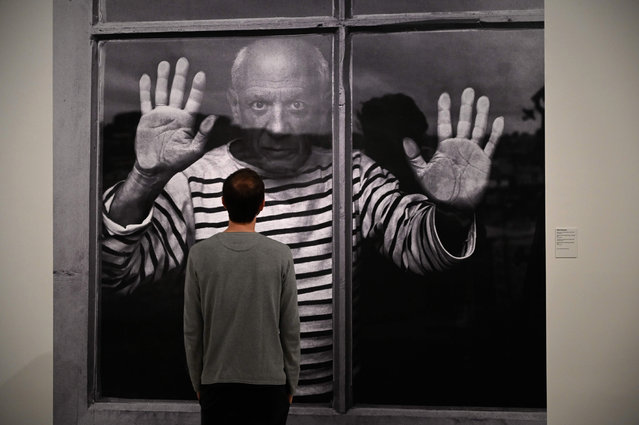
A man looks at a photograph by French photographer Robert Doisneau entitled “The Fate Line: Pablo Picasso at Vallauris, 1952” during the presentation of the photo-exhibition “Picasso, photographer's gaze”, on June 5, 2019 at the Picasso Museum in Barcelona. (Photo by Lluis Gene/AFP Photo)

A man looks at a photograph by French photographer Robert Doisneau entitled “The Fate Line: Pablo Picasso at Vallauris, 1952” during the presentation of the photo-exhibition “Picasso, photographer's gaze”, on June 5, 2019 at the Picasso Museum in Barcelona. (Photo by Lluis Gene/AFP Photo)
Details
07 Jun 2019 00:05:00
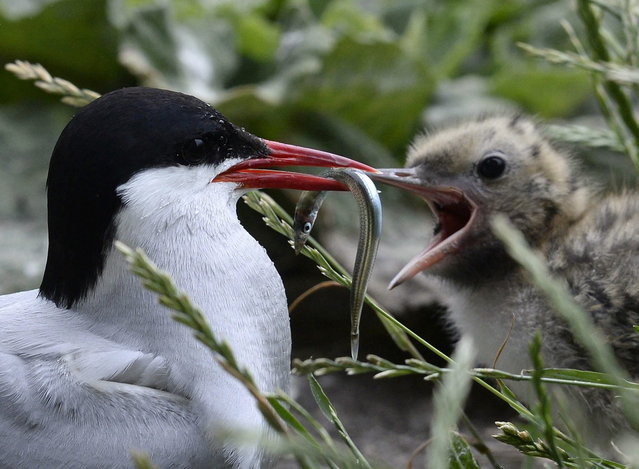
An arctic tern feeds its chick on the Farne Islands off the Northumberland coast, northern England July 8, 2013. (Photo by Nigel Roddis/Reuters)

An arctic tern feeds its chick on the Farne Islands off the Northumberland coast, northern England July 8, 2013. The Farne Islands, which lie off the coast of northeast England, are home to a huge array of wildlife. The islands are owned and protected by the British conservation charity, the National Trust, which says they host some 23 species of seabird, as well as a substantial colony of grey seals, who come to have their pups there in the autumn. Every five years the National Trust carries out a census of the islands' population of puffins, and this year's survey showed there were almost 40,000 nesting pairs on the islands – an 8 percent rise from 2008. (Photo by Nigel Roddis/Reuters)
Details
11 Dec 2013 09:21:00
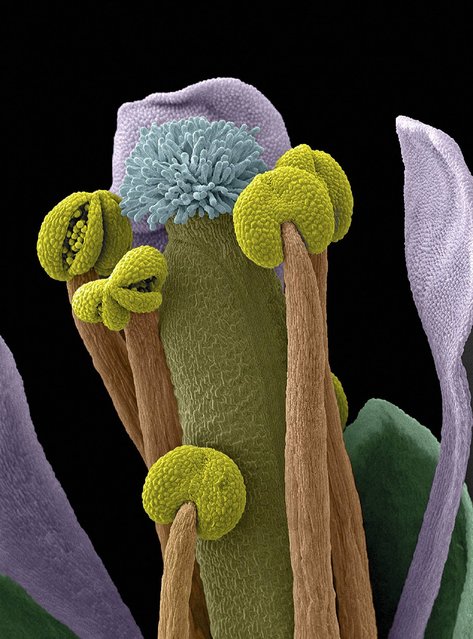
Scanning electron micrograph (SEM) of an Arabidopsis thaliana flower, also commonly known as thale cress. Some of the anthers are open, revealing pollen grains ready for dispersal. Arabidopsis was the first plant to have its entire genome sequenced and is widely used as a model organism in molecular and plant biology. Horizontal width of image is 1200 microns. Magnification 100x. (Photo by Stefan Eberhard/Wellcome Images)

Beautiful, strange and occasionally alarming pictures from the shortlist for this year’s Wellcome image awards – which celebrate the very best in science photography and imaging – from an x-ray of a bat to a micrograph of a kidney stone. The exhibition opens on 12 March at three science centres and the Museum of Science and Industry in Manchester. Photo: Scanning electron micrograph (SEM) of an Arabidopsis thaliana flower, also commonly known as thale cress. Some of the anthers are open, revealing pollen grains ready for dispersal. Arabidopsis was the first plant to have its entire genome sequenced and is widely used as a model organism in molecular and plant biology. Horizontal width of image is 1200 microns. Magnification 100x. (Photo by Stefan Eberhard/Wellcome Images)
Details
11 Mar 2014 05:58:00
Lv Mengmeng, who was born in 1995, poses for a photograph in Shanghai August 22, 2014. When asked if she would like siblings, Mengmeng said: “Maybe brothers, because I think they could protect me”. (Photo by Carlos Barria/Reuters)

Reuters Photographer Carlos Barria photographed a person born in each year China's one child policy has been in existence; from a man born in 1979, to a baby born in 2014, and asked them if they would have like to have siblings. Here: Lv Mengmeng, who was born in 1995, poses for a photograph in Shanghai August 22, 2014. When asked if she would like siblings, Mengmeng said: “Maybe brothers, because I think they could protect me”. (Photo by Carlos Barria/Reuters)
Details
06 Oct 2014 08:20:00