Loading...
Done
A sculpture of Don Quixote shows him wearing the basin he mistook for the enchanted helmet of the fictional Moorish king Mambrino in Alcazar de San Juan, Spain, April 5, 2016. (Photo by Susana Vera/Reuters)

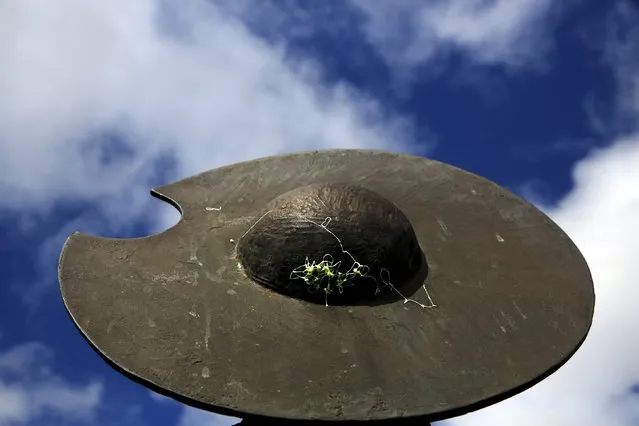
A sculpture of Don Quixote shows him wearing the basin he mistook for the enchanted helmet of the fictional Moorish king Mambrino in Alcazar de San Juan, Spain, April 5, 2016. The arid central Spanish region of La Mancha is the setting for “Don Quixote”, the seventeenth-century novel by Miguel de Cervantes. Four hundred years after his death, references to the characters of Don Quixote, his loyal squire Sancho Panza and his beautiful lady Dulcinea abound in the surrounding villages from sweet treats to theatre productions involving livestock. Cervantes did not give away the name of the birthplace of Don Quixote, a middle-aged gentleman who becomes obsessed with chivalrous ideals. But many identify the village of Argamasilla de Alba as his hometown. The anniversary of Cervantes’ death is marked on the 23 April. (Photo by Susana Vera/Reuters)
Details
21 Apr 2016 12:32:00
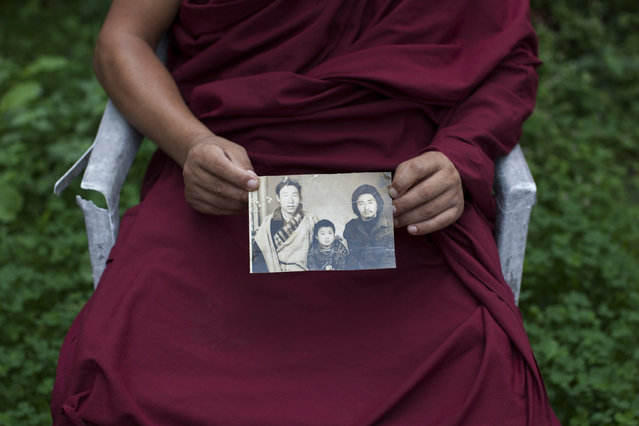
In this Saturday, September 27, 2014 photo, Tibetan monk Dorjee, 38, displays a photograph of his father, left, and himself, center, taken in Tibet, in Dharamsala, India. Dorjee said he held back his tears when he spoke with his parents on the phone after a separation period of 27 years. He exchanged a few words with his father but said his mother fainted on hearing his voice. (Photo by Tsering Topgyal/AP Photo)

“When I was 8 years old, my parents paid a smuggler to take me across the Himalayas, a weekslong walk over the mountains from Tibet to India. It was a trek that tens of thousands of other Tibetans have taken since the Dalai Lama fled a failed 1959 uprising against Chinese rule. My parents must have had their reasons to send me here; they must have had the best of intentions. But 18 years later, I still don't know why they did it. They are not political people. They are small farmers who raise barley and a few yak in a rural area not far from Lhasa, the Tibetan capital. I have not seen them since I left...”. – Tsering Topgyal via The Associated Press. (Photo by Tsering Topgyal/AP Photo)
Details
05 Nov 2014 12:27:00


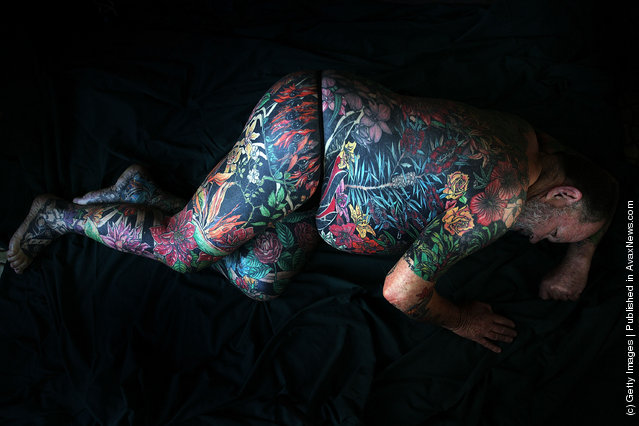
Retired teacher Geoff Ostling displays his tattooed skin at a portrait session at his home in Petersham on May 11, 2009 in Sydney, Australia. The 62-year old has pledged to donate his skin to the National Gallery in Canberra after his death. Ostling, who did not get his first tattoo until he was in his forties, is now covered in the artwork by artist eX de Merci from neck to ankle with the theme 'all the flowers of a Sydney garden'. (Photo by Lisa Maree Williams/Getty Images)
Details
15 Jun 2011 10:22:00
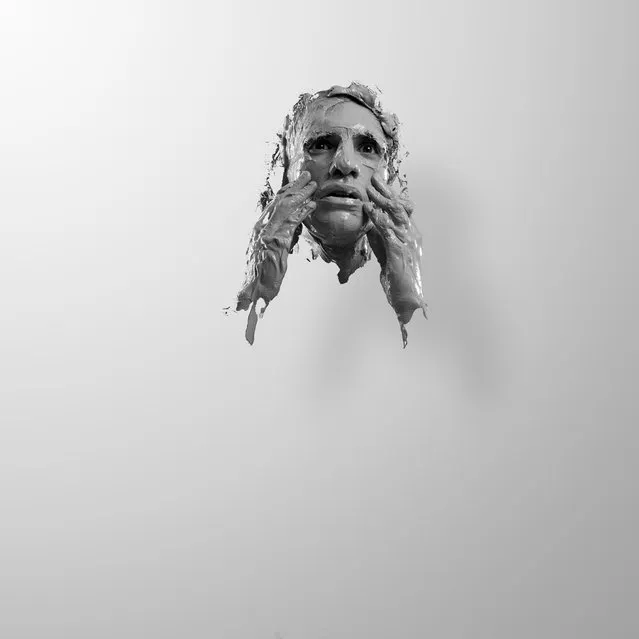
Mud Makes Man By Alejandro Maestre Gasteazi

31-year-old Alejandro Maestre Gasteazi has created an incredibly interesting photographic series about the struggle of an artist. First, though, you may be asking yourself these questions: Exactly, what are we looking at? How did the photographer achieve this strange, sculpture-like illusion?

Gasteazi asked his friend Julián to cover himself with a mixture of blue paint and mud. He then photographed Julián at various stages. Later, in Photoshop, Gasteazi cut around his subject's body to make him appear like a floating sculpture.
Details
06 Jun 2015 09:18:00
A glass building mirrors the sky in Singapore as the sun goes down over the city. (Photo by Fong Qi Wei/Thoughtful Photography)

Intrigued by photographing time, Singapore-based photographer Fong Qi Wei created single, composite pictures from a sequence of images spanning 2-4 hours. He concentrated on capturing sunrises and sunsets as they evolved over different landscapes, seascapes, and cityscapes. He then digitally stitched the images together to get a snapshot of time passing over the scene for his series “Time is a Dimension”. “Most paintings and photographs are an instance of time”, Wei explained in his artist’s statement. “That’s not the way the world works. We experience a sequence of time, and that’s why a video is somehow more compelling than a freeze frame”. (Photo by Fong Qi Wei/Thoughtful Photography)
Details
19 Aug 2014 10:28:00
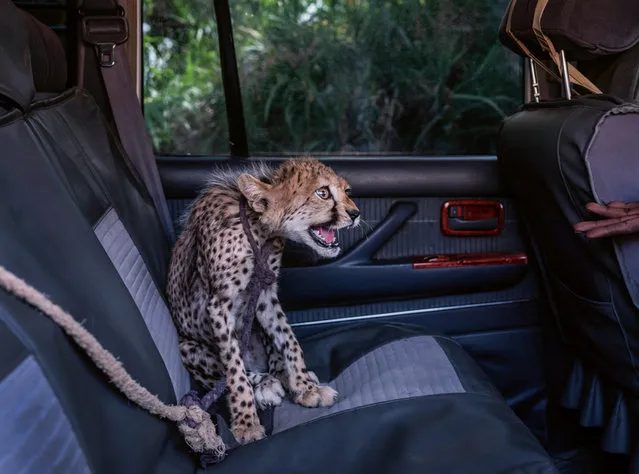
A five-month-old cheetah seated in the back of a Land Cruiser growls at an outstretched hand after being taken from traffickers in Ethiopia and driven to Harirad, Somaliland, in 2020. This photo is part of the work of more than 100 artists in Why We Photograph Animals, a new collection of wildlife photography that aims to help understand why people have photographed animals at different points in history and what it means in the present. (Photo by Nichole Sobecki/Thames & Hudson)

A five-month-old cheetah seated in the back of a Land Cruiser growls at an outstretched hand after being taken from traffickers in Ethiopia and driven to Harirad, Somaliland, in 2020. This photo is part of the work of more than 100 artists in Why We Photograph Animals, a new collection of wildlife photography that aims to help understand why people have photographed animals at different points in history and what it means in the present. (Photo by Nichole Sobecki/Thames & Hudson)
Details
28 Apr 2024 03:15:00
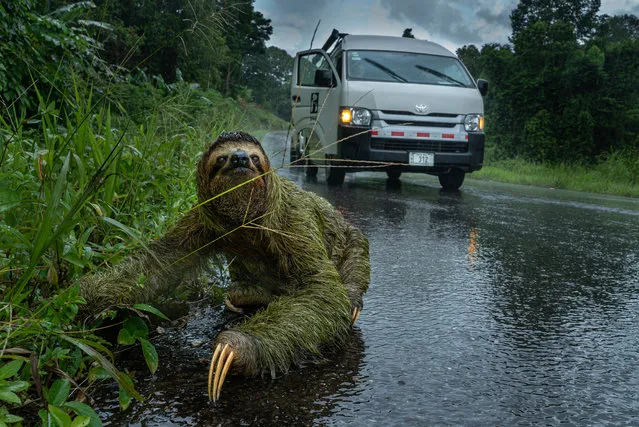
People and Nature category winner: Why did the sloth cross the road? by Andrew Whitworth (Osa Conservation and University of Glasgow), taken in Osa Peninsula, Costa Rica. “I was driving out from the Osa Peninsula, located on the southern Pacific coast of Costa Rica on a dark, stormy day. This female three-toed sloth (Bradypus variegatus) had luckily just about made it across the road, and the drivers of the Toyota on this occasion had spotted her in good time”. (Photo by Andrew Whitworth/2019 British Ecological Society Photography Competition)

People and Nature category winner: Why did the sloth cross the road? by Andrew Whitworth (Osa Conservation and University of Glasgow), taken in Osa Peninsula, Costa Rica. “I was driving out from the Osa Peninsula, located on the southern Pacific coast of Costa Rica on a dark, stormy day. This female three-toed sloth (Bradypus variegatus) had luckily just about made it across the road, and the drivers of the Toyota on this occasion had spotted her in good time”. (Photo by Andrew Whitworth/2019 British Ecological Society Photography Competition)
Details
30 Nov 2019 00:05:00


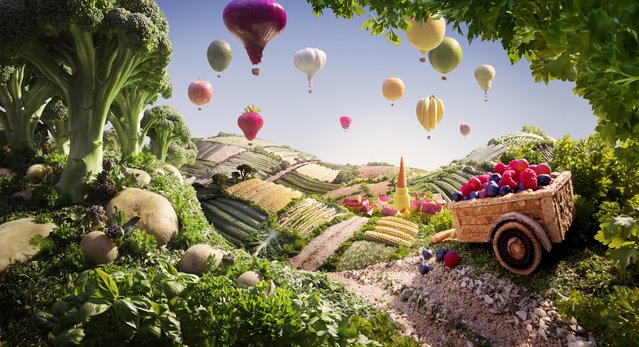
Artist and photographer Carl Warner began his career in landscape and still photography, working many years in the advertising industry. Seeking new inspiration and direction one day, he happened upon a market with Portobello mushrooms that reminded him of trees from an alien world. This would become his first foodscape and the start of a new and exciting direction in his career.
Details
08 Oct 2013 09:27:00