Loading...
Done
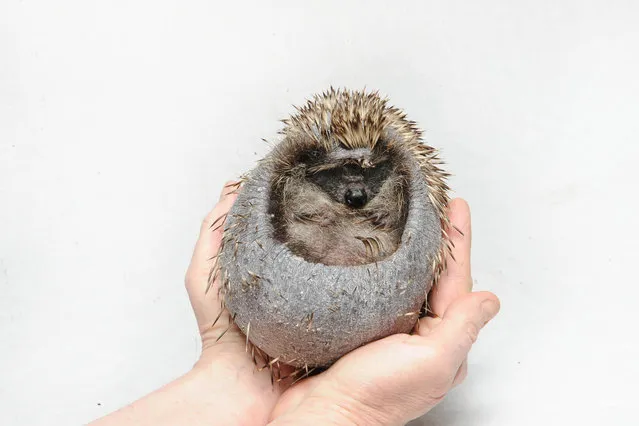
This tiny hedgehog is in a prickly position as hes unable to grow spikes, leaving him needing round-the-clock care. The woodland critter was found with no spikes and has been taken in by a family hoping to nurse him back to health so he can be released into the wild. Named Mr Prickleless, the hedgehog was rescued by Dina Nixon and her daughter Jennifer, 25, after being taken into a rescue centre in December last year. (Photo by Caters News Agency)

This tiny hedgehog is in a prickly position as hes unable to grow spikes, leaving him needing round-the-clock care. The woodland critter was found with no spikes and has been taken in by a family hoping to nurse him back to health so he can be released into the wild. Named Mr Prickleless, the hedgehog was rescued by Dina Nixon and her daughter Jennifer, 25, after being taken into a rescue centre in December last year. It is not known what happened to his spikes, but Dina has vowed that if they ever do return he will be returned to the wild. But for now the hedgehog has taken shelter in a rabbit hutch in her garden. (Photo by Caters News Agency)
Details
19 Jul 2014 11:03:00
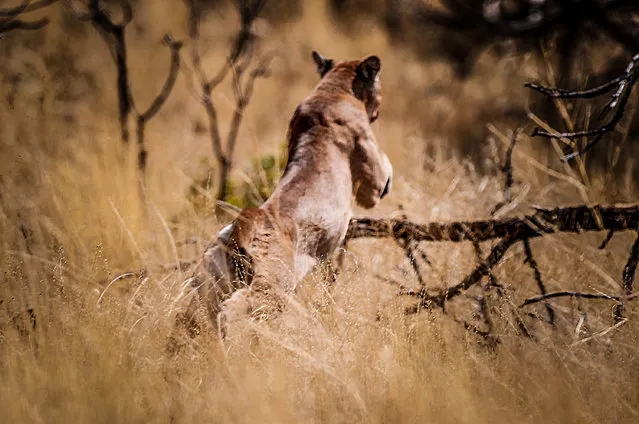
In this Monday, September 22, 2014 photo provided by the Utah Division of Wildlife Resources, a young  cougar is released back into Utah's mountains by the Utah Division of Wildlife Resources in an undisclosed site in central Utah. (Photo by Steve Gray/AP Photo/Utah Division of Wildlife Resources)

In this Monday, September 22, 2014 photo provided by the Utah Division of Wildlife Resources, a young cougar is released back into Utah's mountains by the Utah Division of Wildlife Resources in an undisclosed site in central Utah. State wildlife officials received reports of the cougar roaming Sunday afternoon in a residential area of the city's eastern flank, a few miles from the base of the Wasatch Mountains. Authorities say cougars generally avoid humans but sometimes enter neighborhoods close to their mountain habitats. (Photo by Steve Gray/AP Photo/Utah Division of Wildlife Resources)
Details
27 Sep 2014 12:32:00
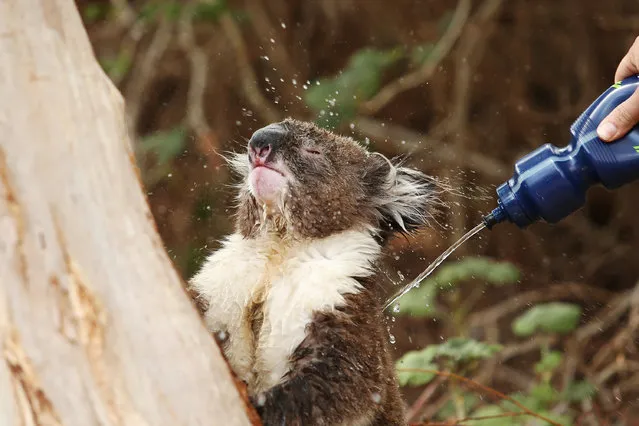
A heat-stressed koala waits as a resident pours water on its back on December 19, 2015 in Adelaide, Australia. Adelaide is experiencing an extreme heatwave, with temperatures reaching over 40 degrees for five consecutive days. (Photo by Morne de Klerk/Getty Images)

A heat-stressed koala waits as a resident pours water on its back on December 19, 2015 in Adelaide, Australia. Adelaide is experiencing an extreme heatwave, with temperatures reaching over 40 degrees for five consecutive days. (Photo by Morne de Klerk/Getty Images)
Details
26 Dec 2015 08:03:00
Visitors look at tropical fish transported from Japan's southern island of Okinawa displayed in a giant 14-ton fish tank at the Sony Square event space in Tokyo on July 17, 2016. The 45-day-long summer exhibition will be held through August 28 to display sea creatures common to the waters around Okinawa. (Photo by Kazuhiro Nogi/AFP Photo)

Visitors look at tropical fish transported from Japan's southern island of Okinawa displayed in a giant 14-ton fish tank at the Sony Square event space in Tokyo on July 17, 2016. The 45-day-long summer exhibition will be held through August 28 to display sea creatures common to the waters around Okinawa. (Photo by Kazuhiro Nogi/AFP Photo)
Details
18 Jul 2016 13:05:00
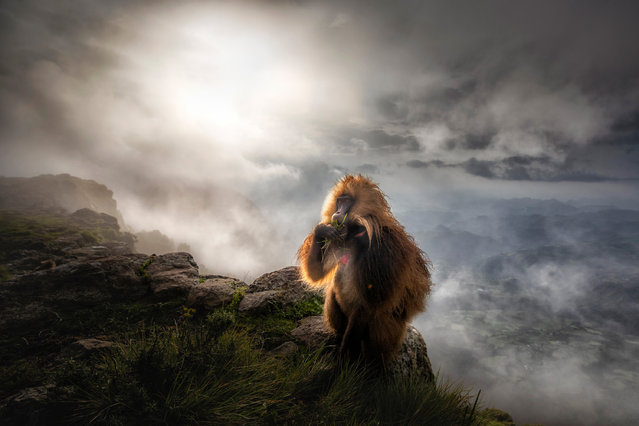
Highly commended, mammals: Gelada after the storm – Marco Gaiotti (Italy). “Gelada baboons are the only monkey species in the world that feed on grasses. They are native to the tableland of Ethiopia. Every morning large family groups wander from their sleeping places in the steep rock face, up to 1,000 metres high, to the feeding grounds at the tablelands. This image clearly depicts their feeding strategy: they pull out bunches of grass, sort the stalks and then lift them to their mouth. This shot was taken towards the end of the rainy season after a heavy storm”. (Photo by Marco Gaiotti/2019 GDT European Wildlife Photographer of the Year)

Highly commended, mammals: Gelada after the storm – Marco Gaiotti (Italy). “Gelada baboons are the only monkey species in the world that feed on grasses. They are native to the tableland of Ethiopia. Every morning large family groups wander from their sleeping places in the steep rock face, up to 1,000 metres high, to the feeding grounds at the tablelands. This image clearly depicts their feeding strategy: they pull out bunches of grass, sort the stalks and then lift them to their mouth. This shot was taken towards the end of the rainy season after a heavy storm”. (Photo by Marco Gaiotti/2019 GDT European Wildlife Photographer of the Year)
Details
31 Oct 2019 00:03:00
Hunt started working as Michael Jackson after receiving compliments at a Halloween party in his hometown of Fort Worth, Texas. His Michael Jackson is from the 2000s, and like a true lookalike, he uses mannerisms and a voice that he’s styled after Michael Jackson when interacting with his audiences. After working in Las Vegas, he returned to Fort Worth and finds work as an actor. (Photo and caption by Lorena Turner)

“Michael Jackson, the performer, consistently transcended racial and gender perceptions; Michael Jackson tribute artists, impersonators and lookalikes reflect this in that they embody a wide span of inspiration and intention. The current crop of impersonators are people who take great care in their appearance – some spend a lot of money and time on their make up and clothing, while others are more concerned with the physical gestures associated with his dances while expressing very little concern in the creation of an illusion”. – Lorena Turner. (Photo and caption by Lorena Turner)
Details
17 Jun 2015 08:09:00
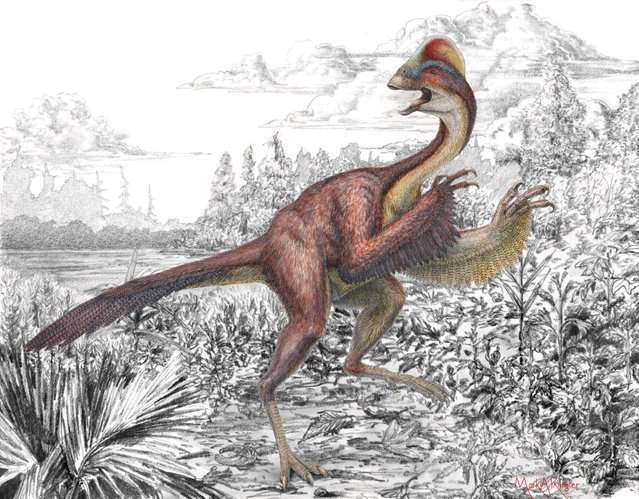
Life reconstruction of the new oviraptorosaurian dinosaur species Anzu wyliei in its 66 million-year-old environment in western North America as seen in an undated handout illustration by Mark A. Klinger, Carnegie Museum of Natural History. Some 18,000 species, great and small, were discovered in 2014, adding to the 2 million already known, scientists said on May 21, 2015 as they released a “Top 10” list that highlights the diversity of life. (Photo by Mark A. Klingler/Reuters/Carnegie Museum of Natural History)

Life reconstruction of the new oviraptorosaurian dinosaur species Anzu wyliei in its 66 million-year-old environment in western North America as seen in an undated handout illustration by Mark A. Klinger, Carnegie Museum of Natural History. Some 18,000 species, great and small, were discovered in 2014, adding to the 2 million already known, scientists said on May 21, 2015 as they released a “Top 10” list that highlights the diversity of life. Anzu wyliei, one of the top 10, dubbed “the chicken from hell”, is extinct. The feathered dinosaur whose partial skeletons were unearthed in the Dakotas was a contemporary of T. rex and Triceratops. (Photo by Mark A. Klingler/Reuters/Carnegie Museum of Natural History)
Details
22 May 2015 12:31:00
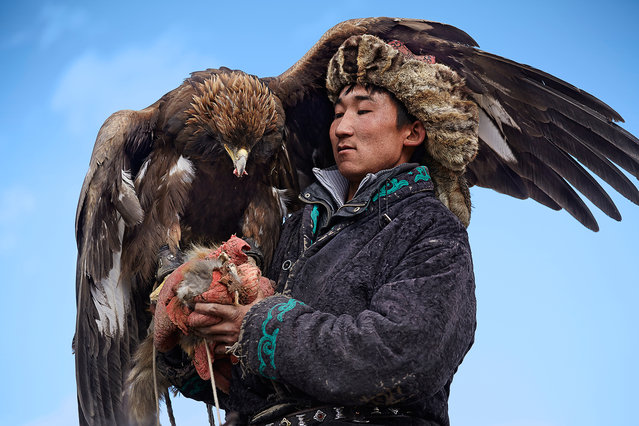
In one of the planet’s most desolate and harsh terrains, the Altai Mountains which run from Siberia in Russia down to Mongolia’s Gobi Desert, hunting with eagles is currently only practiced by a handful of Kyrgyz and Kazakhs. This form of falconry, the practice of hunting with the aid of birds of prey, can be traced back as far as 4,000 years in Central Asia. (Photo by Tariq Zaidi/The Washington Post)

In one of the planet’s most desolate and harsh terrains, the Altai Mountains which run from Siberia in Russia down to Mongolia’s Gobi Desert, hunting with eagles is currently only practiced by a handful of Kyrgyz and Kazakhs. This form of falconry, the practice of hunting with the aid of birds of prey, can be traced back as far as 4,000 years in Central Asia. Here: after a successful hunt, a proud hunter rewards his eagle by feeding it the lungs of the prey, which is considered the most highly prized part of the animal. (Photo by Tariq Zaidi/The Washington Post)
Details
22 Aug 2015 12:46:00