Loading...
Done
Beautiful Photography By Daniel Rericha

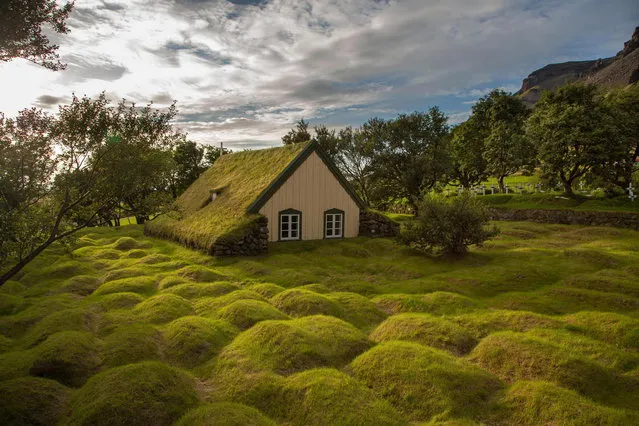
Daniel Rericha born in 1972 in the Czech Republic. Living in a small town, located near the mountain ridge, from childhood he was inspired by the mountains and fell in love with them. In his spare time he enjoys traveling with his wife. In these travels, he tries to capture in his lens as many beautiful places. His work is imbued with the spirit through the mountains, air and space.
Details
06 Sep 2015 13:03:00
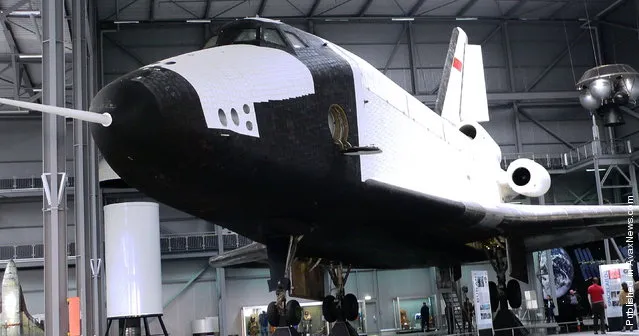
Buran

“The Buran program was a Soviet and later Russian reusable spacecraft project that began in 1974 at TsAGI and was formally suspended in 1993. It was a response to the United States Space Shuttle program”. – Wikipedia

Photo by: These Pictures are Entirely Bad ; Source: Flickr
Details
17 Sep 2011 12:00:00
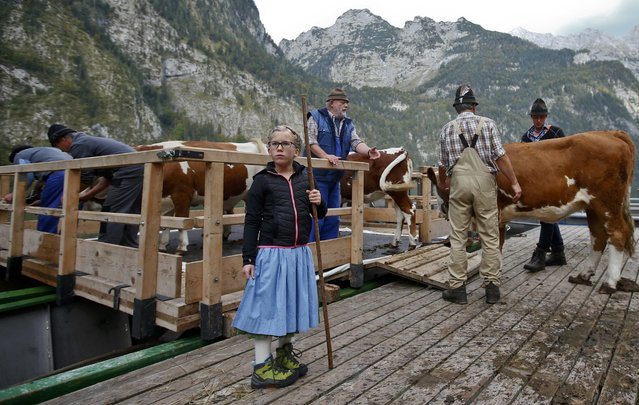
Bavarian farmers load their cows on a boat before they drive over the picturesque Lake Koenigssee, Germany, October 3, 2015. (Photo by Michael Dalder/Reuters)

Bavarian farmers load their cows on a boat before they drive over the picturesque Lake Koenigssee, Germany, October 3, 2015. Before the winter season approaches the farmers have to drive their cattle down from their Alpine meadows to a narrow valley that can only be reached by boat. (Photo by Michael Dalder/Reuters)
Details
06 Oct 2015 08:01:00
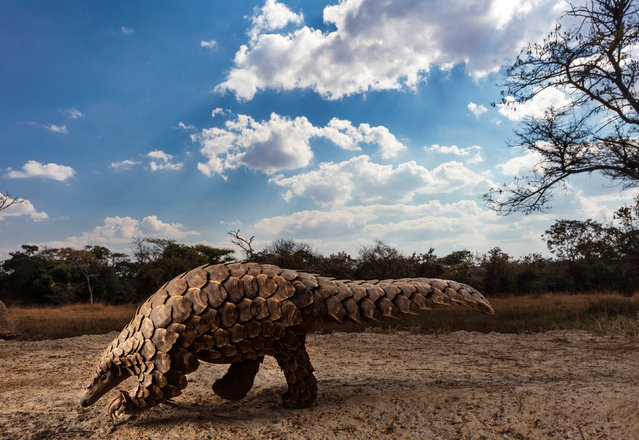
Pangolins in Crisis: Brent Stirton, South Africa; 1st place, Natural world and wildlife. “Pangolins are the world’s most illegally trafficked mammals, with an estimated one million trafficked to Asia in the last 10 years. Their scales are used in traditional Chinese and Vietnamese medicine, and their meat is sold as a high-priced delicacy. As a result, pangolins are listed as critically endangered and anyone who trades or consumes them is breaking the law. This body of work exposes the trade, while exploring aspects of illegality and celebrating the people who are trying to save these animals”. (Photo by Brent Stirton/Sony World Photography Awards 2020)

Pangolins in Crisis: Brent Stirton, South Africa; 1st place, Natural world and wildlife. “Pangolins are the world’s most illegally trafficked mammals, with an estimated one million trafficked to Asia in the last 10 years. Their scales are used in traditional Chinese and Vietnamese medicine, and their meat is sold as a high-priced delicacy. As a result, pangolins are listed as critically endangered and anyone who trades or consumes them is breaking the law. This body of work exposes the trade, while exploring aspects of illegality and celebrating the people who are trying to save these animals”. (Photo by Brent Stirton/Sony World Photography Awards 2020)
Details
11 Jun 2020 00:05:00
Astronaut Edward H. White II, pilot for the Gemini-Titan 4 (GT-4) spaceflight, floats in the zero-gravity of space during the third revolution of the GT-4 spacecraft on June 3, 1965. White wears a specially designed spacesuit. His face is shaded by a gold-plated visor to protect him from unfiltered rays of the sun. (Photo by NASA)

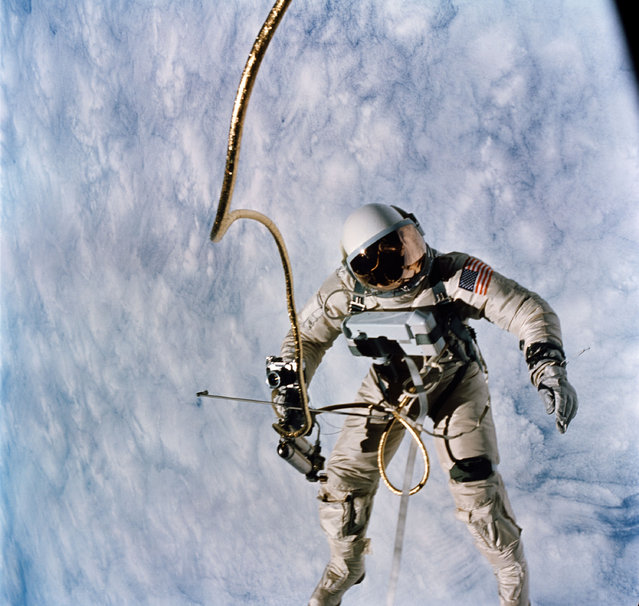
Astronaut Edward H. White II, pilot for the Gemini-Titan 4 (GT-4) spaceflight, floats in the zero-gravity of space during the third revolution of the GT-4 spacecraft on June 3, 1965. White wears a specially designed spacesuit. His face is shaded by a gold-plated visor to protect him from unfiltered rays of the sun. In his right hand he carries a Hand-Held Self-Maneuvering Unit (HHSMU) that gives him control over his movements in space. White also wears an emergency oxygen chest pack; and he carries a camera mounted on the HHSMU for taking pictures of the sky, Earth and the GT-4 spacecraft. He is secured to the spacecraft by a 25-feet umbilical line and a 23-feet tether line. Both lines are wrapped together in gold tape to form one cord. Astronaut James A. McDivitt, command pilot, remained inside the spacecraft during the extravehicular activity (EVA). Astronaut White died in the Apollo/Saturn 204 fire at Cape Kennedy on January 27, 1967. (Photo by NASA)

Details
22 Jul 2014 12:05:00
Soap Bubble Structures by Kym Cox. Bubbles optimise space and minimise their surface area for a given volume of air. This phenomenon makes them a useful tool in many areas of research, in particular, materials science and ‘packing’ – how things fit together. Bubble walls drain under gravity, thin at the top, thick at the bottom, which interferes with travelling lightwaves to create bands of colour. Black spots show the wall is too thin for interference colours, indicating the bubble is about to burst. (Photo by Kym Cox/2019 Science Photographer of the Year/RPS)

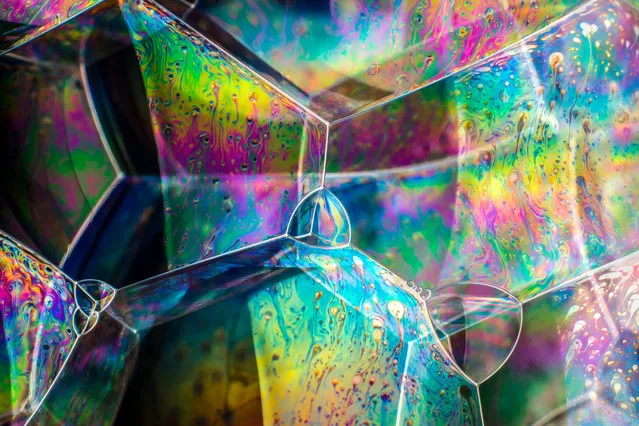
Soap Bubble Structures by Kym Cox. Bubbles optimise space and minimise their surface area for a given volume of air. This phenomenon makes them a useful tool in many areas of research, in particular, materials science and “packing” – how things fit together. Bubble walls drain under gravity, thin at the top, thick at the bottom, which interferes with travelling lightwaves to create bands of colour. Black spots show the wall is too thin for interference colours, indicating the bubble is about to burst. (Photo by Kym Cox/2019 Science Photographer of the Year/RPS)
Details
15 Aug 2019 00:03:00
Dalmatian pelicans on Lake Kerkini in Greece captured over the space of one week (16-21 January 2023) by tour guide photographer Sean Weekly. The Dalmatian pelicans resemble the winged dinosaur pterodactyl as they swoop, splash and feed in the waters of Lake Kerkini in Greece. With wings outstretched, and colourful faces and beaks on display, the birds appear to be in paradise, with the awe-inspiring Kerkini mountains as a mesmerising backdrop. (Photo by Sean Weekly/Animal News Agency)

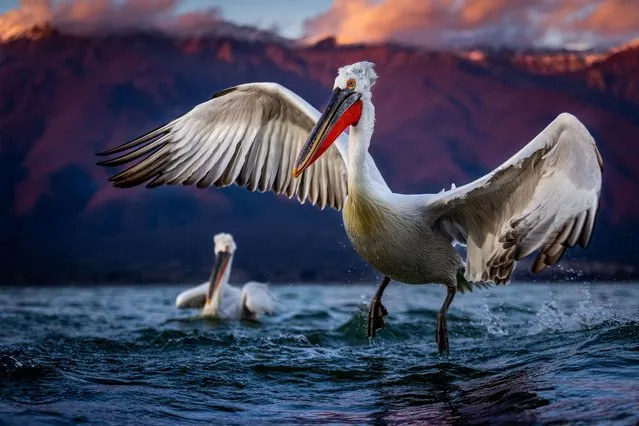
Dalmatian pelicans on Lake Kerkini in Greece captured over the space of one week (16-21 January 2023) by tour guide photographer Sean Weekly. The Dalmatian pelicans resemble the winged dinosaur pterodactyl as they swoop, splash and feed in the waters of Lake Kerkini in Greece. With wings outstretched, and colourful faces and beaks on display, the birds appear to be in paradise, with the awe-inspiring Kerkini mountains as a mesmerising backdrop. (Photo by Sean Weekly/Animal News Agency)
Details
05 Feb 2023 05:57:00
Participants compete to do nothing during the Space-out competition at World Expo 2025 on September 27, 2025 in Osaka, Japan. For 90 minutes, participants sat in silence, trying to remain in a dazed state without distraction. The winner was determined not by activity but by calmness maintaining the most stable heart rate amid the lively crowds of the Osaka Expo site. (Photo by Tomohiro Ohsumi/Getty Images)

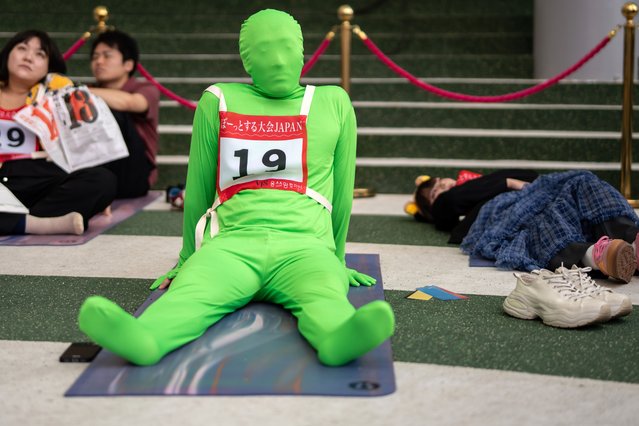
Participants compete to do nothing during the Space-out competition at World Expo 2025 on September 27, 2025 in Osaka, Japan. For 90 minutes, participants sat in silence, trying to remain in a dazed state without distraction. The winner was determined not by activity but by calmness maintaining the most stable heart rate amid the lively crowds of the Osaka Expo site. (Photo by Tomohiro Ohsumi/Getty Images)
Details
25 Nov 2025 05:19:00