Loading...
Done
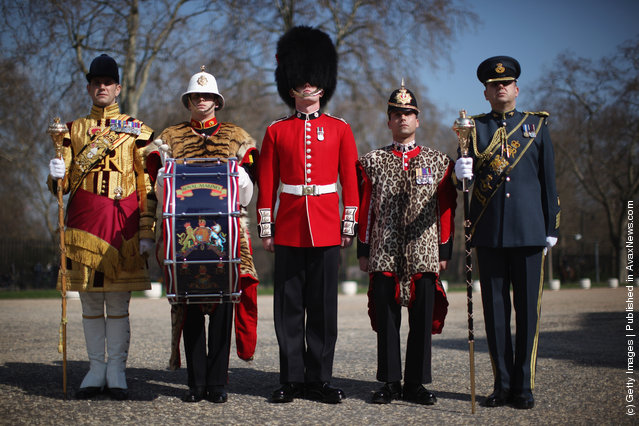
(L-R) Senior Drum Major Betts of the Scotts Guard, Bugler Lee Kidd, Guardsman Adam Deer of the Coldstream Guards and Lance corporal Michael Strong of the Princess of Wales's Royal Regiment pose in their full ceremonial attire at Wellington Barracks

(L-R) Senior Drum Major Betts of the Scotts Guard, Bugler Lee Kidd, Guardsman Adam Deer of the Coldstream Guards and Lance corporal Michael Strong of the Princess of Wales's Royal Regiment pose in their full ceremonial attire at Wellington Barracks on March 21, 2012 in London, England. The group make up part of the ceremonial military personnel who will play a key role during Her Majesty the Queens Diamond Jubilee celebrations between June 2–5. (Photo by Dan Kitwood/Getty Images)
Details
23 Mar 2012 11:50:00
The Three Peaks Of Lavaredo

The three peaks of Lavaredo, or the “Tre Cime di Lavaredo” in Italian, are three distinctive battlement-like peaks, in the Sexten Dolomites of northeastern Italy. They are probably one of the best-known mountain groups in the Alps, and one of the most photographed in Italy. The three peaks are named, from east to west, "little peak" (Cima Piccola), "big peak" (Cima Grande) and "western peak" (Cima Ovest). The Cima Grande has an elevation of 2,999 metres (9,839 ft). It stands between the Cima Piccola, at 2,857 metres (9,373 ft), and the Cima Ovest, at 2,973 metres (9,754 ft).
Details
21 Oct 2013 10:27:00
Finding just the right spot above the clouds at Camp 1 on Ama Dablam, Danuru Sherpa uses his iPhone to catch up with friends and family. Even at 18,500 feet (5,654 meters), climbers here can check their email and other dispatches from the world below. (Photo by Aaron Huey/National Geographic)

Finding just the right spot above the clouds at Camp 1 on Ama Dablam, Danuru Sherpa uses his iPhone to catch up with friends and family. Even at 18,500 feet (5,654 meters), climbers here can check their email and other dispatches from the world below. (Photo by Aaron Huey/National Geographic)
Details
28 Apr 2014 09:14:00
A woman looks out of a dusty window after boarding a bus to be transported to see the casket of Nelson Mandela at the Union Buildings in Pretoria, South Africa, Wednesday December 11, 2013. On Thursday, December 5, 2013, Mandela died at the age of 95. (Photo by Markus Schreiber/AP Photo)

A woman looks out of a dusty window after boarding a bus to be transported to see the casket of Nelson Mandela at the Union Buildings in Pretoria, South Africa, Wednesday December 11, 2013. On Thursday, December 5, 2013, Mandela died at the age of 95. (Photo by Markus Schreiber/AP Photo)
Details
13 Dec 2013 08:21:00


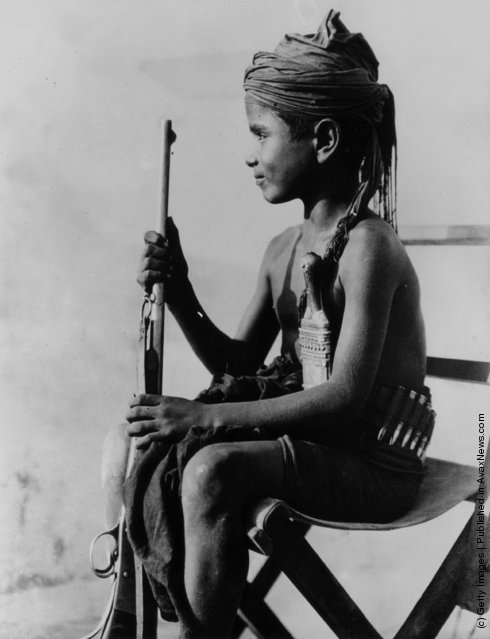
A young arab boy, armed with a rifle and a knife, in the Aden Protectorate near Yemen. (Photo by Richards/Fox Photos/Getty Images). February 1938
Details
01 Apr 2011 14:39:00
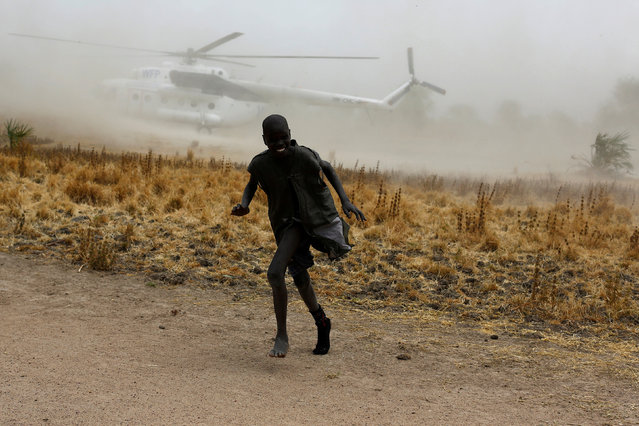
A boy moves away as a United Nations World Food Programme (WFP) helicopter lands in Rubkuai village, Unity State, northern South Sudan, February 18, 2017. (Photo by Siegfried Modola/Reuters)

A boy moves away as a United Nations World Food Programme (WFP) helicopter lands in Rubkuai village, Unity State, northern South Sudan, February 18, 2017. South Sudan on Monday declared famine in some parts of the country, with more than three years of war leaving nearly five million hungry in what aid groups called a “man-made” tragedy. (Photo by Siegfried Modola/Reuters)
Details
22 Feb 2017 00:03:00
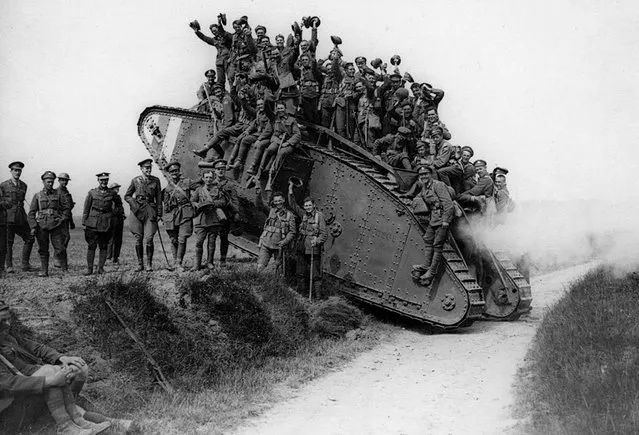
These black-and-white photos are taken from the new book “Armoured Warfare in the First World War 1916 – 1918” by Anthony Tucker-Jones and published by Pen & Sword Military. “Interestingly the British, French and Germans took completely different approaches with varying results”. The British military produced “Little Willie” in Autumn 1915 weighing 18 tonnes, which had a crew of two plus four gunners. “Inspired by a tracked artillery tractor “Little Willie” was referred to as a water tank – hence the name tank – to ensure secrecy”, said Anthony. “This led to the strange looking Mark I with its peculiar rhomboid shape, designed to cross trenches with guns in sponsons on either side. The Germans saw the tank as unchivalrous and were slow to grasp its utility. They favoured the Stormtrooper (specialist soldiers used to infiltrate enemy trenches) and artillery, not the tank”, said Anthony. “However, they didn’t hesitate to make use of captured British tanks. Although the tank helped secure victory and German soldiers dubbed it “Germany’s Downfall” the country was ultimately brought to its knees by the Allies blockade”. Here: British troops hitch a ride on a Mark IV after the massed tank fleet spearheading attack at Cambrai on November 20, 1917. (Photo by Anthony Tucker-Jones/Mediadrumworld.com)

These black-and-white photos are taken from the new book “Armoured Warfare in the First World War 1916 – 1918” by Anthony Tucker-Jones and published by Pen & Sword Military. Here: British troops hitch a ride on a Mark IV after the massed tank fleet spearheading attack at Cambrai on November 20, 1917. (Photo by Anthony Tucker-Jones/Mediadrumworld.com)
Details
23 Feb 2017 00:02:00
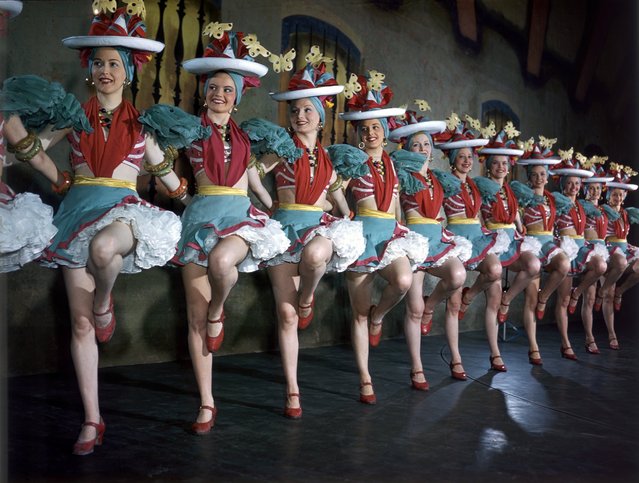
Radio City Music Hall Rockettes perform after days of rehearsal and routine polished to perfection at the Radio City Music Hall in New York City on July 26, 1949. (Photo by Ivan Dmitri/Getty Images)

Radio City Music Hall Rockettes perform after days of rehearsal and routine polished to perfection at the Radio City Music Hall in New York City on July 26, 1949. (Photo by Ivan Dmitri/Getty Images)
Details
12 Jan 2016 08:03:00