Loading...
Done
Makeup artist He Yuhong, also known as “Yuya”, checks herself in the mirror during a photo shoot following her transformation into the “Girl with a Pearl Earring”, the 17th century oil painting by Dutch painter Johannes Vermeer, at her house in Chongqing, China on August 14, 2018. (Photo by Thomas Suen/Reuters)

Makeup artist He Yuhong, also known as “Yuya”, checks herself in the mirror during a photo shoot following her transformation into the “Girl with a Pearl Earring”, the 17th century oil painting by Dutch painter Johannes Vermeer, at her house in Chongqing, China on August 14, 2018. (Photo by Thomas Suen/Reuters)
Details
07 Oct 2018 00:05:00
A group of PETA supporters protest Canada Goose's use of coyote fur, with “Canada Goose Kills” painted on their backs in New York, USA on October 18, 2018. (Photo by Erik Pendzich/Rex Features/Shutterstock)

A group of PETA supporters protest Canada Goose's use of coyote fur, with “Canada Goose Kills” painted on their backs in New York, USA on October 18, 2018. (Photo by Erik Pendzich/Rex Features/Shutterstock)
Details
14 Nov 2018 00:01:00
Rita Ora leaving her hotel to go to BBC Children in need on November 07, 2018 in London, England. (Photo by Mark R. Milan/GC Images)

Rita Ora leaving her hotel to go to BBC Children in need on November 07, 2018 in London, England. (Photo by Mark R. Milan/GC Images)
Details
18 Nov 2018 00:01:00
A man stands by an installation depicting “2019” in the Red Square in Moscow, Russia on December 17, 2018. (Photo by Maxim Shemetov/Reuters)

A man stands by an installation depicting “2019” in the Red Square in Moscow, Russia on December 17, 2018. (Photo by Maxim Shemetov/Reuters)
Details
31 Dec 2018 00:03:00
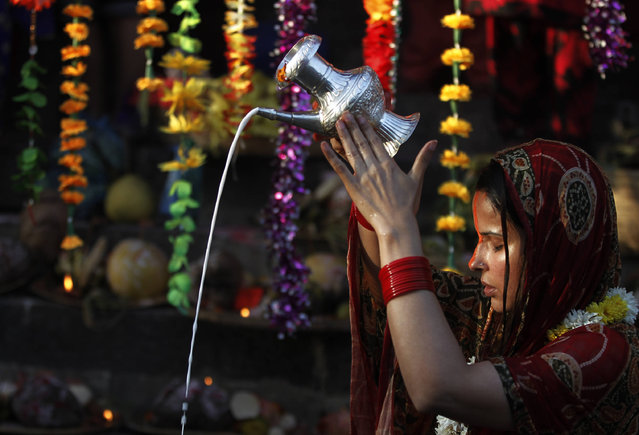
A Nepalese woman pours milk as she offers prayers to the setting Sun on the banks of the Bagmati River during the Chhath Puja festival in Kathmandu, Nepal, Sunday, November 6, 2016. During Chhath, an ancient Hindu festival, rituals are performed to thank the Sun God for sustaining life on earth. (Photo by Niranjan Shrestha/AP Photo)

A Nepalese woman pours milk as she offers prayers to the setting Sun on the banks of the Bagmati River during the Chhath Puja festival in Kathmandu, Nepal, Sunday, November 6, 2016. During Chhath, an ancient Hindu festival, rituals are performed to thank the Sun God for sustaining life on earth. (Photo by Niranjan Shrestha/AP Photo)
Details
08 Nov 2016 11:30:00
Indian school children wearing traditional Punjabi attire sit as they take part in the full and final dress rehearsal for India's Independence Day parade and celebrations in Amritsar, India, 13 August 2016. India's 70th Independence Day will be celebrated on 15 August, to commemorate its independence from British rule and its birth as a sovereign nation on that day in 1947. (Photo by Raminder Pal Singh/EPA)

Indian school children wearing traditional Punjabi attire sit as they take part in the full and final dress rehearsal for India's Independence Day parade and celebrations in Amritsar, India, 13 August 2016. India's 70th Independence Day will be celebrated on 15 August, to commemorate its independence from British rule and its birth as a sovereign nation on that day in 1947. (Photo by Raminder Pal Singh/EPA)
Details
14 Aug 2016 10:08:00
A woman talks to a man as two children play inside a wrecked car at a camp for displaced people in Port-au-Prince, Haiti, March 6, 2016. (Photo by Andres Martinez Casares/Reuters)

A woman talks to a man as two children play inside a wrecked car at a camp for displaced people in Port-au-Prince, Haiti, March 6, 2016. (Photo by Andres Martinez Casares/Reuters)
Details
18 Aug 2016 11:16:00
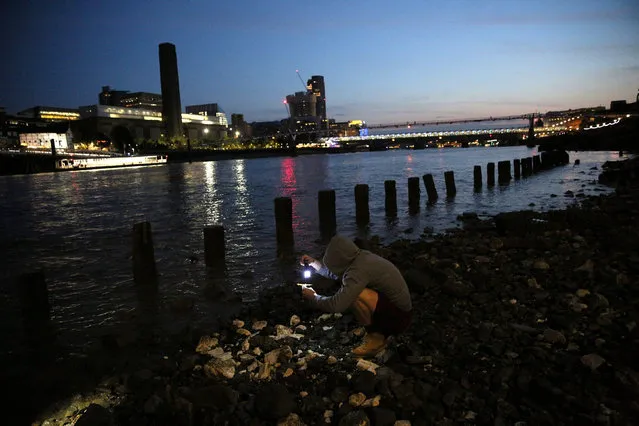
A mudlark uses a torch to look for items on the bank of the River Thames in London, Britain June 06, 2016. Mudlarking is believed to trace its origins to the 18th and 19th century, when scavengers searched the Thames' shores for items to sell. These days, history and archaeology fans are the ones hoping to find old relics such as coins, ceramics, artifacts or everyday items from across centuries. They wait for the low tide and then scour specific areas of exposed shores. "If you're in a field you could be out all day long, with the river you're restricted to about two or three hours," mudlark Nick Stevens said. While many just use the naked eye for their searches, others rely on metal detectors for which a permit from the Port of London Authority is needed. Digging also requires consent. (Photo by Neil Hall/Reuters)

A mudlark uses a torch to look for items on the bank of the River Thames in London, Britain June 06, 2016. Mudlarking is believed to trace its origins to the 18th and 19th century, when scavengers searched the Thames' shores for items to sell. These days, history and archaeology fans are the ones hoping to find old relics such as coins, ceramics, artifacts or everyday items from across centuries. their finds with the Portable Antiquities Scheme. Any item over 300 years old must be recorded. (Photo by Neil Hall/Reuters)
Details
27 Aug 2016 10:43:00