Loading...
Done
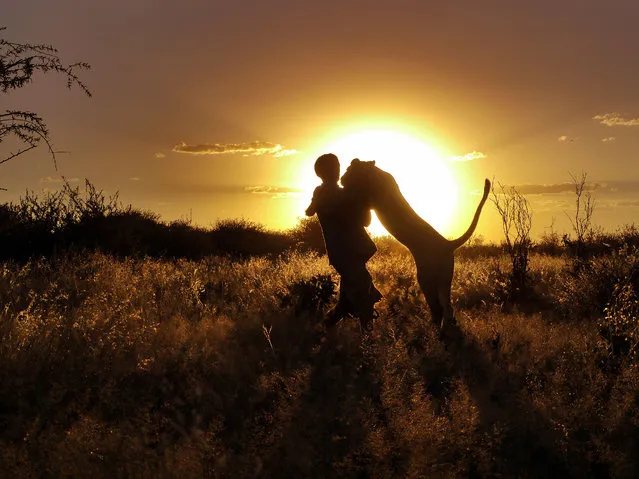
These heart-warming photograph show an incredible bond between a wild lioness and the men fighting to save her species. The picture show Sirga – a 110lb lioness – and her adopted pride Valentin Gruener (not pictured) and Mikkel Legarth. Incredibly she treats the two men just like she would other lions and with their help she can now hunt for prey on her own. (Photo by Caters News)

These heart-warming photograph show an incredible bond between a wild lioness and the men fighting to save her species. The picture show Sirga – a 110lb lioness – and her adopted pride Valentin Gruener (not pictured) and Mikkel Legarth. Incredibly she treats the two men just like she would other lions and with their help she can now hunt for prey on her own. As a cub she was driven out from a pride and rescued by German and Danish duo Valentin and Mikkel who could not stand by and watch her die. She is now a beacon for hoped success of the Modisa Wildlife Project, founded in Botswana, Africa, by Valentin and Mikkel with the hope of saving the lion population. (Photo by Caters News)
Details
27 Apr 2014 09:36:00
Elderly women wait for customers as they sell their self-made food products at a street market, with a graffiti depicting Russian President Vladimir Putin on the wall of a house seen in the background, in the town of Kashira, outside Moscow, Russia October 10, 2017. (Photo by Andrey Volkov/Reuters)

Elderly women wait for customers as they sell their self-made food products at a street market, with a graffiti depicting Russian President Vladimir Putin on the wall of a house seen in the background, in the town of Kashira, outside Moscow, Russia on October 10, 2017. (Photo by Andrey Volkov/Reuters)
Details
12 Oct 2017 08:56:00
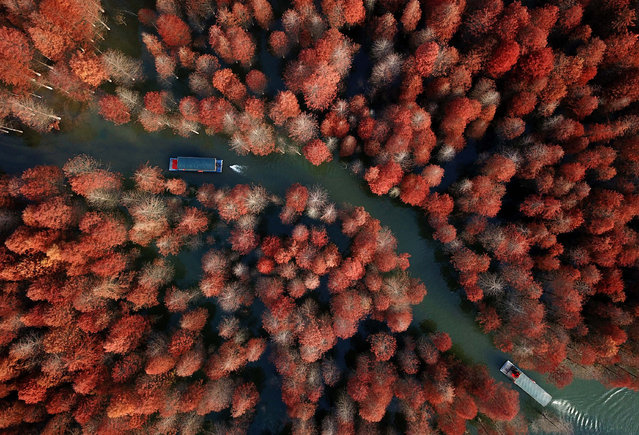
Aerial view of pond cypress at Qinglongwan Forest Park near Ningguo, China on November 26, 2017. (Photo by Imaginechina/Rex Features/Shutterstock)

Aerial view of pond cypress at Qinglongwan Forest Park near Ningguo, China on November 26, 2017. (Photo by Imaginechina/Rex Features/Shutterstock)
Details
08 Dec 2017 02:25:00
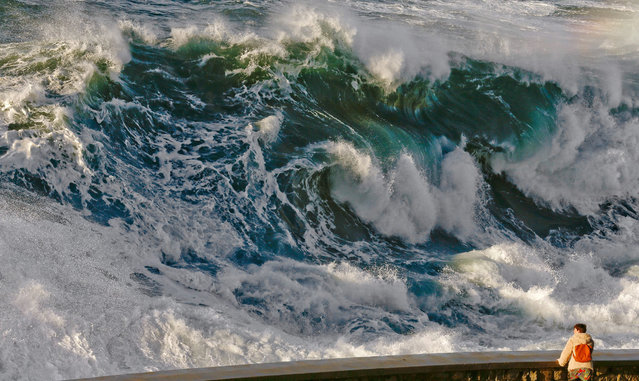
A man watches the huge waves which brakes at the Paseo Nuevo's promenade in San Sebastian, Basque Country, Spain on 11 January 2016 where the wind has reached to 90 km/h and have been registred waves of eight kilometres due to the bad weather. (Photo by Juan Herrero/EPA/EFE)

A man watches the huge waves which brakes at the Paseo Nuevo's promenade in San Sebastian, Basque Country, Spain on 11 January 2016 where the wind has reached to 90 km/h and have been registred waves of eight kilometres due to the bad weather. (Photo by Juan Herrero/EPA/EFE)
Details
29 Dec 2017 08:01:00
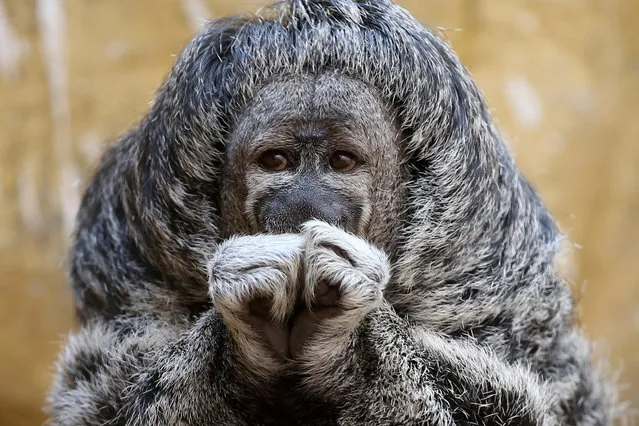
A Geoffroy's Monk Saki is seen at the Parque de Las Leyendas zoo in Lima, Peru, February 14, 2018. (Photo by Guadalupe Pardo/Reuters)

A Geoffroy's Monk Saki is seen at the Parque de Las Leyendas zoo in Lima, Peru, February 14, 2018. (Photo by Guadalupe Pardo/Reuters)
Details
18 Feb 2018 00:02:00
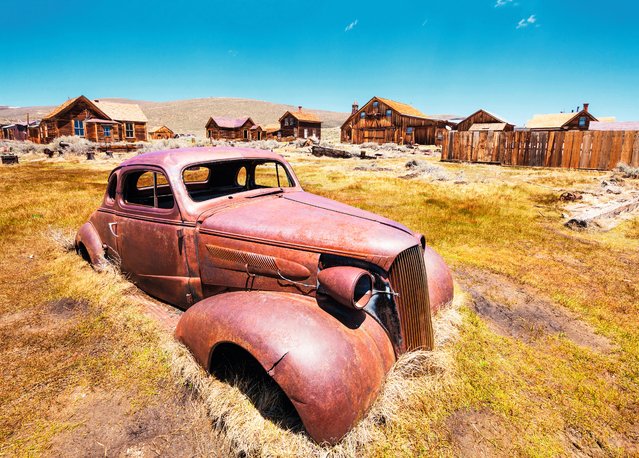
Bodie, Mono County, California. Gold was discovered at Bodie in 1859 (just after the initial California gold rush) and it went from mining camp to boomtown. Its decline began in 1880, when word spread of new boomtowns elsewhere. The Standard Consolidated Mine closed in 1913, and four years later the Bodie Railway was abandoned. By 1940 the population was down to 40. Today, Bodie is maintained in a state of arrested decay as a visitor attraction. (Photo by Alamy Stock Photo)

Kieron Connolly’s new book of photographs of more than 100 once-busy and often elegant buildings gives an idea of how the world might look if humankind disappeared. Here: Bodie, Mono County, California. Gold was discovered at Bodie in 1859 (just after the initial California gold rush) and it went from mining camp to boomtown. Its decline began in 1880, when word spread of new boomtowns elsewhere. The Standard Consolidated Mine closed in 1913, and four years later the Bodie Railway was abandoned. By 1940 the population was down to 40. Today, Bodie is maintained in a state of arrested decay as a visitor attraction. (Photo by Alamy Stock Photo)
Details
07 Sep 2016 09:50:00
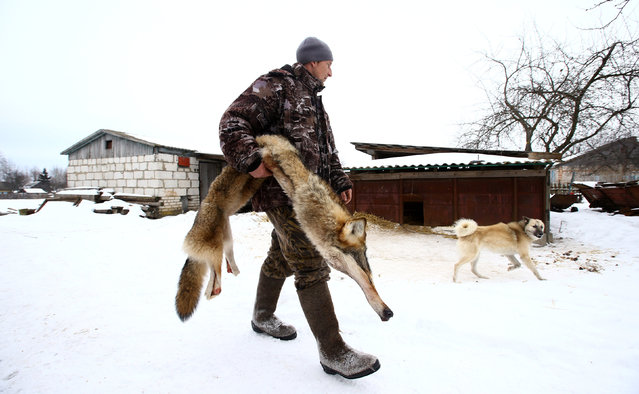
Nikolay Skidan, a hunter, carries the skin of a wolf in the village of Khrapkovo, Belarus February 1, 2017. (Photo by Vasily Fedosenko/Reuters)

Nikolay Skidan, a hunter, carries the skin of a wolf in the village of Khrapkovo, Belarus February 1, 2017. Wolf fur grows thickest in winter, so Belarussian hunter Vladimir Krivenchik only sets his traps once snow is on the ground. He and his wife live on the edge of the Chernobyl exclusion zone – 2,600 square km of land on the Belarus-Ukraine border that was contaminated by a nuclear disaster in 1986. (Photo by Vasily Fedosenko/Reuters)
Details
16 Feb 2017 00:04:00
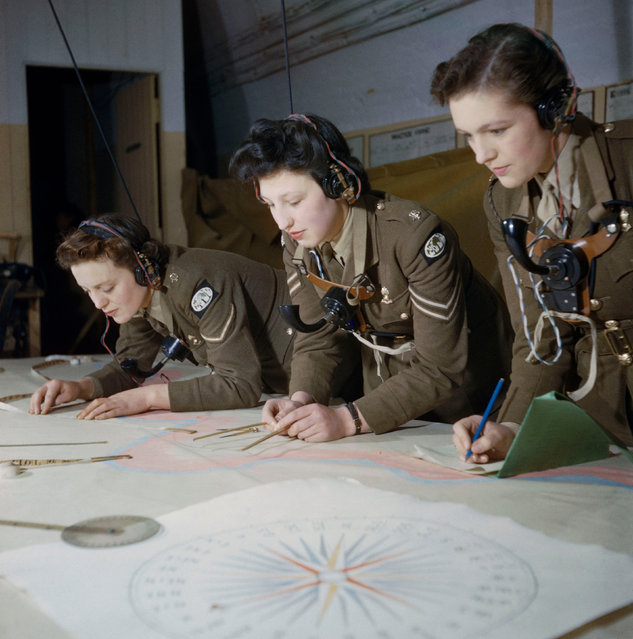
Auxiliary Territorial Service (ATS) plotters at work at Coastal Artillery Headquarters in Dover, December 1942. (Photo by Ted Dearberg/IWM/PA Wire)

Auxiliary Territorial Service (ATS) plotters at work at Coastal Artillery Headquarters in Dover, December 1942. The Auxiliary Territorial Service was the women's branch of the British Army during the Second World War. It was formed on 9 September 1938, initially as a women's voluntary service, and existed until 1 February 1949, when it was merged into the Women's Royal Army Corps. The ATS had its roots in the Women's Auxiliary Army Corps (WAAC), which was formed in 1917 as a voluntary service. During the First World War its members served in a number of jobs including clerks, cooks, telephonists and waitresses. The WAAC was disbanded after four years in 1921. (Photo by Ted Dearberg/IWM/PA Wire)
Details
13 Jul 2017 07:52:00