Loading...
Done
A Chinese stripper dances during a funeral in Handan city, Hebei province, China on March 2015. (Photo by Imaginechina/Rex Features/Shutterstock)

A Chinese stripper dances during a funeral in Handan city, Hebei province, China on March 2015. The Chinese Ministry of Culture has announced plans to work closely with the police to eliminate risqué performances, including strippers, at funeral. The aim of such entertainment is to draw more mourners to the ceremony. (Photo by Imaginechina/Rex Features/Shutterstock)
Details
09 Mar 2018 00:05:00
A ladyboy s*x worker wears a belt with a dollar sign on it while holding condoms and lube handed to her by Sisters, a transgendered outreach and community services organization in Pattaya, Thailand on August 25, 2016. Many of Thailand's ladyboys live in Pattaya, a large percentage of whom work in the s*x industry there. (Photo by Aaron Joel Santos/Getty Images/Aurora Creative)

A ladyboy sеx worker wears a belt with a dollar sign on it while holding condoms and lube handed to her by Sisters, a transgendered outreach and community services organization in Pattaya, Thailand on August 25, 2016. Many of Thailand's ladyboys live in Pattaya, a large percentage of whom work in the sеx industry there. (Photo by Aaron Joel Santos/Getty Images/Aurora Creative)
Details
26 Aug 2016 11:04:00
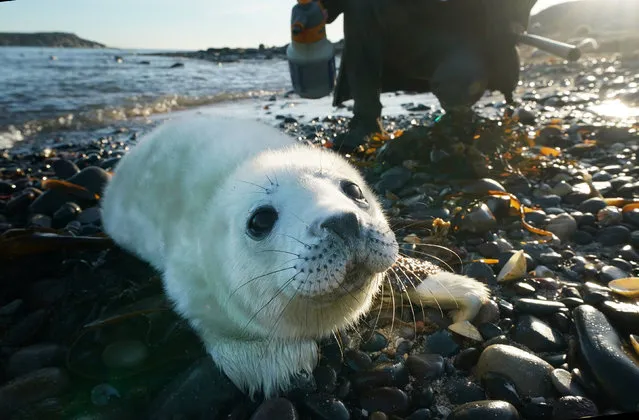
A ranger watches a seal pup near the Northumberland coast, Farne Islands, UK on December 19, 2018, where the National Trust says the number of Atlantic grey seal pups has reached a record high thanks to an abundance of food and a lack of predators. (Photo by Owen Humphreys/PA Wire Press Association)

A ranger watches a seal pup near the Northumberland coast, Farne Islands, UK on December 19, 2018, where the National Trust says the number of Atlantic grey seal pups has reached a record high thanks to an abundance of food and a lack of predators. (Photo by Owen Humphreys/PA Wire Press Association)
Details
23 Dec 2018 00:03:00
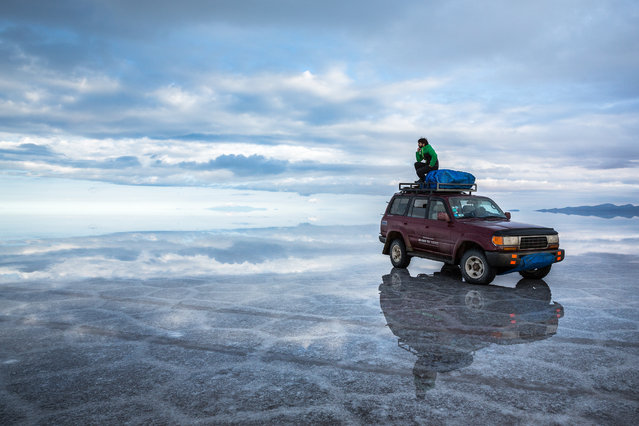
At 10,582 square kilometres, the Bolivian salt flats – otherwise known as Salar de Uyuni – are the largest on the planet and contain between 50 and 70% of the world’s lithium reserves. After exploring Chile and Argentina, photographer Joel Santos decided to travel to Bolivia in January 2017 to check the salt flats off his bucket list. With an electrical storm rolling in, Joel and his two travelling companions were the only souls left on the vast flats and captured the eerie flats without a person in sight. (Photo by Joel Santos/Barcroft Images)

At 10,582 square kilometres, the Bolivian salt flats – otherwise known as Salar de Uyuni – are the largest on the planet and contain between 50 and 70% of the world’s lithium reserves. After exploring Chile and Argentina, photographer Joel Santos decided to travel to Bolivia in January 2017 to check the salt flats off his bucket list. With an electrical storm rolling in, Joel and his two travelling companions were the only souls left on the vast flats and captured the eerie flats without a person in sight. (Photo by Joel Santos/Barcroft Images)
Details
12 Aug 2019 00:03:00
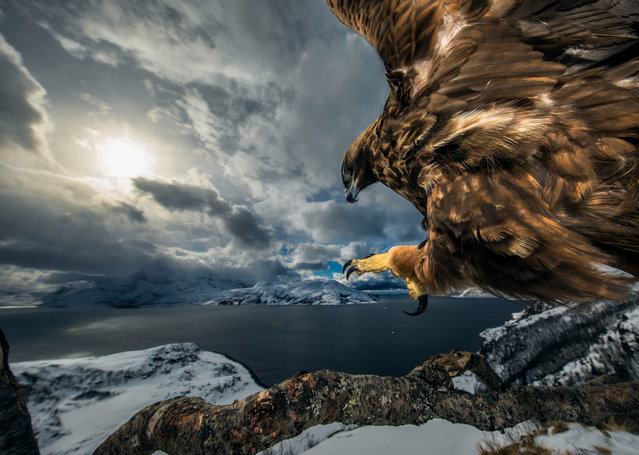
Birds behaviour winner: Land of the Eagle by Audun Rikardsen, Norway. High on a ledge, on the coast near his home in northern Norway, Rikardsen carefully positioned an old tree branch that he hoped would make a perfect golden eagle lookout. To this, he bolted a tripod head with a camera, flashes and motion sensor attached, and built himself a hide a short distance away. From time to time, he left road‑kill carrion nearby. Very gradually – over the next three years – a golden eagle got used to the camera and started to use the branch regularly to survey the coast below. (Photo by Audun Rikardsen/2019 Wildlife Photographer of the Year)

Birds behaviour winner: Land of the Eagle by Audun Rikardsen, Norway. High on a ledge, on the coast near his home in northern Norway, Rikardsen carefully positioned an old tree branch that he hoped would make a perfect golden eagle lookout. To this, he bolted a tripod head with a camera, flashes and motion sensor attached, and built himself a hide a short distance away. From time to time, he left road‑kill carrion nearby. Very gradually – over the next three years – a golden eagle got used to the camera and started to use the branch regularly to survey the coast below. (Photo by Audun Rikardsen/2019 Wildlife Photographer of the Year)
Details
17 Oct 2019 00:03:00
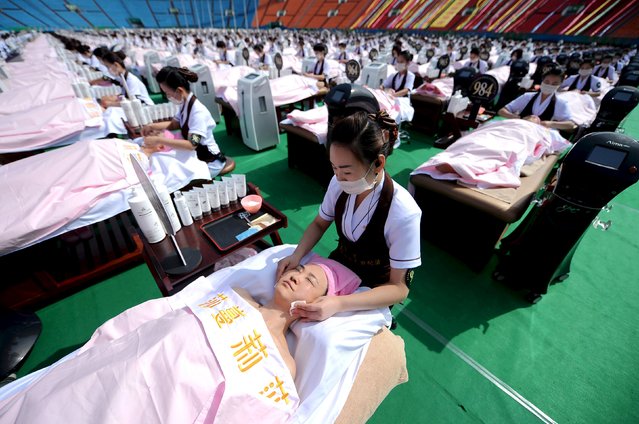
A group of 1000 customers receive a facial massage at a sports centre in Jinan, Shandong province, China, May 4, 2015. (Photo by Reuters/Stringer)

A group of 1000 customers receive a facial massage at a sports centre in Jinan, Shandong province, China, May 4, 2015. A group of 1000 women were given a 30 minutes facial beauty treatment together on Monday that achieved a Guinness record for the largest group of people having beauty treatment in the same location, according to local media. (Photo by Reuters/Stringer)
Details
06 May 2015 13:17:00
A security personnel keeps watch before the second plenary session of the National People's Congress (NPC) at the Great Hall of the People in Beijing, China on March 8, 2022. (Photo by Carlos Garcia Rawlins/Reuters)

A security personnel keeps watch before the second plenary session of the National People's Congress (NPC) at the Great Hall of the People in Beijing, China on March 8, 2022. (Photo by Carlos Garcia Rawlins/Reuters)
Details
12 Mar 2022 05:58:00
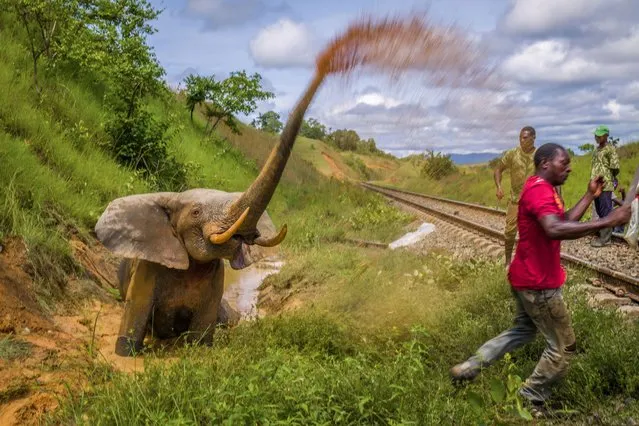
Grand prize winner: environmental photographer of the year 2023; also 1st place in the humanity v nature category; and winner of the 2023 public award. Lopé national park, Gabon, 2021. An angry elephant tries to defend itself after it was hit by a train that crosses paths the animals use within Lopé national park. Park officials decided the elephant was too severely injured to be saved. After it was killed, the park director distributed the meat to local people. As the forest loses its carrying capacity to sustain its megafauna, this kind of human-wildlife conflict is increasing. (Photo by Jasper Doest/Environmental Photography Award)

Grand prize winner: environmental photographer of the year 2023; also 1st place in the humanity v nature category; and winner of the 2023 public award. Lopé national park, Gabon, 2021. An angry elephant tries to defend itself after it was hit by a train that crosses paths the animals use within Lopé national park. Park officials decided the elephant was too severely injured to be saved. After it was killed, the park director distributed the meat to local people. As the forest loses its carrying capacity to sustain its megafauna, this kind of human-wildlife conflict is increasing. (Photo by Jasper Doest/Environmental Photography Award)
Details
09 Jul 2023 03:06:00