Loading...
Done
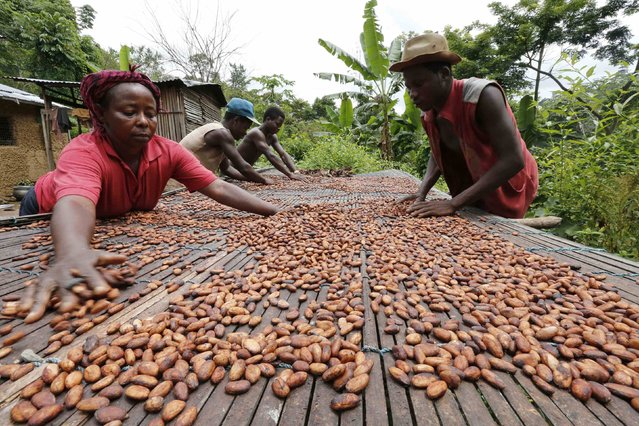
People work with cocoa beans in Enchi June 17, 2014. Picture taken June 17, 2014. Ghana emerged as a success story during the 2000s, when war, political instability and a disastrous liberalization brought Ivory Coast's cocoa sector to its knees. Ghana's output more than tripled from 340,000 tons in the 2001/02 season to a record 1,025,000 tons a decade later. Strict controls cemented its reputation as a producer of top quality beans, establishing a brand that fetches a premium. (Photo by Thierry Gouegnon/Reuters)

People work with cocoa beans in Enchi June 17, 2014. Picture taken June 17, 2014. Ghana emerged as a success story during the 2000s, when war, political instability and a disastrous liberalization brought Ivory Coast's cocoa sector to its knees. Ghana's output more than tripled from 340,000 tons in the 2001/02 season to a record 1,025,000 tons a decade later. Strict controls cemented its reputation as a producer of top quality beans, establishing a brand that fetches a premium. (Photo by Thierry Gouegnon/Reuters)
Details
03 Aug 2014 07:17:00
Google's vice president Alan Eustace looks out of his spacesuit into the stratosphere prior to a record-breaking skydive over New Mexico, in this still image taken from video October 24, 2014, a handout courtesy of the Paragon Space Development Corporation. Eustace was lifted up 135,890 ft (41,420 metres) by an enormous balloon while wearing a specially designed pressurized space suit, the Paragon Space Development Corporation said. (Photo by Reuters/Paragon Space Development Corporation)

Google's vice president Alan Eustace looks out of his spacesuit into the stratosphere prior to a record-breaking skydive over New Mexico, in this still image taken from video October 24, 2014, a handout courtesy of the Paragon Space Development Corporation. Eustace was lifted up 135,890 ft (41,420 metres) by an enormous balloon while wearing a specially designed pressurized space suit, the Paragon Space Development Corporation said. Eustace remained in a free fall for approximately 4.5 minutes before landing safely nearly 70 miles (43.4 kms) from his launch point, setting a world record for the highest skydive and breaking the sound barrier in the process. Eustace landed safely on the ground just 15 minutes after he was lifted into the air. (Photo by Reuters/Paragon Space Development Corporation)
Details
26 Oct 2014 12:16:00
A man walks in the early morning to start his day picking tea leaves at a plantation in Nandi Hills, in Kenya's highlands region west of capital Nairobi, November 5, 2014. Emerald-coloured tea bushes blanketing the rolling hills of Nandi County have long provided a livelihood for small-scale farmers, helping make Kenya one of the world's biggest tea exporters. But ideal weather and bigger harvests, instead of producing bumper earnings, have led to a glut of Kenya's speciality black tea. (Photo by Noor Khamis/Reuters)

A man walks in the early morning to start his day picking tea leaves at a plantation in Nandi Hills, in Kenya's highlands region west of capital Nairobi, November 5, 2014. Emerald-coloured tea bushes blanketing the rolling hills of Nandi County have long provided a livelihood for small-scale farmers, helping make Kenya one of the world's biggest tea exporters. But ideal weather and bigger harvests, instead of producing bumper earnings, have led to a glut of Kenya's speciality black tea. (Photo by Noor Khamis/Reuters)

Details
17 Nov 2014 12:44:00
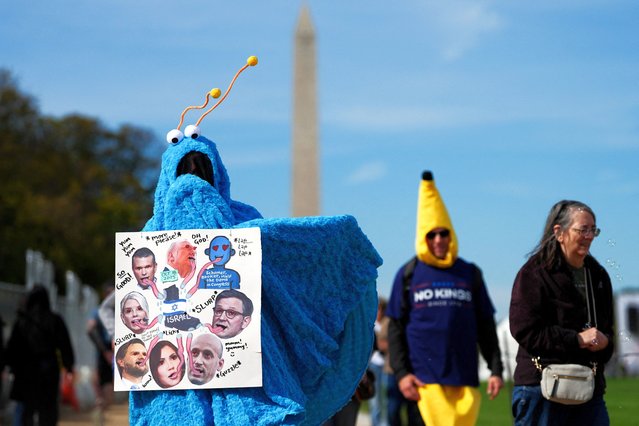
A demonstrator wearing a The Martians from Sesame Street costume holds a placard depicting U.S. President Donald Trump, U.S. Secretary of Defense Pete Hegseth, U.S. Attorney General Pam Bondi, U.S Vice President JD Vance, U.S. Homeland Security Secretary Kristi Noem, White House Deputy Chief of Staff Stephen Miller and U.S. House Speaker Mike Johnson as people march down the National Mall to take part in a “No Kings” protest against U.S. President Donald Trump's policies, in Washington, D.C., U.S., October 18, 2025. (Photo by Leah Millis/Reuters)

A demonstrator wearing a The Martians from Sesame Street costume holds a placard depicting U.S. President Donald Trump, U.S. Secretary of Defense Pete Hegseth, U.S. Attorney General Pam Bondi, U.S Vice President JD Vance, U.S. Homeland Security Secretary Kristi Noem, White House Deputy Chief of Staff Stephen Miller and U.S. House Speaker Mike Johnson as people march down the National Mall to take part in a “No Kings” protest against U.S. President Donald Trump's policies, in Washington, D.C., U.S., October 18, 2025. (Photo by Leah Millis/Reuters)
Details
27 Oct 2025 05:41:00
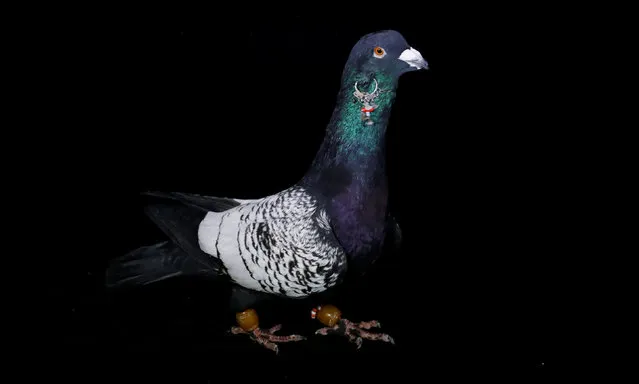
A pigeon, known as Siyah Kinifirli, with an approximate market value of 1000 Turkish Lira ($263), bred by 23-year-old Ismail Ozbek, is pictured in Sanliurfa, Turkey, December 23, 2016. As night-time approaches in Sanliurfa, southeastern Turkey, most of the alleyways of the city's old bazaar are emptying out of buyers and vendors, except for one. The bustle of daytime trading has died down, but on this little street, a stream of men carry cardboard boxes filled with pigeons to a cluster of three teahouses. Here, they sell the birds at Sanliurfa's famed auctions to a dedicated band of pigeon keepers and breeders, a pastime that has been thriving for hundreds of years across the region and over the nearby border into war-torn Syria. In a country where the minimum wage is about 1,400 Liras ($367) a month, enthusiasts regularly easily spend hundreds of dollars for one bird. “I once sold a pair of pigeons for 35,000 Turkish Lira”, says auctioneer Imam Dildas. “This is a passion, a hobby you cannot quit. I've been known to sell the fridge and my wife's gold bracelets to pay for pigeons”. (Photo by Umit Bektas/Reuters)

A pigeon, known as Siyah Kinifirli, with an approximate market value of 1000 Turkish Lira ($263), bred by 23-year-old Ismail Ozbek, is pictured in Sanliurfa, Turkey, December 23, 2016. As night-time approaches in Sanliurfa, southeastern Turkey, most of the alleyways of the city's old bazaar are emptying out of buyers and vendors, except for one. (Photo by Umit Bektas/Reuters)
Details
17 Jan 2017 12:05:00
A milk custard bun made to resemble one of the popular Japanese “Kobitos” characters is squeezed during a display for the photographer at Dim Sum Icon restaurant in Hong Kong, China July 25, 2016. A dim sum restaurant in Hong Kong encourages diners to play with their food, and the result will either disgust or delight you. At Dim Sum Icon customers can squeeze a strange creature to poo or vomit on their plate before eating it. Hungry punters poke a hole into the mouth – or the rear – of the dim sum with a chopstick, squeeze it and watch the brown or white cream ooze out. (Photo by Bobby Yip/Reuters)

A milk custard bun made to resemble one of the popular Japanese “Kobitos” characters is squeezed during a display for the photographer at Dim Sum Icon restaurant in Hong Kong, China July 25, 2016. A dim sum restaurant in Hong Kong encourages diners to play with their food, and the result will either disgust or delight you. At Dim Sum Icon customers can squeeze a strange creature to poo or vomit on their plate before eating it. Hungry punters poke a hole into the mouth – or the rear – of the dim sum with a chopstick, squeeze it and watch the brown or white cream ooze out. The unique dim sums are made with a face to resemble Japanese Kobitos characters. (Photo by Bobby Yip/Reuters)
Details
31 Jul 2016 11:25:00
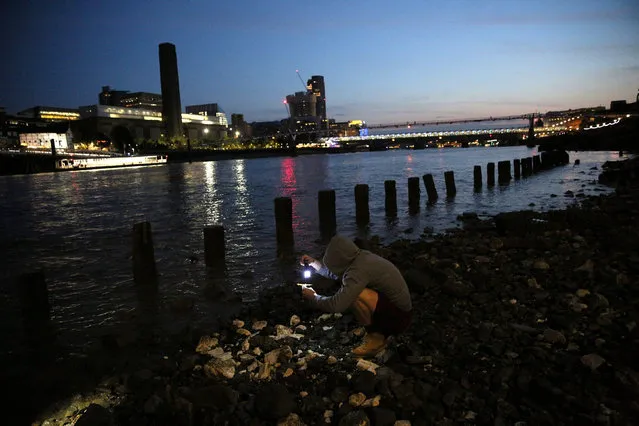
A mudlark uses a torch to look for items on the bank of the River Thames in London, Britain June 06, 2016. Mudlarking is believed to trace its origins to the 18th and 19th century, when scavengers searched the Thames' shores for items to sell. These days, history and archaeology fans are the ones hoping to find old relics such as coins, ceramics, artifacts or everyday items from across centuries. They wait for the low tide and then scour specific areas of exposed shores. "If you're in a field you could be out all day long, with the river you're restricted to about two or three hours," mudlark Nick Stevens said. While many just use the naked eye for their searches, others rely on metal detectors for which a permit from the Port of London Authority is needed. Digging also requires consent. (Photo by Neil Hall/Reuters)

A mudlark uses a torch to look for items on the bank of the River Thames in London, Britain June 06, 2016. Mudlarking is believed to trace its origins to the 18th and 19th century, when scavengers searched the Thames' shores for items to sell. These days, history and archaeology fans are the ones hoping to find old relics such as coins, ceramics, artifacts or everyday items from across centuries. their finds with the Portable Antiquities Scheme. Any item over 300 years old must be recorded. (Photo by Neil Hall/Reuters)
Details
27 Aug 2016 10:43:00
A woman loyal to the Houthi movement holds a rifle as she takes part in a parade to show support to the movement in Sanaa, Yemen September 6, 2016. Dressed in the head to toe garments which obscured their faces, the female fighters brandished machine guns, rocket launchers and grenades. The women also wore hats as they showed support for the Shiite Houthi rebels. The Saudi-led Arab coalition launched a military campaign against the Houthis and their allies in March 2015. It was after the rebels closed in on Gulf-backed President Abedrabbo Mansour Hadi in his southern refuge of Aden, forcing him into exile. The female protesters have pledged to remain supportive and do whatever they can to back the ongoing resistance against the kingdom. Yemen is in the grip of its most severe crisis in years, and is on the brink of civil war. (Photo by Khaled Abdullah/Reuters)

A woman loyal to the Houthi movement holds a rifle as she takes part in a parade to show support to the movement in Sanaa, Yemen September 6, 2016. The Saudi-led Arab coalition launched a military campaign against the Huthis and their allies in March 2015, after the rebels closed in on Gulf-backed President Abedrabbo Mansour Hadi in his southern refuge of Aden, forcing him into exile. (Photo by Khaled Abdullah/Reuters)
Details
07 Sep 2016 10:24:00