Loading...
Done
Isabel Schmalenbach, an environmental scientist with the Helgoland Biological Institute (Biologische Anstalt Helgoland), part of the Alfred Wegener Institute for Polar and Marine Research, holds a one-year old baby European lobster (Homarus gammarus) raised at the institute on August 3, 2013 on Helgoland Island, Germany. (Photo by Sean Gallup/Getty Images)

Isabel Schmalenbach, an environmental scientist with the Helgoland Biological Institute (Biologische Anstalt Helgoland), part of the Alfred Wegener Institute for Polar and Marine Research, holds a one-year old baby European lobster (Homarus gammarus) raised at the institute on August 3, 2013 on Helgoland Island, Germany. Later in the day Schmalenbach and her colleagues released a total of 415 one-year old lobsters into the North Sea as part of an effort to repopulate the lobster population around Helgoland (also called Heligoland). In the 19th century local fishermen caught up to 80,000 lobsters a year in the surrounding waters, combined with the heavy allied bombing of the island during and after World War II, as well as other environmental factors, decimated the lobster population. (Photo by Sean Gallup)
Details
05 Aug 2013 08:39:00
World's Ugliest Dog

It's that time of year again when dogs with unusually large heads, hairless bodies and other oddities compete to be the World's Ugliest Dog. This year's winner? A 2-year-old mutt named Peanut, whose wild white and brown hair, bulging eyes and protruding teeth belie his sweet, energetic personality. Peanut's owner, Holly Chandler of Greenville, North Carolina, says he was seriously burned as a puppy and she wants to use her pet to raise awareness about animal abuse. She plans to use the $1,500 prize to pay for other animals' veterinary bills. The contest, held at the Sonoma-Marin Fairgrounds in Petaluma, California, is in its 26 year. The dogs are scored by a three-judge panel in several categories, including special or unusual attributes, personality and natural ugliness.
Details
24 Jun 2014 10:04:00
A thrill-seeking snapper has shot a powerful series of images featuring people carrying out everyday chores in front of giant storms. Benjamin Von Wong's surreal scenes include individuals ironing, barbecuing, playing video games and even sitting on the toilet – seemingly unaware of the threatening situations approaching. Here: Models pose in front of a storm in Cheyenne Wyoming. (Photo by Benjamin Von Wongs/Caters News)

A thrill-seeking snapper has shot a powerful series of images featuring people carrying out everyday chores in front of giant storms. Benjamin Von Wong's surreal scenes include individuals ironing, barbecuing, playing video games and even sitting on the toilet – seemingly unaware of the threatening situations approaching. The project was initiated to raise awareness about climate change, and the the storms appearing across six different states in the U.S. Von Wong, 29, started the project in Colorado, before traveling to South Dakota, Wyoming, Montana, North Dakota and Nebraska for the unusual images. Here: Models pose in front of a storm in Cheyenne Wyoming. (Photo by Benjamin Von Wongs/Caters News)
Details
08 Dec 2015 08:02:00
Female metro passengers hold flowers presented to them by metro workers, prior to International Women's Day in Kiev, Ukraine, 02 March 2016. (Photo by Sergey Dolzhenko/EPA)

Female metro passengers hold flowers presented to them by metro workers, prior to International Women's Day in Kiev, Ukraine, 02 March 2016. The hustle and bustle of the morning commute is broken up by an unexpected surprise. The first passengers to step on the train receive – a warm welcome and a pot of flowers. One woman says, “It's very nice. All the running around and then you're given a flower, it's not often. It's very nice. I'm going to take care of this flower”. International Women's Day first emerged from the activities of labour movements at the turn of the twentieth century, in North America and across Europe, it is celebrated on March 08 in many countries around the world. (Photo by Sergey Dolzhenko/EPA)
Details
03 Mar 2016 11:34:00
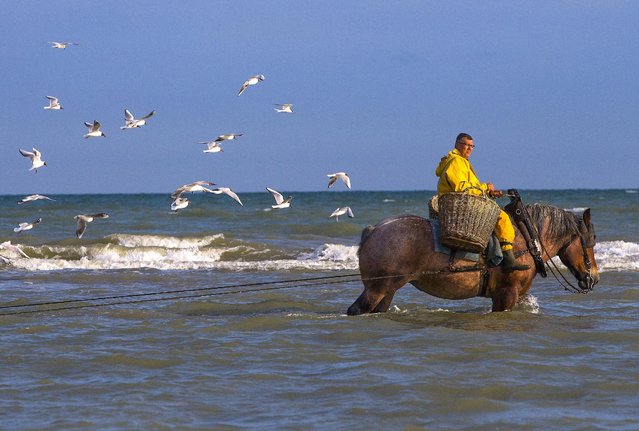
A Belgian shrimp fisherman rides a carthorse to haul a net out in the sea to catch shrimps during low tide at the coastal town of Oostduinkerke, Belgium July 3, 2015. (Photo by Yves Herman/Reuters)

A Belgian shrimp fisherman rides a carthorse to haul a net out in the sea to catch shrimps during low tide at the coastal town of Oostduinkerke, Belgium July 3, 2015. At the end of each fishing session, the fishermen and their mounts leave the water to empty the net's contents into two wicker baskets fixed on each side of the horse. This traditional method of catching shrimps along the North Sea coast, which dates back to some 500 years, attracts tourists every summer. In 2013, Unesco recognized shrimp fishing on horseback as an intangible cultural heritage. (Photo by Yves Herman/Reuters)
Details
04 Jul 2015 11:29:00
A clown plays the violin during the XXI Convention of Clowns, at the Jimenez Rueda Theatre, in Mexico City, Mexico, October 19, 2016. (Photo by Carlos Jasso/Reuters)

A clown plays the violin during the XXI Convention of Clowns, at the Jimenez Rueda Theatre, in Mexico City, Mexico, October 19, 2016. In the wake of the creepy clown sightings in several states of North and South Americas and Europe that caused widespread panic, professional clowns from across Latin America came together at an annual convention in Mexico to give a serious message: “We are clowns, not killers!”. Around 200 clowns took part in the 21st International Clown Convention, dressed in bright coloured clothes and makeup, and chanted the word as they clicked group pictures to counter the “creepy clown” craze. (Photo by Carlos Jasso/Reuters)
Details
20 Oct 2016 10:58:00
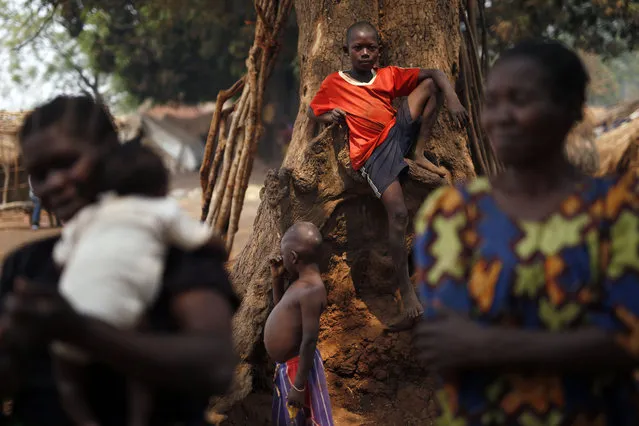
Christian families living in a refugee camp stand under a tree in Kaga-Bandoro, Central African Republic, Tuesday February 16,  2016. (Photo by Jerome Delay/AP Photo)

Christian families living in a refugee camp stand under a tree in Kaga-Bandoro, Central African Republic, Tuesday February 16, 2016. Refugees in the north of Central African Republic say they hope the new president will bring peace but no one is heading home just yet. Thousands are still living in displacement camps in Kaga-Bandoro, a stronghold of the former Muslim rebel group known as Seleka that was in power for nearly a year. The one-time rebels say they are waiting to see how the election turns out before taking any action. (Photo by Jerome Delay/AP Photo)
Details
20 Feb 2016 10:13:00
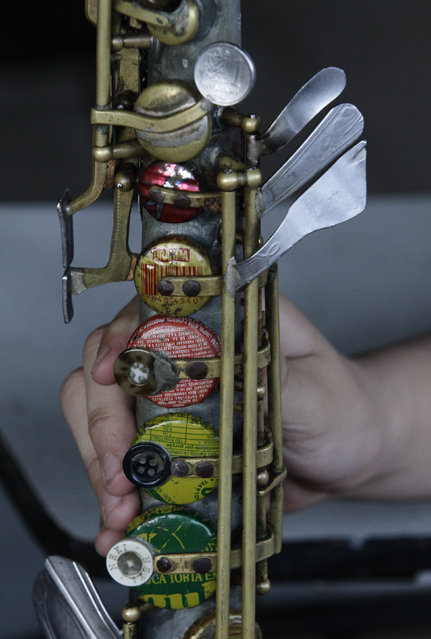
A student of the Orchestra of Recycled Instruments of Cateura holds an instrument made from recycled material by craftsman Nicolas Gomez, in Cateura, near Asuncion, May 9, 2013. The orchestra is the brainchild of its conductor Favio Chavez, who wanted to help the children of garbage pickers at the local landfill, and the instruments are made from salvaged materials by craftsman Gomez. (Photo by Jorge Adorno/Reuters)

A student of the Orchestra of Recycled Instruments of Cateura holds an instrument made from recycled material by craftsman Nicolas Gomez, in Cateura, near Asuncion, May 9, 2013. The orchestra is the brainchild of its conductor Favio Chavez, who wanted to help the children of garbage pickers at the local landfill, and the instruments are made from salvaged materials by craftsman Gomez. The orchestra now involves 30 schoolchildren who have toured countries in Latin America, North America and Europe to play music ranging from Beethoven and Mozart to the Beatles and Paraguayan folk songs. (Photo by Jorge Adorno/Reuters)
Details
12 Jul 2013 09:23:00