Loading...
Done
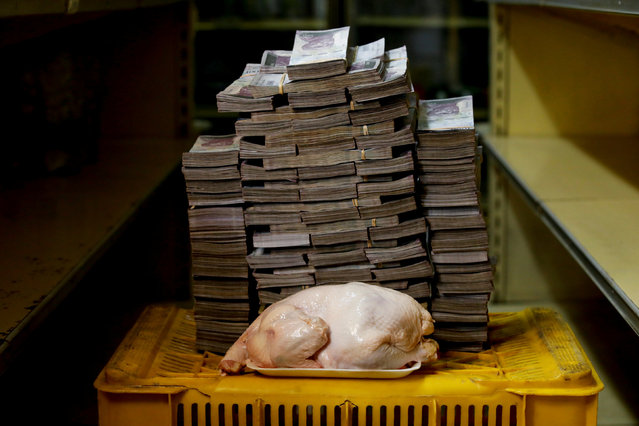
A 2.4 kg chicken is pictured next to 14,600,000 bolivars, its price and the equivalent of 2.22 USD, at a mini-market in Caracas, Venezuela August 16, 2018. It was the going price at an informal market in the low-income neighborhood of Catia. (Photo by Carlos Garcia Rawlins/Reuters)

A 2.4 kg chicken is pictured next to 14,600,000 bolivars, its price and the equivalent of 2.22 USD, at a mini-market in Caracas, Venezuela on August 16, 2018. It was the going price at an informal market in the low-income neighborhood of Catia. (Photo by Carlos Garcia Rawlins/Reuters)
Details
21 Aug 2018 00:01:00
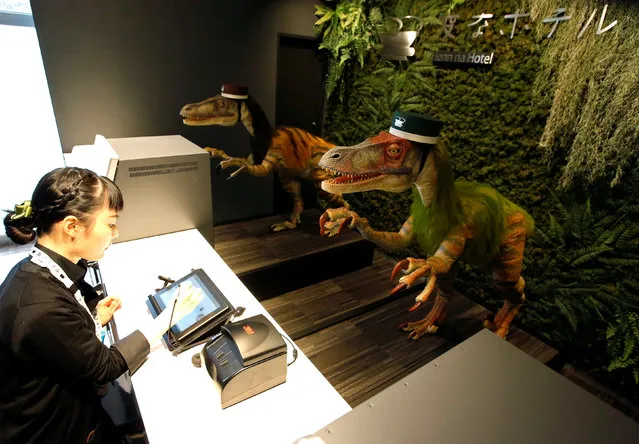
Dinosaur robots acting as receptionist greet a hotel employee demonstrating how to check-in to the hotel during a press preview for the newly-opening Henn na Hotel Maihama Tokyo Bay in Urayasu, east of Tokyo, Japan March 15, 2017. The reception desk is handled by robots that speak Japanese, English, Chinese and Korean, as well as porter robots that help guests carry luggage to their rooms. Tasks such as window-cleaning and vacuuming are also handled by robots. Japan's second robot-run hotel Henn na Hotel (“strange hotel” in Japanese) opened on March 15, 2017 as the robot-staffed hotel near Tokyo, operating company H.I.S. Co. said. (Photo by Issei Kato/Reuters)

Dinosaur robots acting as receptionist greet a hotel employee demonstrating how to check-in to the hotel during a press preview for the newly-opening Henn na Hotel Maihama Tokyo Bay in Urayasu, east of Tokyo, Japan March 15, 2017. The reception desk is handled by robots that speak Japanese, English, Chinese and Korean, as well as porter robots that help guests carry luggage to their rooms. Tasks such as window-cleaning and vacuuming are also handled by robots. Japan's second robot-run hotel Henn na Hotel (“strange hotel” in Japanese) opened on March 15, 2017 as the robot-staffed hotel near Tokyo, operating company H.I.S. Co. said. (Photo by Issei Kato/Reuters)
Details
16 Mar 2017 09:54:00
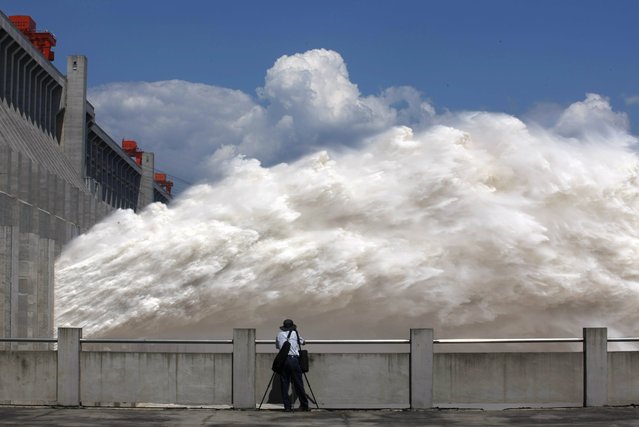
This picture taken on September 3, 2014 shows a man taking pictures of floodwater released from the Three Gorges Dam, a gigantic hydropower project on the Yangtze river, in Yichang, central China's Hubei province, after heavy downpours in the upper reaches of the dam caused the highest flood peak of the year. (Photo by AFP Photo/Stringer)

This picture taken on September 3, 2014 shows a man taking pictures of floodwater released from the Three Gorges Dam, a gigantic hydropower project on the Yangtze river, in Yichang, central China's Hubei province, after heavy downpours in the upper reaches of the dam caused the highest flood peak of the year. Eleven people died and 27 others are missing after torrential rains battered southwest China's Chongqing, a municipality in the upper reaches of the Three Gorges Dam, causing thousands of houses to collapse, state media said. (Photo by AFP Photo/Stringer)
Details
06 Sep 2014 12:02:00
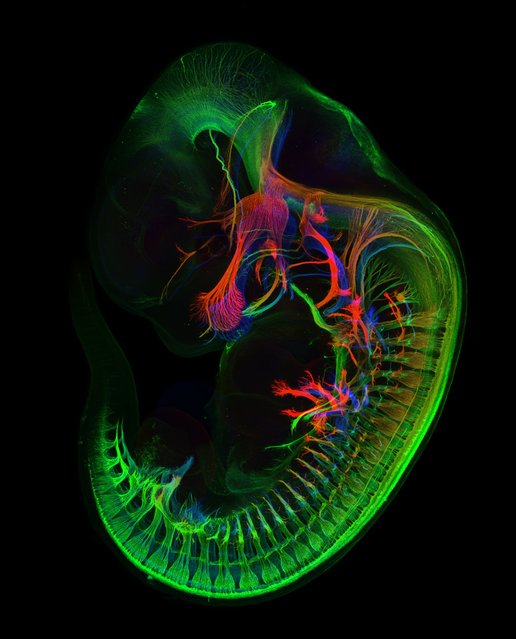
Mr. Zhong Hua, of Johns Hopkins University School of Medicine, took this image of the peripheral nerves (those outside of the brain) in an 11.5-day-old mouse embryo, magnified five times. (Photo by Zhong Hua)

Mr. Zhong Hua, of Johns Hopkins University School of Medicine, took this image of the peripheral nerves (those outside of the brain) in an 11.5-day-old mouse embryo, magnified five times. (Photo by Zhong Hua)
Details
31 Oct 2013 09:39:00
Miranda Kerr going back to her hotel during Paris fashion week Paris,France on October 04th 2016. (Photo by KCS Presse/Splash News and Pictures)

Miranda Kerr going back to her hotel during Paris fashion week Paris,France on October 04th 2016. (Photo by KCS Presse/Splash News and Pictures)
Details
09 Oct 2016 07:37:00
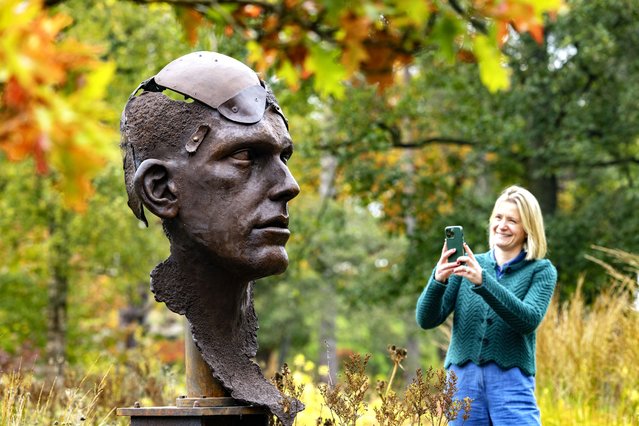
Sophie Roberts admires Angel of the Trench by artists Laura and Paul Carey at the Himalayan Garden and Sculpture Park near Masham, North Yorkshire, UK on October 14, 2025. (Photo by James Glossop/Times Media Ltd)

Sophie Roberts admires Angel of the Trench by artists Laura and Paul Carey at the Himalayan Garden and Sculpture Park near Masham, North Yorkshire, UK on October 14, 2025. (Photo by James Glossop/Times Media Ltd)
Details
27 Oct 2025 05:36:00
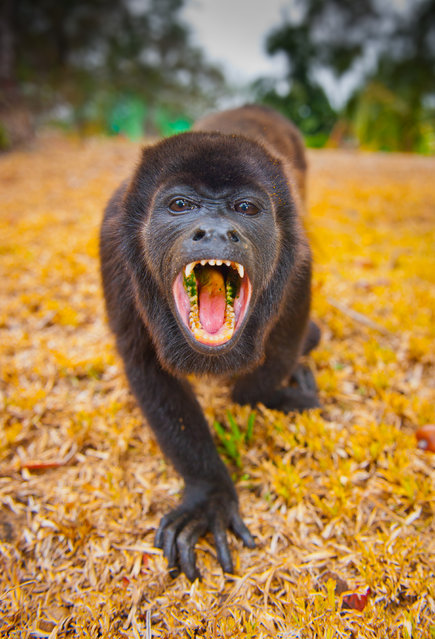
“Attacking Howler Monkey”. Due to a major tropical rainstorm my wife and I were forced to stay overnight in a Howler Monkey Rescue center in Panama. I used the time to explore the area and to take photos of the monkeys. Just after the rain finally stopped, I ran into this monkey that tried to mock attack me. I quickly took a couple of photos before retreating to a (more) safe distance. (Photo and caption by Christian Mueller-Planitz/National Geographic Traveler Photo Contest)

“Attacking Howler Monkey”. Due to a major tropical rainstorm my wife and I were forced to stay overnight in a Howler Monkey Rescue center in Panama. I used the time to explore the area and to take photos of the monkeys. Just after the rain finally stopped, I ran into this monkey that tried to mock attack me. I quickly took a couple of photos before retreating to a (more) safe distance. (Photo and caption by Christian Mueller-Planitz/National Geographic Traveler Photo Contest)

ATTENTION! All pictures are presented in high resolution. To see Hi-Res images – just TWICE click on any picture. In other words, click small picture – opens the BIG picture. Click BIG picture – opens VERY BIG picture.
Details
30 Jun 2013 12:25:00
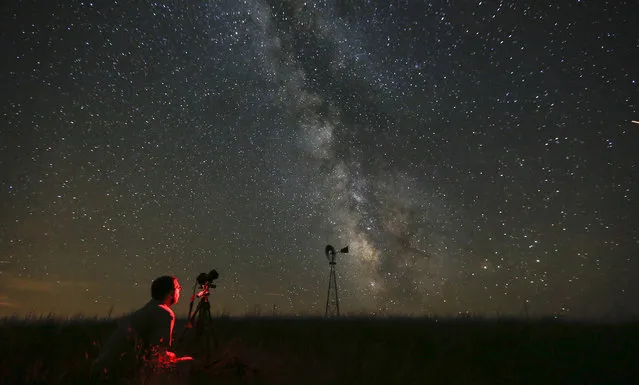
In this Wednesday, July 23, 2014 file photo, Omaha photographer Lane Hickenbottom photographs the night sky in a pasture near Callaway, Neb. With no moon in the sky, the Milky Way was visible to the naked eye. More than one-third of the world’s population can no longer see the Milky Way because of man-made lights, according to a scientific paper by Light Pollution Science and Technology Institute's Fabio Falchi and his team members, published on Friday, June 10, 2016. (Photo by Travis Heying/The Wichita Eagle via AP Photo)

In this Wednesday, July 23, 2014 file photo, Omaha photographer Lane Hickenbottom photographs the night sky in a pasture near Callaway, Neb. With no moon in the sky, the Milky Way was visible to the naked eye. More than one-third of the world’s population can no longer see the Milky Way because of man-made lights, according to a scientific paper by Light Pollution Science and Technology Institute's Fabio Falchi and his team members, published on Friday, June 10, 2016. (Photo by Travis Heying/The Wichita Eagle via AP Photo)
Details
11 Jun 2016 12:37:00