Loading...
Done
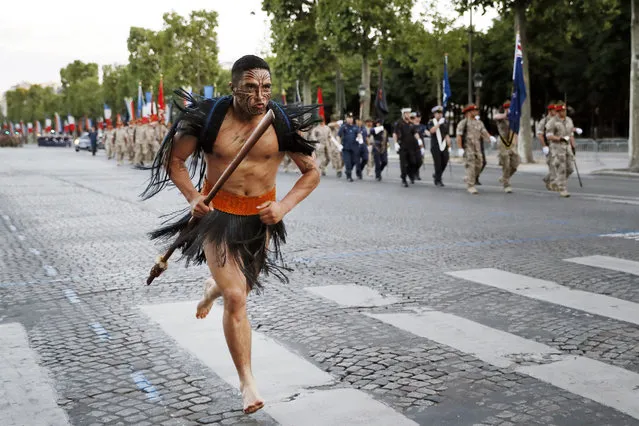
A Maori soldier runs as New Zealand's soldiers march down the Champs Elysees in Paris during a rehearsal of the annual Bastille Day military parade on July 12, 2016. (Photo by Thomas Samson/AFP Photo)

A Maori soldier runs as New Zealand's soldiers march down the Champs Elysees in Paris during a rehearsal of the annual Bastille Day military parade on July 12, 2016. (Photo by Thomas Samson/AFP Photo)
Details
13 Jul 2016 14:11:00
Atomic Annie at work during the Upshot-Knothole test series, 1953. (Photo by Los Alamos National Laboratory/US Army)

“A fter the former Soviet Union conducted its first nuclear test in August 1949, the US reevaluated its postwar defense policies. With the US monopoly on atomic weapons broken, military and political leaders chose to diversify the American stockpile by developing thermonuclear and tactical nuclear weapons. One of the more interesting concepts to come out of this period was atomic artillery, which was successfully tested at the Nevada Proving Grounds (now the Nevada Test Site) in May 1953”. – Alan Carr. Photo: Atomic Annie at work during the Upshot-Knothole test series, 1953. (Photo by Los Alamos National Laboratory/US Army)
Details
11 Mar 2013 11:43:00
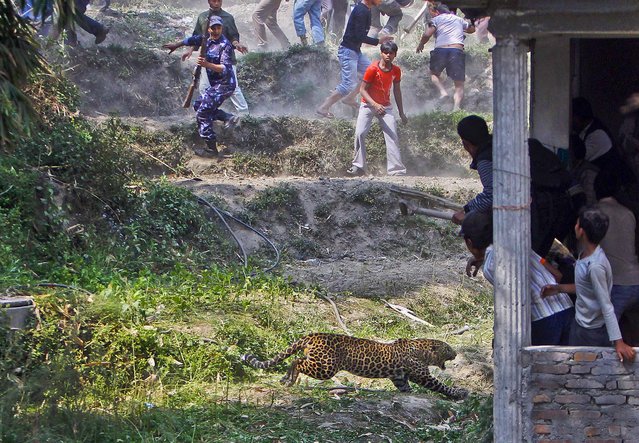
A leopard runs to at people as they run for cover in Katmandu, Nepal, on April 10, 2013. According to reports, 15 people were injured including three policemen and two officials from the Department of Forest. The leopard was later killed with the help of Nepalese policemen and local media. (Photo by Niranjan Shrestha/Associated Press)

A leopard runs to at people as they run for cover in Katmandu, Nepal, on April 10, 2013. According to reports, 15 people were injured including three policemen and two officials from the Department of Forest. The leopard was later killed with the help of Nepalese policemen and local media. (Photo by Niranjan Shrestha/Associated Press)

ATTENTION: VISUAL COVERAGE OF SCENES OF INJURY AND DEATH
Details
13 Apr 2013 15:20:00
Rangoli Folk Art From India

Rangoli, also known as kolam or Muggu, is a folk art from India in which patterns are created on the floor in living rooms or courtyards using materials such as colored rice, dry flour, colored sand or flower petals. It is usually made during Diwali, Onam, Pongal and other Indian festivals. They are meant to be sacred welcoming areas for the Hindu deities. The ancient symbols have been passed down through the ages, from each generation to the next, keeping both the art form and the tradition alive. Similar practices are followed in different Indian states: in Tamil Nadu, there is Kolam in Tamil Nadu; Mandana in Rajasthan; Chaookpurna in Chhattisgarh; Alpana in West Bengal; Aripana in Bihar; Chowk pujan in Uttar Pradesh; Muggu in Andhra Pradesh and others.
Details
16 Jun 2014 10:37:00


West German police arrest a young man, one of the angry crowd throwing stones at a bus full of Soviet guards making their way to the Soviet War Memorial, 20th August 1962. The crowd were incensed by the death of 18-year-old Peter Fechter, who was shot while trying to cross the Berlin Wall a few days earlier. (Photo by Central Press/Hulton Archive/Getty Images)
Details
23 May 2011 08:24:00


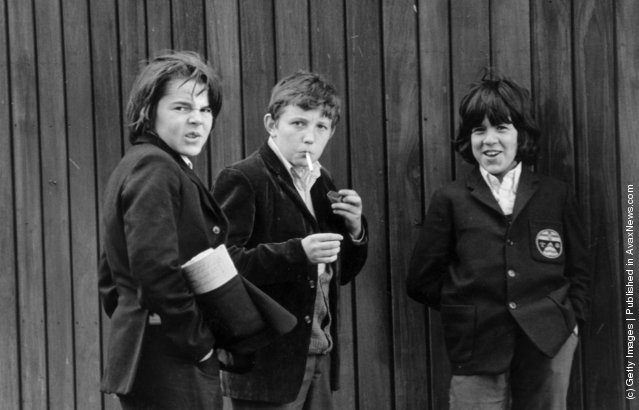
Three secondary schoolboys smoking an illicit cigarette in Hyde Park, London. (Photo by Evening Standard/Getty Images). May 1972
Details
31 May 2011 07:52:00
Tridacna Gigas, or Giant Clams

“The giant clam, Tridacna gigas (known as pā’ua in Cook Islands Māori), is the largest living bivalve mollusc. T. gigas is one of the most endangered clam species. It was mentioned as early as 1825 in scientific reports. One of a number of large clam species native to the shallow coral reefs of the South Pacific and Indian oceans, they can weigh more than 200 kilograms (440 lb) measure as much as 120 cm (47 in) across, and have an average lifespan in the wild of 100 years or more”. – Wikipedia

Photo: Tridacna Gigas, or Giant Clams spew water as a traditional fisherman passes by a small sanctuary on January 23, 2004 near Bolinao in the Northern Philippines. The clams, prime builders for coral reefs and providing shelter for spawning fish and other marine life, are exposed by low tides in the sanctuary. Overfishing and pollution throughout the country are not only threatening food security, but are also starting to choke one of the few working clam sanctuaries in the world. (Photo by David Greedy/Getty Images)
Details
01 Oct 2011 13:10:00
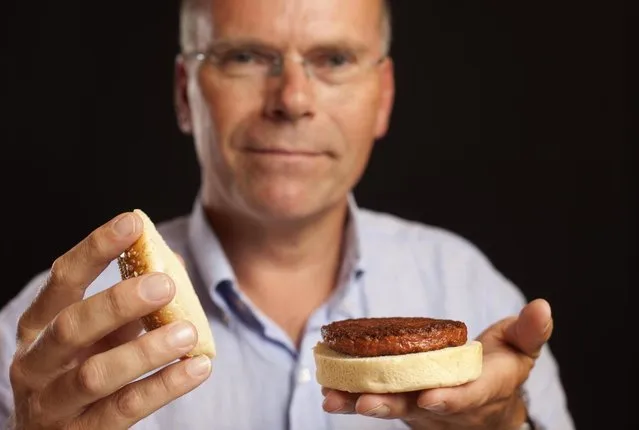
In this handout image provided by Ogilvy, a burger made from cultured beef, which has been developed by Professor Mark Post of Maastricht University in the Netherlands (pictured) is shown to the media during a press conference on August 5, 2013 in London, England. Cultured Beef could help solve the coming food crisis and combat climate change with commercial production of Cultured Beef beginning within ten to twenty years. (Photo by David Parry via Getty Images)

In this handout image provided by Ogilvy, a burger made from cultured beef, which has been developed by Professor Mark Post of Maastricht University in the Netherlands (pictured) is shown to the media during a press conference on August 5, 2013 in London, England. The in-vitro burger, cultured from cattle stem cells, the first example of what its creator says could provide an answer to global food shortages and help combat climate change, was fried in a pan and tasted by two volunteers. The burger is the result of years of research by Dutch scientist Mark Post, a vascular biologist at the University of Maastricht, who is working to show how meat grown in petri dishes might one day be a true alternative to meat from livestock.The meat in the burger has been made by knitting together around 20,000 strands of protein that has been cultured from cattle stem cells in Post's lab. (Photo by David Parry)
Details
06 Aug 2013 08:48:00