Loading...
Done
Miniatur Wunderland – The World's Biggest Model Train

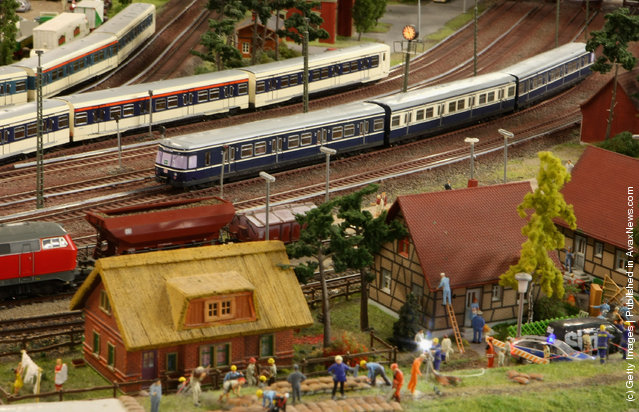
“Miniatur Wunderland is a model railway attraction in Hamburg, Germany and the largest of its kind in the world. As of January 2011, the railway consists of 12,000 metres (39,370 ft) of track in HO scale, divided into seven sections: Harz, the fictitious city of Knuffingen, the Alps and Austria, Hamburg, America, Scandinavia, and Switzerland. Of the 6,400 square metres (68,889 sq ft) of floorspace, the model takes 1,150 m2 (12,378 sq ft)”. – Wikipedia

Photo: Details of the “Miniatur Wunderland” are pictured on April 2, 2009 in Hamburg, Germany. The world's largest model railway and one of the most popular tourist attractions in Germany is located next to the Elbe in Hamburg's Speicherstadt. (Photo by Joern Pollex/Getty Images)
Details
29 Nov 2011 09:02:00
Rosanna Davison attends the 'Lambertz Monday Night' at Alter Wartesaal

Rosanna Davison attends the “Lambertz Monday Night” at Alter Wartesaal on February 1, 2012 in Cologne, Germany. (Photo by Andreas Rentz/Getty Images)
Details
21 Feb 2012 12:36:00
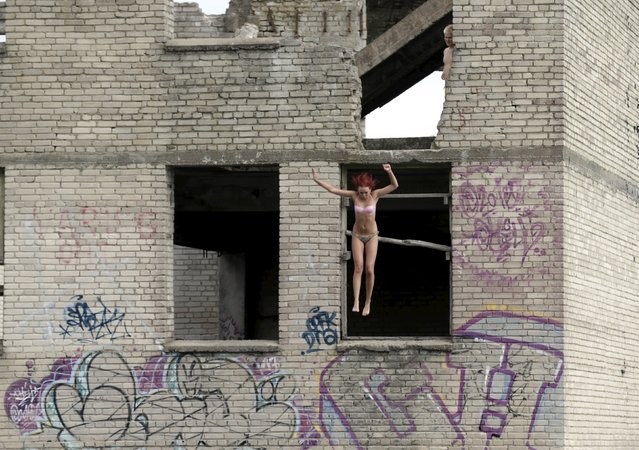
A woman jumps into water from the roof of Murru prison, an abandoned Soviet prison, in Rummu quarry, Estonia, during hot weather July 4, 2015. (Photo by Ints Kalnins/Reuters)

A woman jumps into water from the roof of Murru prison, an abandoned Soviet prison, in Rummu quarry, Estonia, during hot weather July 4, 2015. During the Soviet time, Rummu quarry was used as a mining site for Vasalemma marble and most of the workforce came from among the detainees of Murru prison. When the prison closed after 1991, pumps that once kept the quarry and the prison dry were shut down, causing water to fill the quarry. It has become an unofficial and unguarded swimming and diving spot, attracting locals and tourists. (Photo by Ints Kalnins/Reuters)
Details
05 Jul 2015 09:52:00
A model gets her outfit arranged backstage before showcasing the collection by Zhang Kejia during the China Fashion Week in Beijing on March 26, 2019. (Photo by Nicolas Asfouri/AFP Photo)

A model gets her outfit arranged backstage before showcasing the collection by Zhang Kejia during the China Fashion Week in Beijing on March 26, 2019. (Photo by Nicolas Asfouri/AFP Photo)
Details
28 Mar 2019 00:05:00
Armed police Taser a man inside the grounds of the Houses of Parliament on 11 December 2018. (Photo by Peter Nicholls/Reuters)

Armed police Taser a man inside the grounds of the Houses of Parliament on 11 December 2018. (Photo by Peter Nicholls/Reuters)
Details
17 May 2019 00:05:00
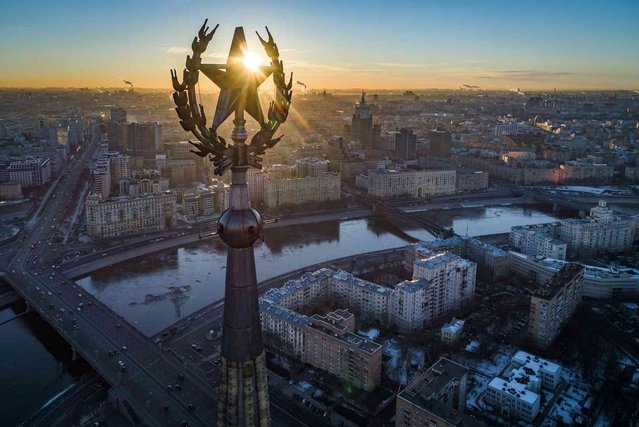
In this photo taken on Thursday, March 7, 2019, the sun rises over the star on the spire on top of a Stalin-era skyscraper, now the Radisson Royal Hotel on the banks of the Moskva River in Moscow, Russia. (Photo by Dmitry Serebryakov/AP Photo)

In this photo taken on Thursday, March 7, 2019, the sun rises over the star on the spire on top of a Stalin-era skyscraper, now the Radisson Royal Hotel on the banks of the Moskva River in Moscow, Russia. (Photo by Dmitry Serebryakov/AP Photo)
Details
07 Jun 2019 00:03:00
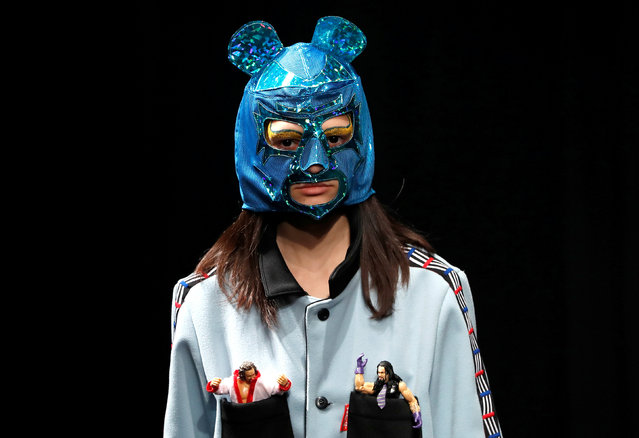
A model presents a creation of YUKIHERO PRO-WRESTLING by designer Yukihiro Teshima from his Autumn/Winter 2018 collection during Fashion Week Tokyo in Tokyo, Japan March 20, 2018. (Photo by Issei Kato/Reuters)

A model presents a creation of YUKIHERO PRO-WRESTLING by designer Yukihiro Teshima from his Autumn/Winter 2018 collection during Fashion Week Tokyo in Tokyo, Japan March 20, 2018. (Photo by Issei Kato/Reuters)
Details
23 Mar 2018 00:05:00
Of all the species affected by river regulation in Australia, the ibis is one of the few that has changed its behaviour and moved to coastal cities. (Photo by Rick Stevens/The Guardian)

Tip turkey, dumpster chook, rubbish raptor – the Australian white ibis goes by many unflattering names. But it is a true urban success story, scavenging to survive in cities across Australia as wetlands have been lost. Wildlife photographer Rick Stevens captured them in Sydney. Here: Of all the species affected by river regulation in Australia, the ibis is one of the few that has changed its behaviour and moved to coastal cities. (Photo by Rick Stevens/The Guardian)
Details
11 Apr 2018 00:03:00