Loading...
Done
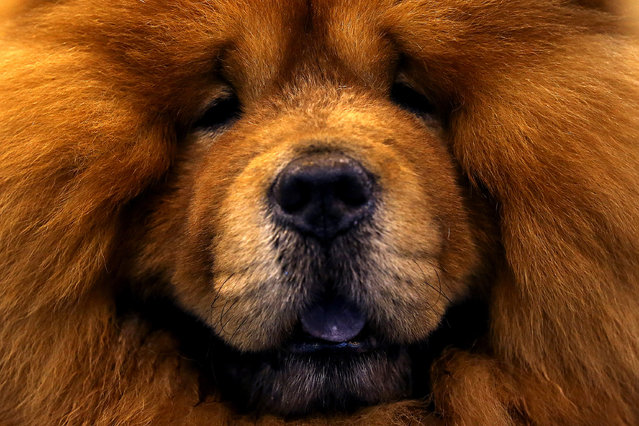
A Chow Chow is seen  on the fourth and final day of Crufts dog show at the National Exhibition Centre on March 8, 2015 in Birmingham, England.  First held in 1891, Crufts is said to be the largest show of its kind in the world. The annual four-day event, features thousands of dogs, with competitors travelling from countries across the globe to take part and vie for the coveted title of 'Best in Show'. (Carl Court/Getty Images)

Crufts is among the largest dog events worldwide. It was first held more than a century ago in 1891. Since then it has grown into more than just a dog show, but an event that celebrates the role that dogs play in our everyday lives. It is unimaginable how much this show has changed since the first time it was set up by Charles Cruft. Even though this event was very different back then, Charles Cruft would surely enjoy the scope and size of the modern Crufts show. The core event of the show is of course the dog show, which celebrates the unique relationship between dogs and their owners.
Details
11 Mar 2015 18:30:00
Online hostess Xianggong (L) and other hostesses check their pictures as they gather around the photographer while taking part in a football-themed photoshoot at a photography studio in Beijing March 4, 2015. (Photo by Jason Lee/Reuters)

Online hostess Xianggong (L) and other hostesses check their pictures as they gather around the photographer while taking part in a football-themed photoshoot at a photography studio in Beijing March 4, 2015. In China's online hostessing world, men find virtual company and the women can find riches. Xianggong is one of more than 10,000 hostesses on the internet site bobo.com, a live broadcasting web platform where anyone can record themselves singing, playing piano, dancing or just chatting. (Photo by Jason Lee/Reuters)
Details
17 Apr 2015 10:06:00
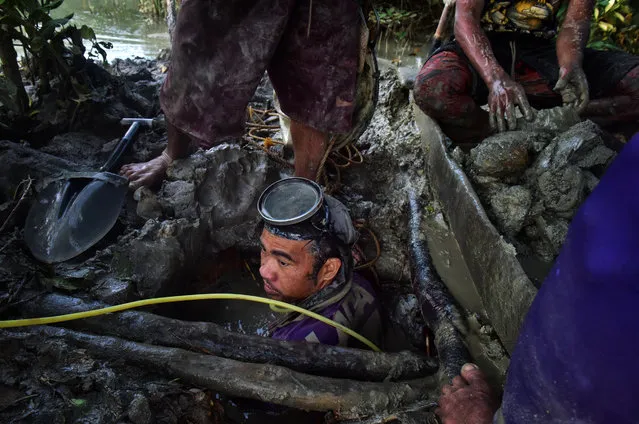
Christian Balderosdasco, 31, is being pulled up a mud pit after diving for 3 hours to look for gold on March 22, 2017 in Paracale, Philippines. (Photo by Jes Aznar/Getty Images)

Christian Balderosdasco, 31, is being pulled up a mud pit after diving for 3 hours to look for gold on March 22, 2017 in Paracale, Philippines. Apart from tunneling and sifting sand, locals dive down murky swamps with the aid of a compressor with air flowing in a small tube for breathing, as they blindly swim under the mud for up to four hours to look for tiny rocks containing gold particles. For decades, local residents at Paracale town work in hazardous conditions scavenging under the earth and diving into tunnels filled with mud using only makeshift tools to mine for gold, often placing their health and lives at risk. (Photo by Jes Aznar/Getty Images)
Details
06 Apr 2017 09:21:00
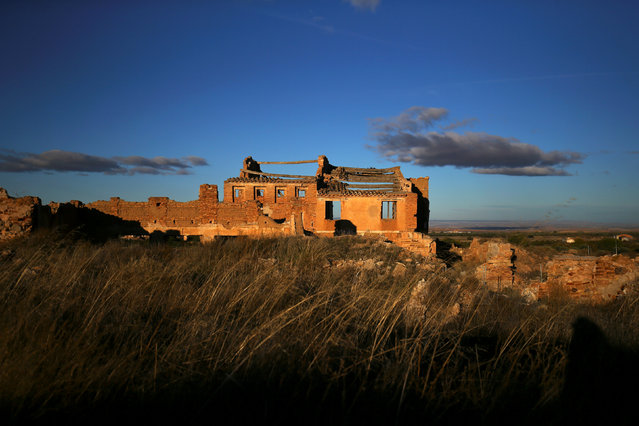
Ruins of a building are seen in the old village of Belchite, in northern Spain, November 13, 2016. (Photo by Andrea Comas/Reuters)

Ruins of a building are seen in the old village of Belchite, in northern Spain, November 13, 2016. Almost 80 years ago Tomas Ortin fled under the cover of night from his home in the small town of Belchite on Spain's northern plains to escape with hundreds of others from one of the bloodiest battles of the country's civil war. At 94 years old, Ortin now lives just across the road from Belchite, which has lain in ruins since Republican forces attacked it, a symbol of the destruction caused by the 1936-1939 war in which an estimated 500,000 people died. (Photo by Andrea Comas/Reuters)
Details
30 Nov 2016 12:31:00
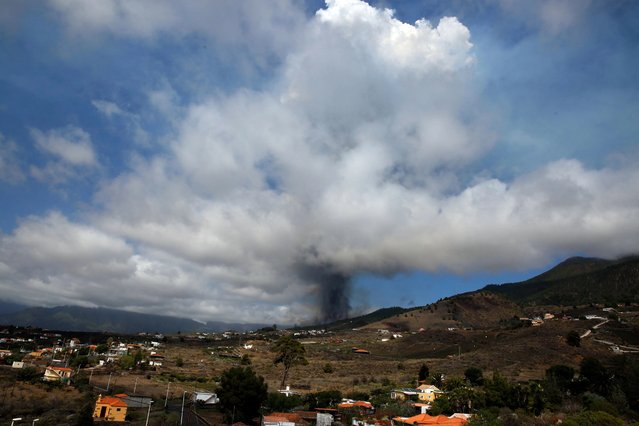
Mount Cumbre Vieja erupts spewing a column of smoke and ash as seen from Los Llanos de Aridane on the Canary island of La Palma on September 19, 2021. (Photo by Desiree Martin/AFP Photo)

Mount Cumbre Vieja erupts spewing a column of smoke and ash as seen from Los Llanos de Aridane on the Canary island of La Palma on September 19, 2021. The Cumbre Vieja volcano erupted on Spain's Canary Islands today spewing out lava, ash and a huge column of smoke after days of increased seismic activity, sparking evacuations of people living nearby, authorities said. Cumbre Vieja straddles a ridge in the south of La Palma island and has erupted twice in the 20th century, first in 1949 then again in 1971. (Photo by Desiree Martin/AFP Photo)
Details
20 Sep 2021 08:27:00
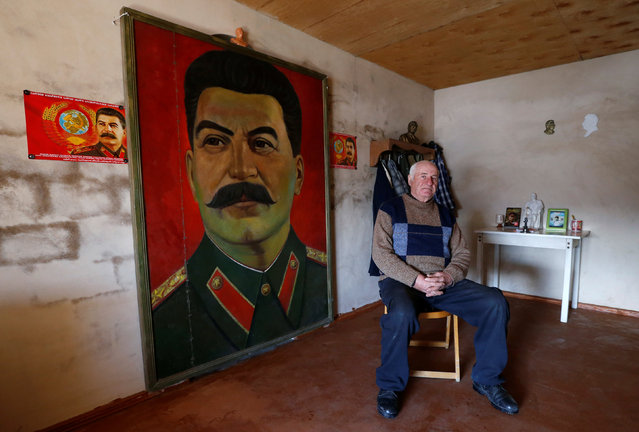
Retired builder Vasili Sidamonidze, 70, poses for a portrait at his home in Gori, Georgia, December 6, 2016. “Unfortunately, Stalin is not popular nowadays. Our people don't respect him. Only we, members of the (Communist) Party, respect him”, Sidamonidze said. “I always try to attend Stalin's birthday anniversaries in Gori. Unfortunately many people don't want to join us even if they live nearby. They look at us from their windows”. Stalin, who was born in Gori in 1878 and died in 1953, is largely reviled today in Georgia, which regained its independence during the 1991 collapse of the Soviet Union. Over the years, his memorials have been dismantled, most recently in 2010 when authorities removed a statue of the dictator from Gori's central square. But Stalin is still revered by a small group of mainly elderly supporters who stress his role in the industrialisation of the Soviet Union and in defeating Nazi Germany in World War Two. Each Dec. 21, a few dozen people mark his birthday by gathering outside a Gori museum dedicated to Stalin, where they make speeches and walk to the square where a 6-meter-high bronze statue of him once stood, calling for it to be reinstated. Opponents say it was a symbol of Moscow's still lingering shadow. In 2008, Russia fought a brief war with Georgia and recognised its breakaway regions of Abkhazia and South Ossetia as independent states. (Photo by David Mdzinarishvili/Reuters)

Retired builder Vasili Sidamonidze, 70, poses for a portrait at his home in Gori, Georgia, December 6, 2016. “Unfortunately, Stalin is not popular nowadays. Our people don't respect him. Only we, members of the (Communist) Party, respect him”, Sidamonidze said. “I always try to attend Stalin's birthday anniversaries in Gori. Unfortunately many people don't want to join us even if they live nearby. They look at us from their windows”. (Photo by David Mdzinarishvili/Reuters)
Details
17 Dec 2016 07:59:00
Ocean voyage

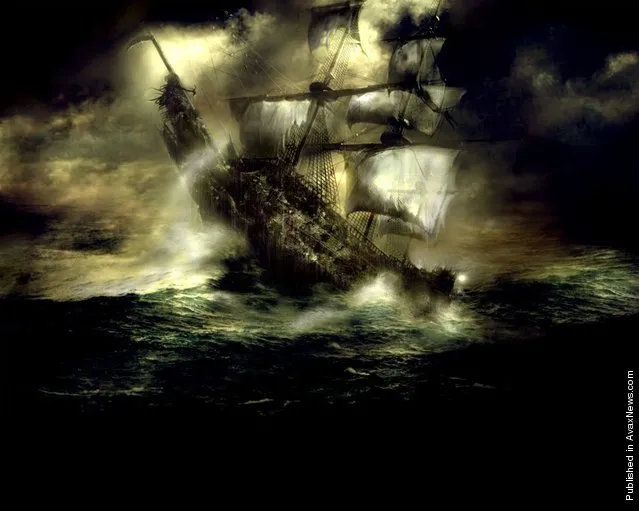
Do you think that history is a science? Well, not exactly. First, and foremost, history is the state's “legend of wars”, it’s official regalia. Of course, public historians are not interested in scientific truth – quite the opposite. In this respect, any attempt to present a state’s history as altruistic and benevolent as possible is welcomed and encouraged – as opposed to any revisionism attempts that may be more accurate. In this matter, Chinese have surpassed us all – they revised in highly creative manner (but rather shamelessly) the technology already invented by Europeans, a process that resulted in oldest state on the planet. Here is an interesting paradox: ask any sinologist about the Middle Kingdom during second century B.C., and he will describe it to you in such a vivid manner as if he has been living there all his life – but as soon as you will ask him to describe Chinese history in the 19-20th centuries… let's say, his eagerness will be greatly diminished. However, we will discuss China in a different article, and in the meantime we will try to understand how exactly historic “legend of wars” is formed and functions – based on a specific and well-known example. A great example is Ferdinand Magellan's first voyage around the world.
Details
14 Nov 2011 09:11:00
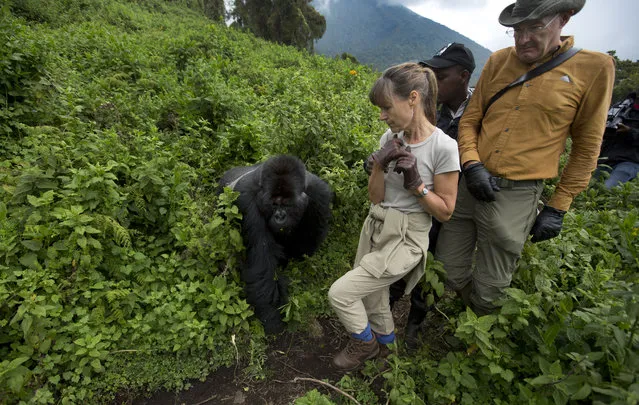
In this photo taken Friday, September 4, 2015, tourists Sarah and John Scott from Worcester, England, take a step back as a male silverback mountain gorilla from the family of mountain gorillas named Amahoro, which means “peace” in the Rwandan language, unexpectedly steps out from the bush to cross their path in the dense forest on the slopes of Mount Bisoke volcano in Volcanoes National Park, northern Rwanda. (Photo by Ben Curtis/AP Photo)

In this photo taken Friday, September 4, 2015, tourists Sarah and John Scott from Worcester, England, take a step back as a male silverback mountain gorilla from the family of mountain gorillas named Amahoro, which means “peace” in the Rwandan language, unexpectedly steps out from the bush to cross their path in the dense forest on the slopes of Mount Bisoke volcano in Volcanoes National Park, northern Rwanda. Deep in Rwanda's steep-sloped forest, increasing numbers of tourists are heading to see the mountain gorillas, a subspecies whose total population is an estimated 900 and who also live in neighboring Uganda and Congo, fueling an industry seen as key to the welfare of the critically endangered species as well as Rwanda's economy. (Photo by Ben Curtis/AP Photo)
Details
18 Sep 2015 14:55:00