Loading...
Done
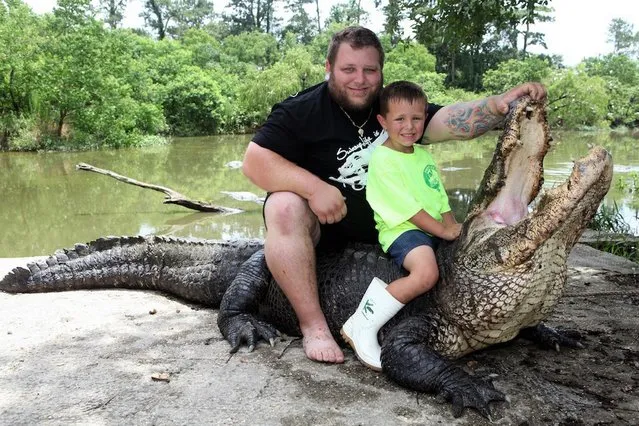
T-Mike Kliebert and his son Blaise tackle Chinaman a 12 foot alligator in Hammond, Louisiana. (Photo by Barcroft Media)

These pictures show a five-year-old boy who is already extremely comfortable around alligators. Blaise's dad T-Mike runs the Kliebert Gator Farm, the biggest and oldest in the world and which was started by his grandfather Harvey in 1957. Photo: T-Mike Kliebert and his son Blaise tackle Chinaman a 12 foot alligator in Hammond, Louisiana. (Photo by Barcroft Media)
Details
22 Jul 2014 12:18:00
An Edinburgh Fringe performer shows off his makeup on the Royal Mile, in the final weekend of this year's festival. (Photo by Jeff J. Mitchell/Getty Images)

An Edinburgh Fringe performer shows off his makeup on the Royal Mile, in the final weekend of this year's festival. The largest performing arts festival in the world has been running for the past three weeks and has enjoyed an increase in venues and visitors compared with previous years. (Photo by Jeff J. Mitchell/Getty Images)
Details
05 Aug 2014 12:19:00
Photographers: Joel Robison Part3

“Hi! I'm Joel, I live in a valley in British Columbia's Rocky Mountains, as close to the forest as I could possibly be! I love to run, bike, jump, eat and create and I hope that you enjoy my work as much as I enjoy creating it!” – Joel Robison. (Photo by: Joel Robison; Source: Flickr)


See Also:Photographers: Joel Robison Part1
Details
02 Nov 2013 09:03:00
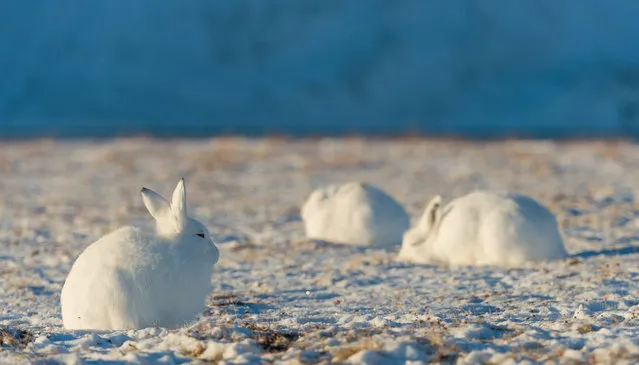
Arctic Hare

The arctic hare, or polar rabbit, is a species of hare which is adapted largely to polar and mountainous habitats. The arctic hare survives with a thick coat of fur and usually digs holes in the ground or under snow to keep warm and sleep. Arctic hares look like rabbits but have shorter ears, are taller when standing, and, unlike rabbits, can thrive in cold climates. They can travel together with many other hares, sometimes huddling with dozens or more, but are usually found alone, taking, in some cases, more than one partner. The arctic hare can run up to 60 kilometres per hour (40 mph). Its predators include the arctic wolf, arctic fox, and ermine.
Details
17 Mar 2014 13:56:00
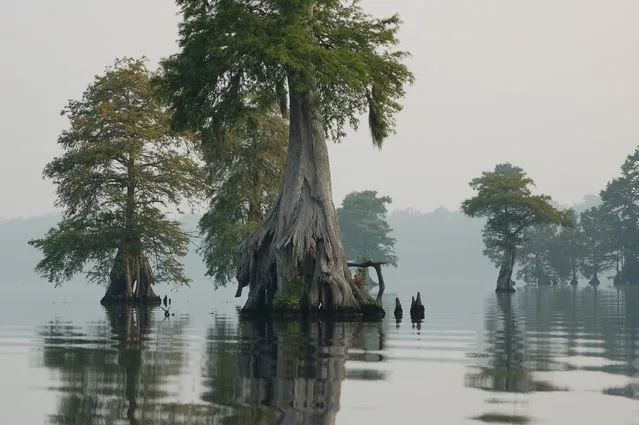
The Great Dismal Swamp

The Great Dismal Swamp is a marshy area in the Coastal Plain Region of southeastern Virginia and northeastern North Carolina, between Norfolk, Virginia, and Elizabeth City, North Carolina. It is located in parts of southern Virginia cities Chesapeake and Suffolk and northern North Carolina counties Gates, Pasquotank and Camden. It is a southern swamp, one of many along the Atlantic Ocean's coast, including the Everglades and Big Cypress Swamp in Florida, the Okefenokee Swamp in Georgia, the Congaree and Four Holes swamps of South Carolina, and some of the Carolina bays in the Carolinas and Georgia. Along the eastern edge runs the Dismal Swamp Canal, completed in 1805.
Details
09 Dec 2013 11:40:00
Monumental Plant Sculptures At The 2013 Mosaicultures Internationales De Montreal

Mosaïcultures Internationales de Montréal is an international mosaiculture competition held in Montréal, Canada. According to their website, mosaiculture “is a refined horticultural art that involves creating and mounting living artworks made primarily from plants with colourful foliage (generally annuals, and occasionally perennials).” The 2013 competition and exhibition opened June 22 and runs through September 29 at the Montréal Botanical Garden and features some 22,000 plant species and cultivars distributed throughout 10 exhibition greenhouses and 30 themed gardens.
Details
29 Jan 2014 11:38:00
Rolling Through the Bay By Scott Weaver

It has taken 3,000 hours and 34 years to make – but the results are incredible. Artist Scott Weaver has created a huge but incredibly detailed model of San Francisco using 100,000 toothpicks. The work entitled Rolling Through the Bay also doubles as a marble run. Ping pong balls dropped on several ramps at the top of the model follow several “tours” through the city. They pass matchstick replicas of sights such as Alcatraz, Fisherman's Wharf, the Golden Gate Bridge and the city's trademark terraced houses on steep hills.
Details
21 Feb 2014 13:26:00


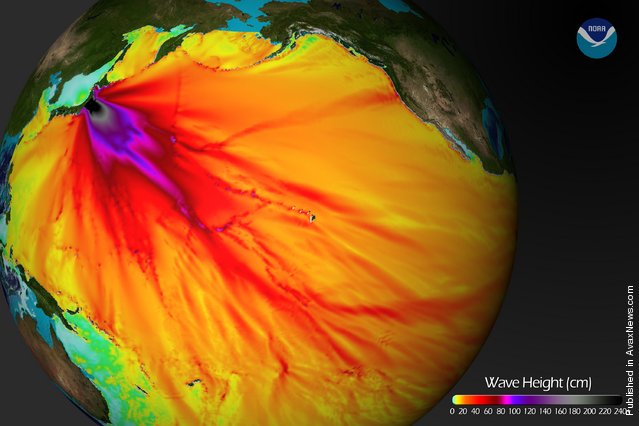
In this handout image provided by the National Oceanic and Atmospheric Administration (NOAA), model runs from the Center for Tsunami Research at the NOAA Pacific Marine Environmental Laboratory show the expected wave heights of the tsunami as it travels across the Pacific basin March 11, 2011. The largest wave heights are expected near the earthquake epicenter, off Japan. The wave will decrease in height as it travels across the deep Pacific but grow taller as it nears coastal areas. In general, as the energy of the wave decreases with distance, the near shore heights will also decrease (e.g., coastal Hawaii will not expect heights of that encountered in coastal Japan). (Photo by NOAA via Getty Images)
Details
13 Mar 2011 14:29:00