Loading...
Done
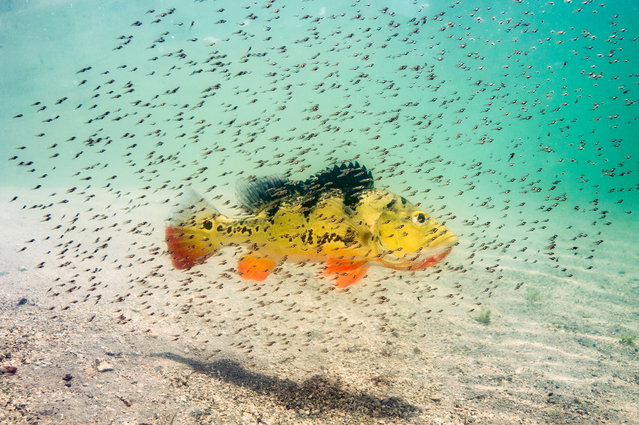
Michael O’Neill won a prize in animal portraits with fry of a peacock bass hovering around their mother for protection against predators in South Florida. (Photo by Michael Patrick O'Neill/2016 National Geographic Nature Photographer of the Year)

Michael O’Neill won a prize in animal portraits with fry of a peacock bass hovering around their mother for protection against predators in South Florida. (Photo by Michael Patrick O'Neill/2016 National Geographic Nature Photographer of the Year)
Details
10 Dec 2016 08:57:00
Hikaru Cho believes that we should challenge our imaginations to create new work using traditional tools, not fancy computers and software. (Photo by Jim Marks/PA Wire)

Hikaru Cho believes that we should challenge our imaginations to create new work using traditional tools, not fancy computers and software. (Photo by Jim Marks/PA Wire)
Details
06 Mar 2014 10:06:00
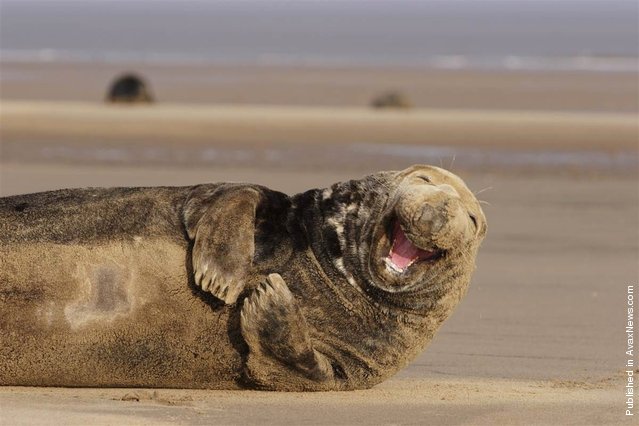
This grey adult male seal enjoys a good grin while lying on the beach

“This grey adult male seal enjoys a good grin while lying on the beach”. (Photo by Michael Hutch/SplashdownDirect via Rex USA)
Details
20 Apr 2012 13:30:00
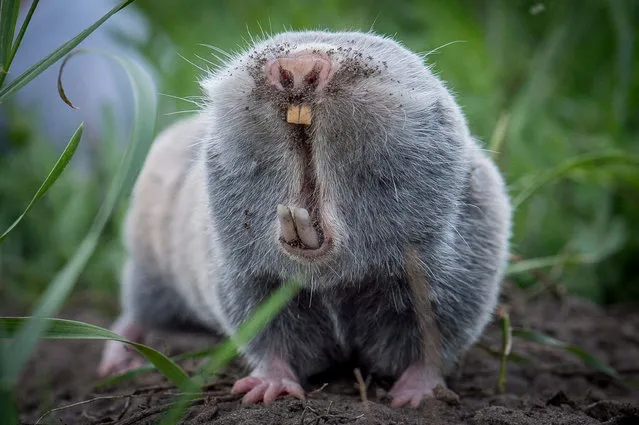
An adult specimen of Nannospalax (leucodon) montanosyrmiensis, a variant of the lesser mole-rat (Spalax leucodon) is pictured near Albertirsa, some 60 kilometers southeast of Budapest, Hungary, 12 May 2018. The critically endangered rodent lives in several isolated populations in the Carpathian Basin. (Photo by Sandor Ujvari/EPA/EFE)

An adult specimen of Nannospalax (leucodon) montanosyrmiensis, a variant of the lesser mole-rat (Spalax leucodon) is pictured near Albertirsa, some 60 kilometers southeast of Budapest, Hungary, 12 May 2018. The critically endangered rodent lives in several isolated populations in the Carpathian Basin. (Photo by Sandor Ujvari/EPA/EFE)
Details
20 May 2018 00:03:00
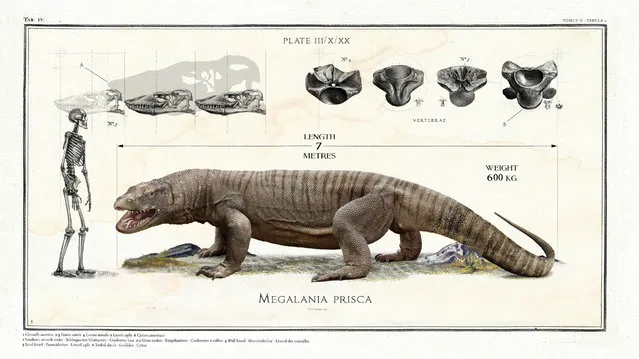
Fossil records indicate that this early lizard, Megalina prisca, was a whopping seven metres in length. (Photo by Sky TV/The Guardian)

Fossil records indicate that this early lizard, Megalania (Megalania prisca or Varanus priscus), was a whopping seven metres in length. They were part of a megafaunal assemblage that inhabited southern Australia during the Pleistocene. The youngest fossil remains date to around 50,000 years ago. The first aboriginal settlers of Australia might have encountered them and been a factor in their extinction. (Photo by Sky TV/The Guardian)
Details
12 Jun 2018 00:05:00
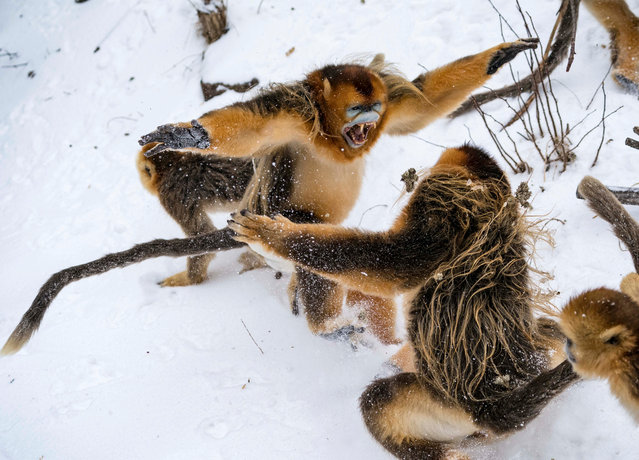
Golden monkeys play at a conservation base in Shennongjia, central China's Hubei Province, January 26, 2018. The golden monkey conservation base witnessed a snowfall recently. (Photo by Du Huaju/Xinhua/Barcroft Images)

Golden monkeys play at a conservation base in Shennongjia, central China's Hubei Province, January 26, 2018. The golden monkey conservation base witnessed a snowfall recently. (Photo by Du Huaju/Xinhua/Barcroft Images)
Details
04 Feb 2018 06:39:00
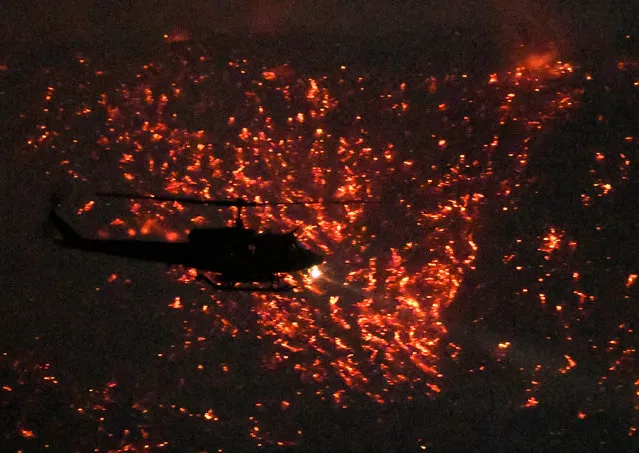
A helicopter is silhouetted by glowing embers as it makes a water drop at the “Old Fire”, which burned in Calabasas, California, U.S., June 4, 2016. (Photo by Gene Blevins/Reuters)

A helicopter is silhouetted by glowing embers as it makes a water drop at the “Old Fire”, which burned in Calabasas, California, U.S., June 4, 2016. (Photo by Gene Blevins/Reuters)
Details
07 Jun 2016 13:17:00
Four pillars of light from the 4 Laser Guide Star Facility on ESO's Very Large Telescope (VLT) are shown reaching into the Chilean night sky in this image from ESO Photo Ambassador Fred Kamphues, on September 2, 2016. The lasers are a key part of the adaptive optics system on the VLT. Adaptive optics allows astronomers to drastically reduce the atmospheric distortion present at even the best sites in the world for astronomy, including Paranal in Chile, the home of the VLT. (Photo by F. Kamphues/ESO)

Four pillars of light from the 4 Laser Guide Star Facility on ESO's Very Large Telescope (VLT) are shown reaching into the Chilean night sky in this image from ESO Photo Ambassador Fred Kamphues, on September 2, 2016. The lasers are a key part of the adaptive optics system on the VLT. Adaptive optics allows astronomers to drastically reduce the atmospheric distortion present at even the best sites in the world for astronomy, including Paranal in Chile, the home of the VLT. (Photo by F. Kamphues/ESO)
Details
23 Feb 2017 00:06:00