Loading...
Done
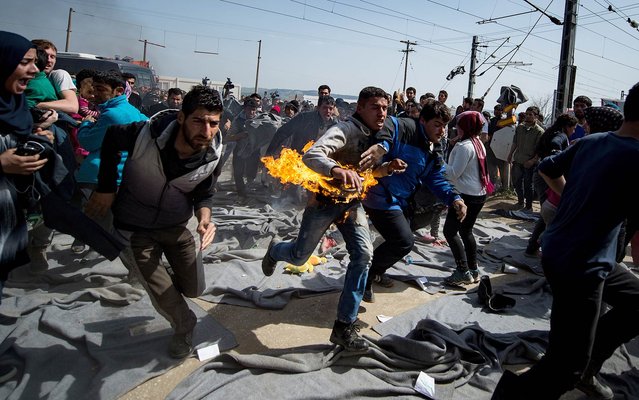
A man runs after he tried to put himself on fire during a protest at a makeshift camp at the Greek-Macedonian border near the village of Idomeni on March 22, 2016. Greece will not be able to start sending refugees back to Turkey from March 20, 2016, the government said, as the country struggles to implement a key deal aimed at easing Europe's migrant crisis. The numbers are daunting: officials said as of Saturday there were 47,500 migrants in Greece, including 8,200 on the islands and 10,500 massed at the Idomeni camp on the Macedonian border. (Photo by Andrej Isakovic/AFP Photo)

A man runs after he tried to put himself on fire during a protest at a makeshift camp at the Greek-Macedonian border near the village of Idomeni on March 22, 2016. Greece will not be able to start sending refugees back to Turkey from March 20, 2016, the government said, as the country struggles to implement a key deal aimed at easing Europe's migrant crisis. The numbers are daunting: officials said as of Saturday there were 47,500 migrants in Greece, including 8,200 on the islands and 10,500 massed at the Idomeni camp on the Macedonian border. (Photo by Andrej Isakovic/AFP Photo)
Details
23 Mar 2016 12:25:00
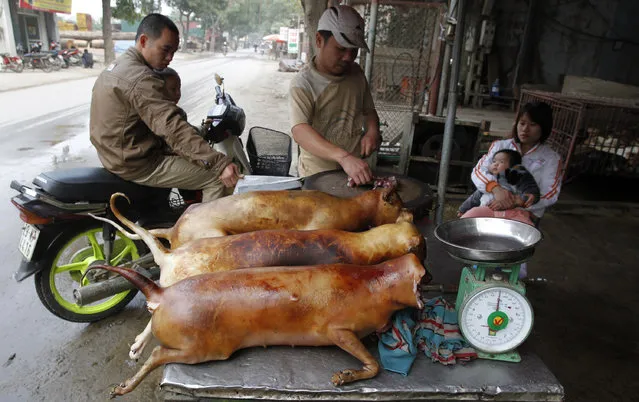
A vendor (C) cuts slaughtered dogs for sale at his roadside stall in Duong Noi village, outside Hanoi December 16, 2011. While animal rights activists have condemned eating dog meat as cruel treatment of the animals, it is still an accepted popular delicacy for some Vietnamese, as well in some other Asian countries. (Photo by Reuters/Kham)

A vendor (C) cuts slaughtered dogs for sale at his roadside stall in Duong Noi village, outside Hanoi December 16, 2011. While animal rights activists have condemned eating dog meat as cruel treatment of the animals, it is still an accepted popular delicacy for some Vietnamese, as well in some other Asian countries. Duong Noi is well-known as a dog-meat village, where hundreds of dogs are killed each day for sale as popular traditional food. Dog-eating as a custom is rooted in Vietnam and was developed as a result of poverty. One kilogram of dog meat costs about 130,000 dongs ($6.2). (Photo by Reuters/Kham)
Details
16 Jul 2013 11:40:00
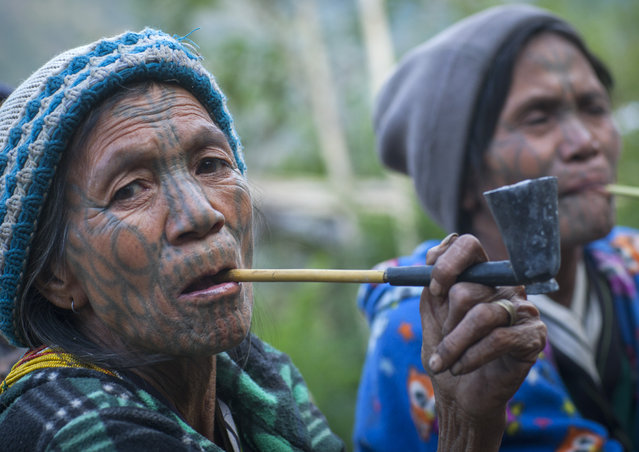
A group of tattooed women from the Muun tribe who inhabit the hills of the Arakan state. The design, known as the letter B-pattern, is common in the Mindat area. It is composed of dots, lines and occasionally circles, in February, 2015, in Myanmar, Burma. (Photo by Eric Lafforgue/Barcroft Media)

A group of tattooed women from the Muun tribe who inhabit the hills of the Arakan state. The design, known as the letter B-pattern, is common in the Mindat area. It is composed of dots, lines and occasionally circles, in February, 2015, in Myanmar, Burma. With spider webs, B-patterns and crossed lines painstakingly inked on their faces these stunning photographs show the tattooed women of Burma. French photographer Eric Lafforgue travelled to the Chin, Rakhine and Arakan states of northwestern Myanmar to capture the rare facial designs. (Photo by Eric Lafforgue/Barcroft Media)
Details
16 Mar 2015 10:54:00
Chinelos (traditional costumed dancers) perform in front of San Andres Ocotlan church as part of continuing festivities to welcome the new year in Calimaya, Mexico on January 4, 2016. (Photo by Arturo Hernandez/Demotix/Corbis)

Chinelos (traditional costumed dancers) perform in front of San Andres Ocotlan church as part of continuing festivities to welcome the new year in Calimaya, Mexico on January 4, 2016. (Photo by Arturo Hernandez/Demotix/Corbis)
Details
05 Jan 2016 12:31:00
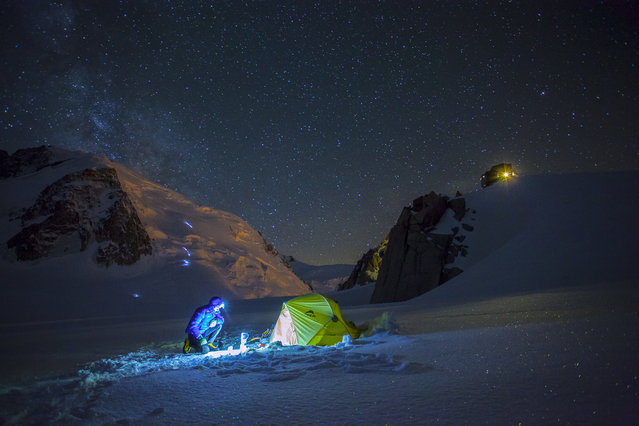
“A snapshot from mountaineer's life”. Have you ever wondered how does a mountaineer's day start? (Photo and caption by Kamil Tamiola/National Geographic Traveler Photo Contest)

“A snapshot from mountaineer's life”. Have you ever wondered how does a mountaineer's day start? I will give you a hint: you wake up at 3 am, set the stove, wake up your partner, pretend it is warm, quickly consume a high-calorie breakfast, watch your friends slowly ascending the icy slopes of your dream summit with their tiny head torches glimmering against perfectly blue ice, and hope for the good weather. One would ask: why all this trouble? The answer is easy: for the love of the adventure and the unknown. Location: Chamonix, Haute Savoye, France. (Photo and caption by Kamil Tamiola/National Geographic Traveler Photo Contest)

ATTENTION! All pictures are presented in high resolution. To see Hi-Res images – just TWICE click on any picture. In other words, click small picture – opens the BIG picture. Click BIG picture – opens VERY BIG picture.
Details
27 Jun 2013 12:47:00
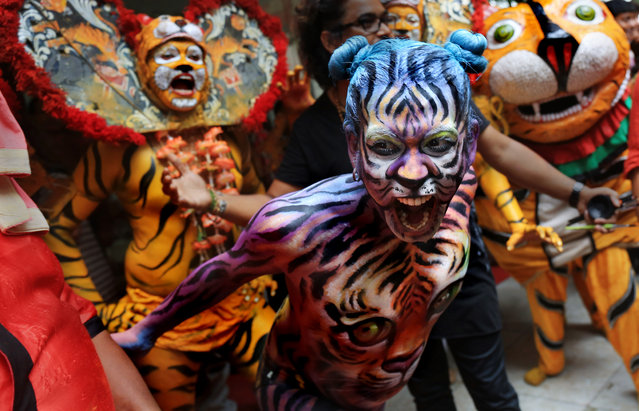
Indian dancers paint their body like tigers as they perform a Tiger dance during the International day of the Tiger in Calcutta, India, July 29, 2015. Students of Calcutta are taking part in an awareness campaign aiming to draw attention to the threats that tigers face due to habitat loss and poaching. (Photo by Piyal Adhikary/EPA)

Indian dancers paint their body like tigers as they perform a Tiger dance during the International day of the Tiger in Calcutta, India, July 29, 2015. Students of Calcutta are taking part in an awareness campaign aiming to draw attention to the threats that tigers face due to habitat loss and poaching. (Photo by Piyal Adhikary/EPA)
Details
30 Jul 2015 12:47:00
Mummies

Dried and shrivelled corpses, some fully clothed and some in coffins, line the wall of a vault of the Pantheon Cemetery on the summit of Cerro del Trozado in Mexico. They were removed from the crypts because of non-payment of cemetery fees. The hot dry air stopped the bodies from rotting. Most of them were placed here between the turn of the century and WW I. (Photo by Three Lions/Getty Images). Circa 1955
Details
29 Aug 2011 13:46:00


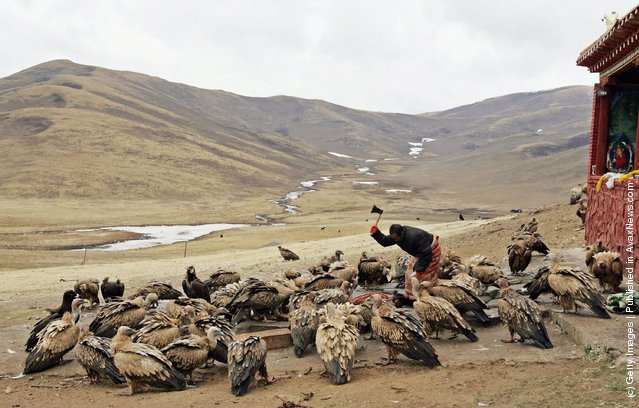
“Sky burial or ritual dissection was once a common funerary practice in Tibet wherein a human corpse is cut in specific locations and placed on a mountaintop, exposing it to the elements or the mahabhuta and animals – especially to birds of prey. The location of the sky burial preparation and place of execution are understood in the Vajrayana traditions as charnel grounds. In Tibet the practice is known as jhator, which literally means, «giving alms to the birds»”. – Wikipedia

Photo: A burial master chops bones of a body to feed vultures during a celestial burial ceremony on April 19, 2006 in Dari County of Guoluo Prefecture, Qinghai Province, northwest China. Celestial burial is a traditional funeral of Tibetan people, which began in the 7th century. (Photo by China Photos/Getty Images)
Details
18 Jun 2011 12:12:00