Loading...
Done
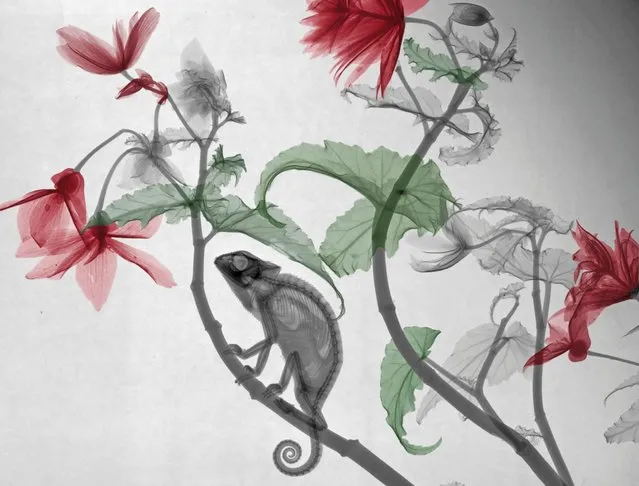
“Chameleon and Begonia”. (Photo by Arie van't Riet)

Physicist Arie van't Riet uses a series of duel X-ray cameras to capture flowers, plants and small animals in living dioramas. The x-rays are then finished and colorized in Photoshop. Giving way to some breathtaking nature scenes. Photo: “Chameleon and Begonia”. (Photo by Arie van't Riet)
Details
13 Mar 2014 05:45:00
Photographers: Frank Uyttenhove

“Frank Uyttenhove is an exceptionally talented photographer and film director. He has an extensive career, which has seen many interesting projects and many awards”. – Tim Mitchell
Details
18 Feb 2012 11:12:00
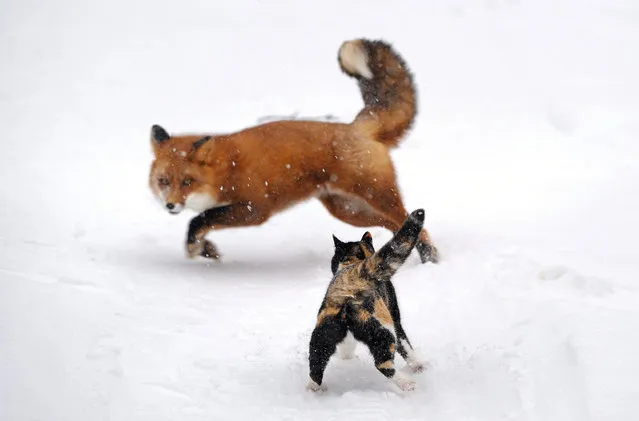
Respect, Kronotsky nature reserve, Russia. The photographer’s cat, Ryska – her name means little lynx in Russian – stands outside their cabin and with aggressive posturing warns off a fox. In winter, foxes would regularly visit the cabin searching for food. If one peered in at the window, possible when the snow was deep, Ryska would sit on the other side, fur raised, and growl. When outside, she would hold her ground. The foxes were not always frightened and so encounters could be a sort of dance. (Photo by Igor Shpilenok/Unforgettable Behaviour/NHM)

Respect, Kronotsky nature reserve, Russia. The photographer’s cat, Ryska – her name means little lynx in Russian – stands outside their cabin and with aggressive posturing warns off a fox. In winter, foxes would regularly visit the cabin searching for food. If one peered in at the window, possible when the snow was deep, Ryska would sit on the other side, fur raised, and growl. When outside, she would hold her ground. The foxes were not always frightened and so encounters could be a sort of dance. (Photo by Igor Shpilenok/Unforgettable Behaviour/NHM)
Details
08 Apr 2017 09:14:00
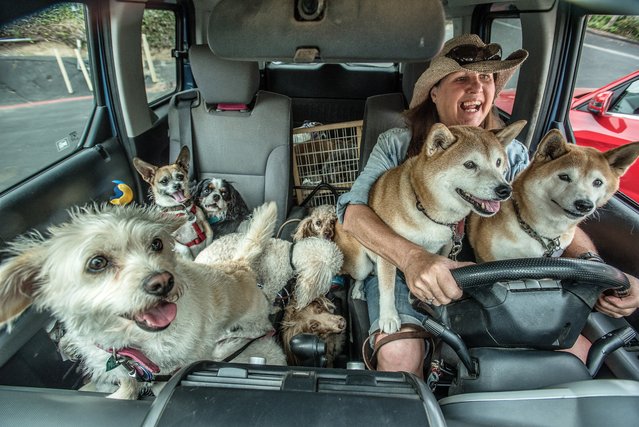
Dog Walker – 15:00. (Photo by Johanna Siegmann)

The CBRE Urban Photographer of the Year competition – now in its ninth year – encourages professional and amateur photographers to capture cities at work. Here: Dog Walker – 15:00. The competition allows photographers to enter up to 24 images, one representing each hour of the day. (Photo by Johanna Siegmann)
Details
17 Oct 2015 08:06:00
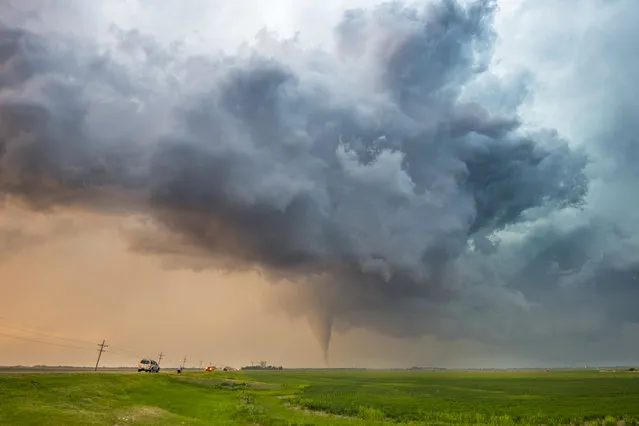
“The Sunsetter”. An EF-4 tornado rips through the open space of farmland near Rozel, Kansas. This tornado moves slowly but powerful towards the setting sun an gets its beautiful color right before sunset. Storm Chasers are spotting on the left side. Photo location: Rozel, Kansas. (Photo and caption by Dennis Oswald/National Geographic Photo Contest)

“The Sunsetter”. An EF-4 tornado rips through the open space of farmland near Rozel, Kansas. This tornado moves slowly but powerful towards the setting sun an gets its beautiful color right before sunset. Storm Chasers are spotting on the left side. Photo location: Rozel, Kansas. (Photo and caption by Dennis Oswald/National Geographic Photo Contest)

ATTENTION! All pictures are presented in high resolution. To see Hi-Res images – just TWICE click on any picture. In other words, click small picture – opens the BIG picture. Click BIG picture – opens VERY BIG picture.
Details
01 Dec 2013 11:03:00
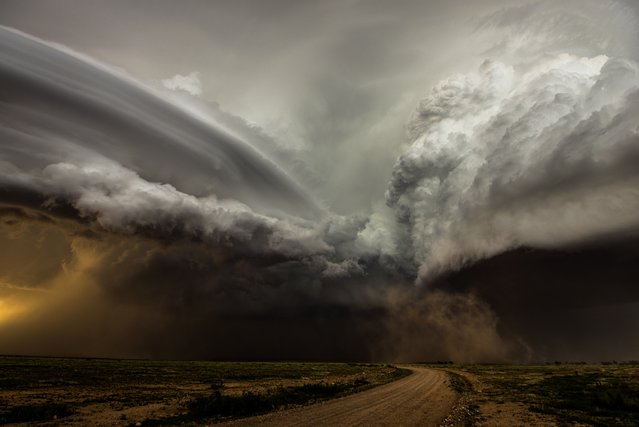
Clash of the storms, New Mexico, US by Camelia Czuchnicki. “A clash between two storm cells in New Mexico, US, each with its own rotating updraft. The curved striations of the oldest noticeable against the new bubbling convection of the newer. It was a fantastic sight to watch and it’s the rarity of such scenes that keep drawing me back to the US Plains each year”. (Photo by Camelia Czuchnicki/Weather Photographer of the Year 2016)

Clash of the storms, New Mexico, US by Camelia Czuchnicki. “A clash between two storm cells in New Mexico, US, each with its own rotating updraft. The curved striations of the oldest noticeable against the new bubbling convection of the newer. It was a fantastic sight to watch and it’s the rarity of such scenes that keep drawing me back to the US Plains each year”. (Photo by Camelia Czuchnicki/Weather Photographer of the Year 2016)
Details
16 Sep 2016 11:11:00
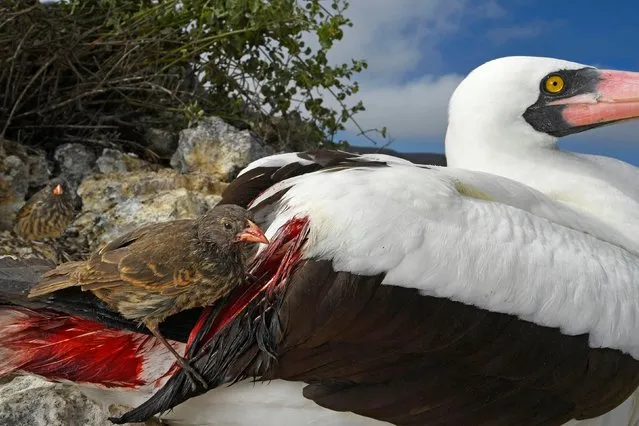
Bloodthirsty by Thomas P Peschak, Germany/South Africa — winner, Behaviour: birds. When rations run short on Wolf Island, in the remote northern Galápagos, the sharp-beaked ground finches become vampires. Their sitting targets are Nazca boobies and other large birds. The finches rely on a scant diet of seeds and insects, which regularly dries up, so they drink blood to survive. ‘I’ve seen more than half a dozen finches drinking from a single Nazca booby,’ says Tom. Rather than leave their nests the boobies tolerate the vampires, and the blood loss doesn’t seem to cause permanent harm. (Photo by Thomas P Peschak/2018 Wildlife Photographer of the Year)

Bloodthirsty by Thomas P. Peschak, Germany/South Africa — winner, Behaviour: birds. When rations run short on Wolf Island, in the remote northern Galápagos, the sharp-beaked ground finches become vampires. Their sitting targets are Nazca boobies and other large birds. The finches rely on a scant diet of seeds and insects, which regularly dries up, so they drink blood to survive. ‘I’ve seen more than half a dozen finches drinking from a single Nazca booby,’ says Tom. Rather than leave their nests the boobies tolerate the vampires, and the blood loss doesn’t seem to cause permanent harm. (Photo by Thomas P. Peschak/2018 Wildlife Photographer of the Year)
Details
19 Oct 2018 00:05:00
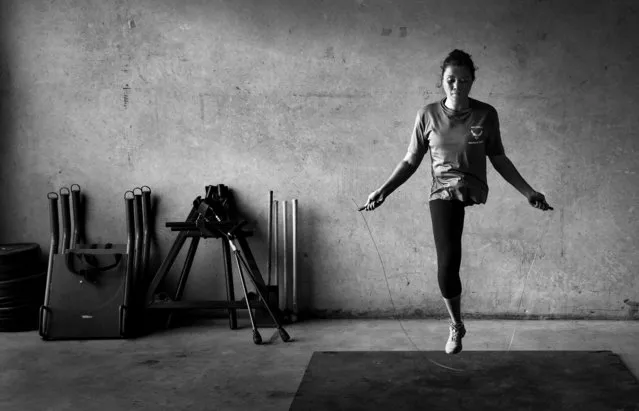
U.S. Air Force wounded warrior, Capt. Sarah Evans, jumps rope in a gym in San Antonio, Texas. Evans was diagnosed with cancer while deployed to Afghanistan and was medically evacuated back to the United States where her leg was amputated. (Photo by Master Sgt. Jeffrey Allen/U.S. Air Force)

U.S. Air Force wounded warrior, Capt. Sarah Evans, jumps rope in a gym in San Antonio, Texas. Evans was diagnosed with cancer while deployed to Afghanistan and was medically evacuated back to the United States where her leg was amputated. (Photo by Master Sgt. Jeffrey Allen/U.S. Air Force)
Details
26 Mar 2015 11:43:00