Loading...
Done
Imagine living in the sea where it is permanently dark, cold, and food is hard to find. For many animals at depth, it may be weeks to months between meals. If you find something to eat, you have to hang on to it

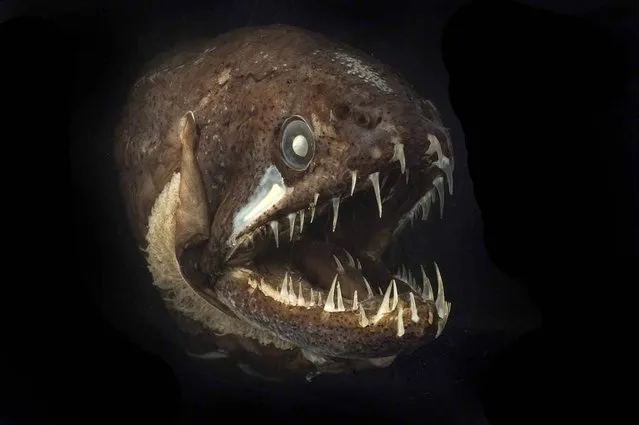
Imagine living in the sea where it is permanently dark, cold, and food is hard to find. For many animals at depth, it may be weeks to months between meals. If you find something to eat, you have to hang on to it. This is why so many deep-sea fishes have lots of big teeth. This dragonfish, spotted off the coast of Australia, even has teeth on its tongue. They would be terrifying animals ... if they weren’t the size of a banana. (Photo by Julian Finn/Museum Victoria)
Details
21 May 2012 12:14:00
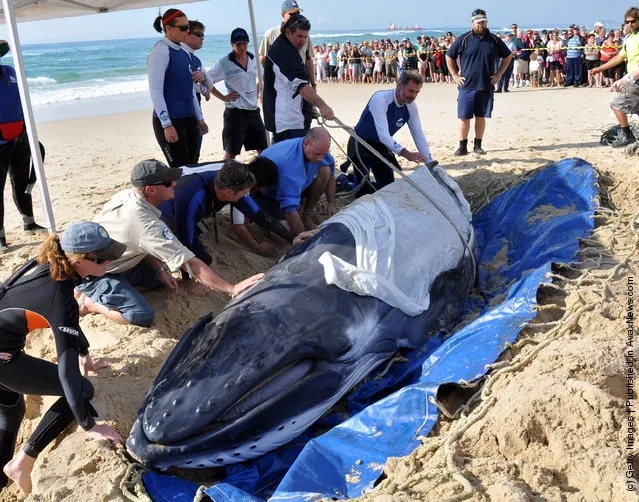
Volunteer rescue a beached humpback calf to sea at Surfers Paradise Beach on the Gold Coast, Australi

Volunteer rescuers prepare to drag a beached humpback calf to sea at Surfers Paradise Beach on August 8, 2011 on the Gold Coast, Australia. The humpback calf was stranded on the beach yesterday for hours before volunteer rescuers were able to drag it back to the sea. SeaWorld Australia says a mother and calf humpback were sighted near where the calf was released and are hoping to get photos to verify it is the same calf and that it has been reunited with it's mother. (Photo by 2011 SeaWorld Australia via Getty Images)
Details
09 Aug 2011 12:26:00
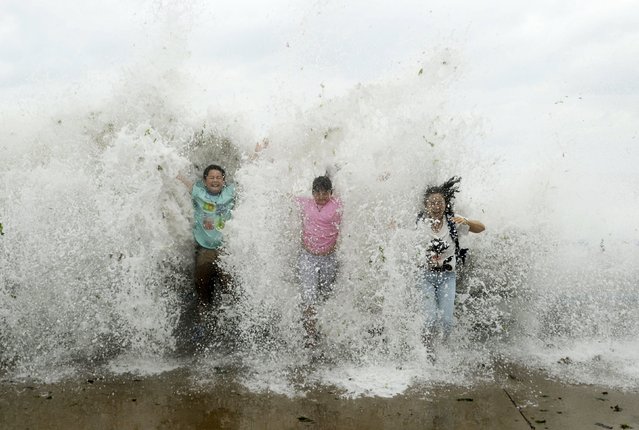
Tourists standing near the sea shore are hit by a wave, which surged past a barrier under the influence of Typhoon Chan-hom, in Qingdao, Shandong province, China, July 12, 2015. (Photo by Reuters/Stringer)

Tourists standing near the sea shore are hit by a wave, which surged past a barrier under the influence of Typhoon Chan-hom, in Qingdao, Shandong province, China, July 12, 2015. One of the most powerful typhoons to strike eastern China in decades disrupted air, rail and sea transport on Saturday after forcing the evacuation of more than a million people from the provinces of Zhejiang and Jiangsu, state media reported. (Photo by Reuters/Stringer)
Details
13 Jul 2015 10:47:00
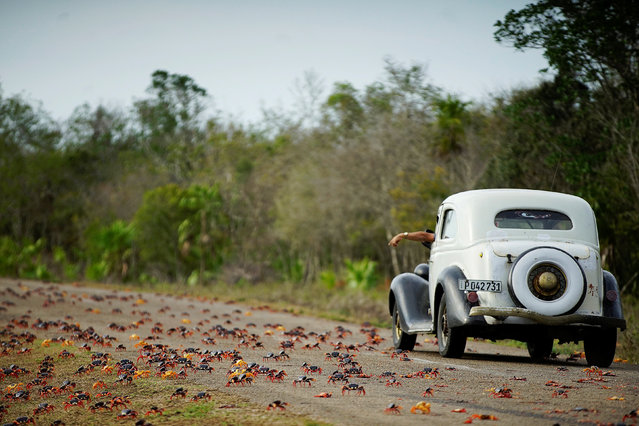
A man driving a vintage car reacts as he passes by crabs crossing a highway on their way to spawn in the sea in Playa Giron, Cuba on April 25, 2017. (Photo by Alexandre Meneghini/Reuters)

A man driving a vintage car reacts as he passes by crabs crossing a highway on their way to spawn in the sea in Playa Giron, Cuba on April 25, 2017. Each year, after the first spring rains, millions of red, yellow and black landcrabs march for days from the surrounding forests to the bay on Cuba's southern coast to spawn in the sea. (Photo by Alexandre Meneghini/Reuters)
Details
26 Apr 2017 08:40:00
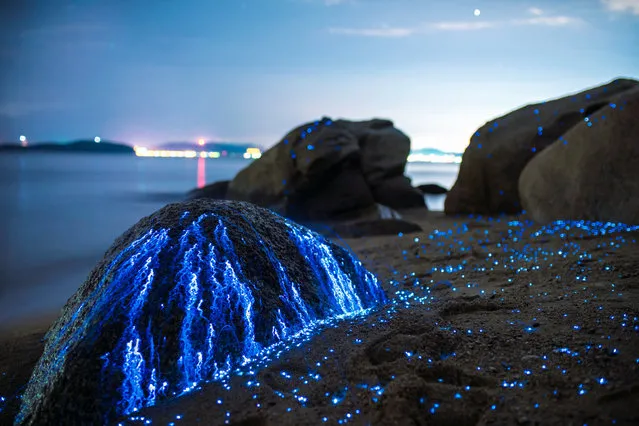
Bioluminescent sea fireflies glittering like diamonds on the rocks and sand. Okayama, Japan. July 2016. (Photo by Trevor Williams/Jonathan Galione/Getty Images)

Those lights are actually bioluminescent shrimp, better known as sea fireflies, or, in Japan, as “umibotaru”. Visible every year from May until the end of October, they live in the sand around very shallow sea water and are often seen floating between the extremes of high and low tides. Here: Bioluminescent sea fireflies glittering like diamonds on the rocks and sand. Okayama, Japan. July 2016. (Photo by Trevor Williams/Jonathan Galione/Getty Images)
Details
23 Aug 2016 10:13:00
A photo taken on July 22, 2017 shows beach- goers dancing at the West Sea Barrage beach outside the coastal city of Nampo, southwest of Pyongyang. (Photo by Ed Jones/AFP Photo)

A photo taken on July 22, 2017 shows beach- goers dancing at the West Sea Barrage beach outside the coastal city of Nampo, southwest of Pyongyang. The West Sea Barrage beach features as a stopping point for foreign tourists, and is a destination for North Korean work groups from the neighbouring area. The beach lies at the end of an eight- kilometre- long barrage that separates the sea from the Taedong River, which runs through Pyongyang. (Photo by Ed Jones/AFP Photo)
Details
04 Aug 2017 09:09:00
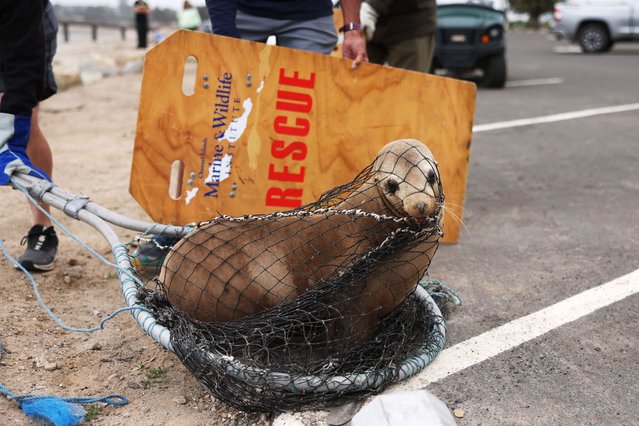
A sick California sea lion with possible domoic acid poisoning is rescued to be evaluated by volunteers from CIMWI (Channel Islands Marine & Wildlife Institute) in Santa Barbara, California, on March 25, 2025. Over a hundred sea lions, dolphins and other marine mammals, including birds, have been sickened by domoic acid poisoning from algal blooms in Southern California since February, US media reported. (Photo by David Swanson/AFP Photo)

A sick California sea lion with possible domoic acid poisoning is rescued to be evaluated by volunteers from CIMWI (Channel Islands Marine & Wildlife Institute) in Santa Barbara, California, on March 25, 2025. Over a hundred sea lions, dolphins and other marine mammals, including birds, have been sickened by domoic acid poisoning from algal blooms in Southern California since February, US media reported. (Photo by David Swanson/AFP Photo)
Details
02 Apr 2025 04:29:00
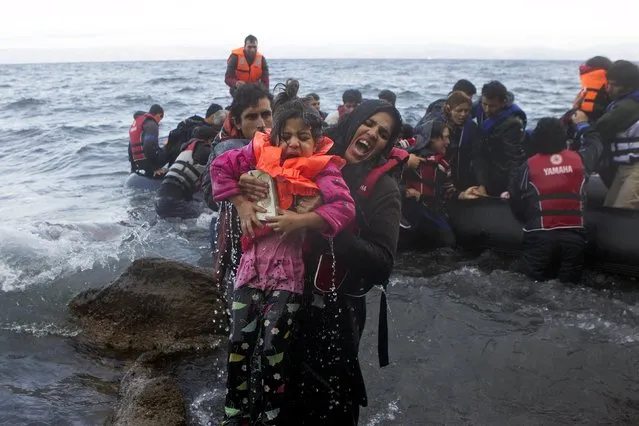
A migrant woman pulls a girl out of the water as refugees and migrants arrive on an overcrowded dinghy in rough sea on the Greek island of Lesbos, after crossing a part of the Aegean Sea from the Turkish coast, October 2, 2015. A record number of at least 430,000 refugees and migrants have taken rickety boats across the Mediterranean to Europe this year, 309,000 via Greece, according to International Organization for Migration figures. (Photo by Dimitris Michalakis/Reuters)

A migrant woman pulls a girl out of the water as refugees and migrants arrive on an overcrowded dinghy in rough sea on the Greek island of Lesbos, after crossing a part of the Aegean Sea from the Turkish coast, October 2, 2015. A record number of at least 430,000 refugees and migrants have taken rickety boats across the Mediterranean to Europe this year, 309,000 via Greece, according to International Organization for Migration figures. (Photo by Dimitris Michalakis/Reuters)
Details
05 Oct 2015 08:05:00