Loading...
Done
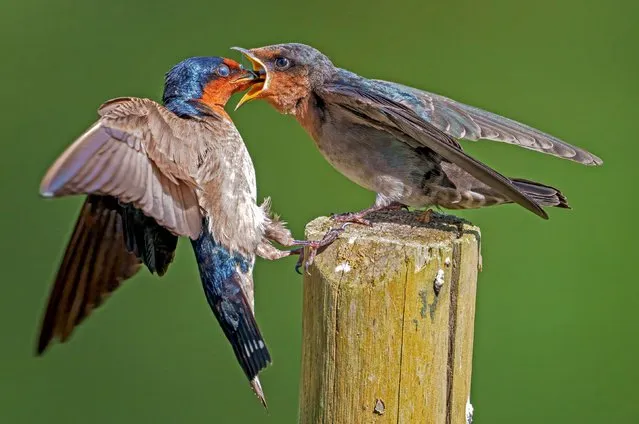
A bird swoops in to deliver its food to its chick, ramming it deep into its mouth while in flight. The photos of the swallows were captured by Kelvin Leong in Hampstead Wetlands Park, Singapore in July 2023. (Photo by Kelvin Leong/Solent News & Photo Agency)

A bird swoops in to deliver its food to its chick, ramming it deep into its mouth while in flight. The photos of the swallows were captured by Kelvin Leong in Hampstead Wetlands Park, Singapore in July 2023. (Photo by Kelvin Leong/Solent News & Photo Agency)
Details
20 Aug 2023 03:27:00
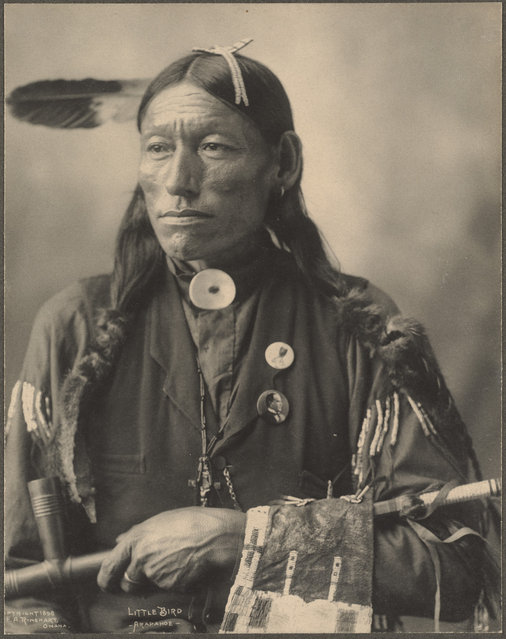
Little Bird, Arapahoe, 1899. (Photo by Frank A. Rinehart)

Frank A. Rinehart, a commercial photographer in Omaha, Nebraska, was commissioned to photograph the 1898 Indian Congress, part of the Trans-Mississippi International Exposition. More than five hundred Native Americans from thirty-five tribes attended the conference, providing the gifted photographer and artist an opportunity to create a stunning visual document of Native American life and culture at the dawn of the 20th century. Photo: Little Bird, Arapahoe, 1899. (Photo by Frank A. Rinehart)
Details
25 Apr 2013 11:30:00
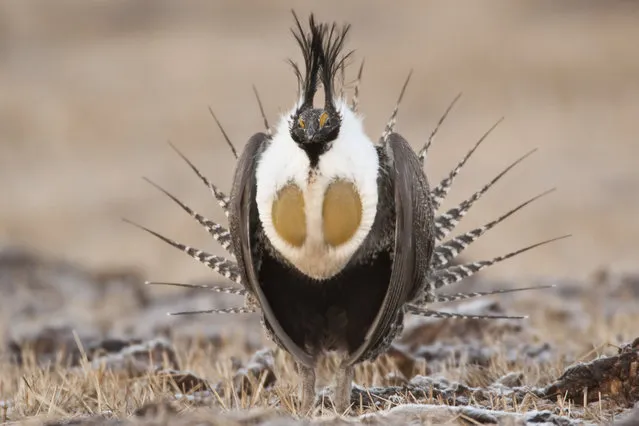
Greater Sage-Grouse

The Greater Sage-Grouse is certainly a formidable-looking bird. Being the largest grouse in North America and having tail feathers, which look like giant spikes, make for a ferocious sight. These birds are well known for their complicated courtship rituals, in which the males perform a special “strutting display” to attract the females. Another distinct feature of the Greater Sage-Grouse is two large yellow throat sacs (gular sacs), which are inflated by the males during the courtship display. Unlike pelicans, whose gular sacs are used to store fish while hunting, the throat sacks of the Greater Sage-Grouse are merely for display.
Details
21 Nov 2014 12:25:00
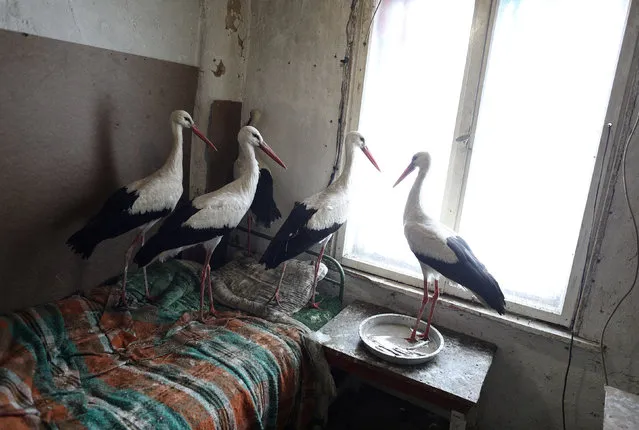
Storks that were saved by Bulgarian farmer Safet Ismail are pictured in the village of Zaritsa, Bulgaria, March 21, 2018. Dozens of people from villages in north-eastern Bulgaria took storks to their houses as a lot of the birds got injured due to freezing temperatures and snowfalls in the area over the last few days. (Photo by Stoyan Nenov/Reuters)

Storks that were saved by Bulgarian farmer Safet Ismail are pictured in the village of Zaritsa, Bulgaria, March 21, 2018. Dozens of people from villages in north-eastern Bulgaria took storks to their houses as a lot of the birds got injured due to freezing temperatures and snowfalls in the area over the last few days. (Photo by Stoyan Nenov/Reuters)
Details
22 Mar 2018 08:26:00
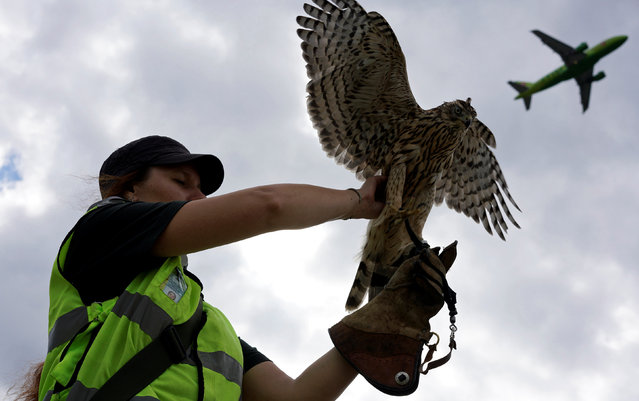
Employee of ornithological flight support service Nika Ryzhova-Alenicheva holds her hawk, which is used to control fauna to avoid bird strikes during takeoffs and landings, at Domodedovo airport outside Moscow, Russia September 2, 2016. (Photo by Maxim Zmeyev/Reuters)

Employee of ornithological flight support service Nika Ryzhova-Alenicheva holds her hawk, which is used to control fauna to avoid bird strikes during takeoffs and landings, at Domodedovo airport outside Moscow, Russia September 2, 2016. (Photo by Maxim Zmeyev/Reuters)
Details
06 Sep 2016 10:41:00
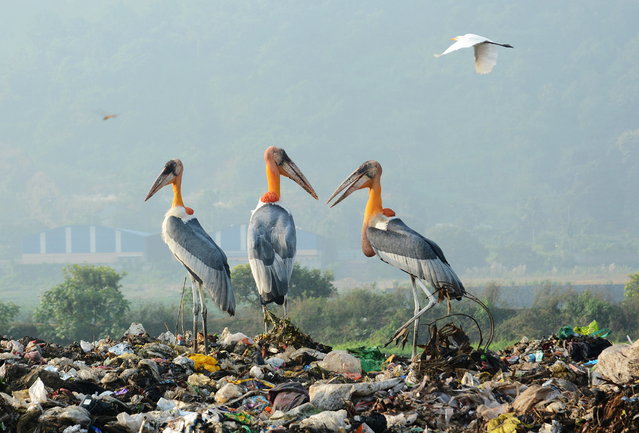
A flock of Adjutants storks sit on a garbage dump at Borgaon in Guwahati, Assam, India, 17 October 2019. Wildlife activists and environmentalists have protested in the past for shifting the garbage dump to another site since it is situated near the Deepor Beel Bird Sanctuary. (Photo by EPA/EFE/Stringer)

A flock of Adjutants storks sit on a garbage dump at Borgaon in Guwahati, Assam, India, 17 October 2019. Wildlife activists and environmentalists have protested in the past for shifting the garbage dump to another site since it is situated near the Deepor Beel Bird Sanctuary. (Photo by EPA/EFE/Stringer)
Details
20 Oct 2019 00:03:00


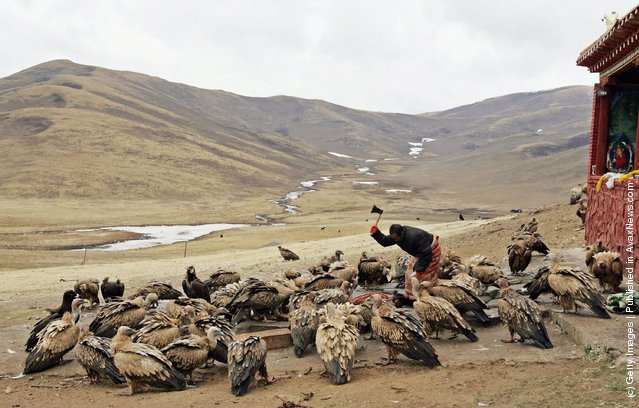
“Sky burial or ritual dissection was once a common funerary practice in Tibet wherein a human corpse is cut in specific locations and placed on a mountaintop, exposing it to the elements or the mahabhuta and animals – especially to birds of prey. The location of the sky burial preparation and place of execution are understood in the Vajrayana traditions as charnel grounds. In Tibet the practice is known as jhator, which literally means, «giving alms to the birds»”. – Wikipedia

Photo: A burial master chops bones of a body to feed vultures during a celestial burial ceremony on April 19, 2006 in Dari County of Guoluo Prefecture, Qinghai Province, northwest China. Celestial burial is a traditional funeral of Tibetan people, which began in the 7th century. (Photo by China Photos/Getty Images)
Details
18 Jun 2011 12:12:00
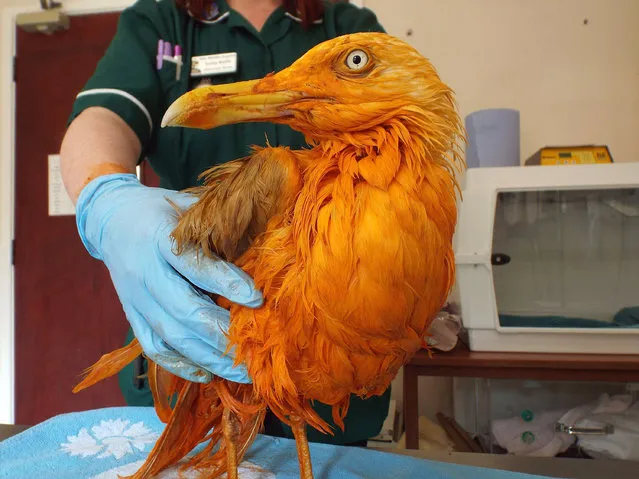
A seagull who turned bright orange after he plunged into a vat of chicken tikka masala in Beckford, England on June 9, 2016. The bird fell into a container of the food while trying to scavenge a piece of meat from a food factory bin in Wales. (Photo by Vale Wildlife Hospital/PA Wire)

A seagull who turned bright orange after he plunged into a vat of chicken tikka masala in Beckford, England on June 9, 2016. The bird fell into a container of the food while trying to scavenge a piece of meat from a food factory bin in Wales. (Photo by Vale Wildlife Hospital/PA Wire)
Details
12 Jun 2016 10:11:00